The $100,000 Mistake Shopify Stores Make by Relying Only on Mobile Websites

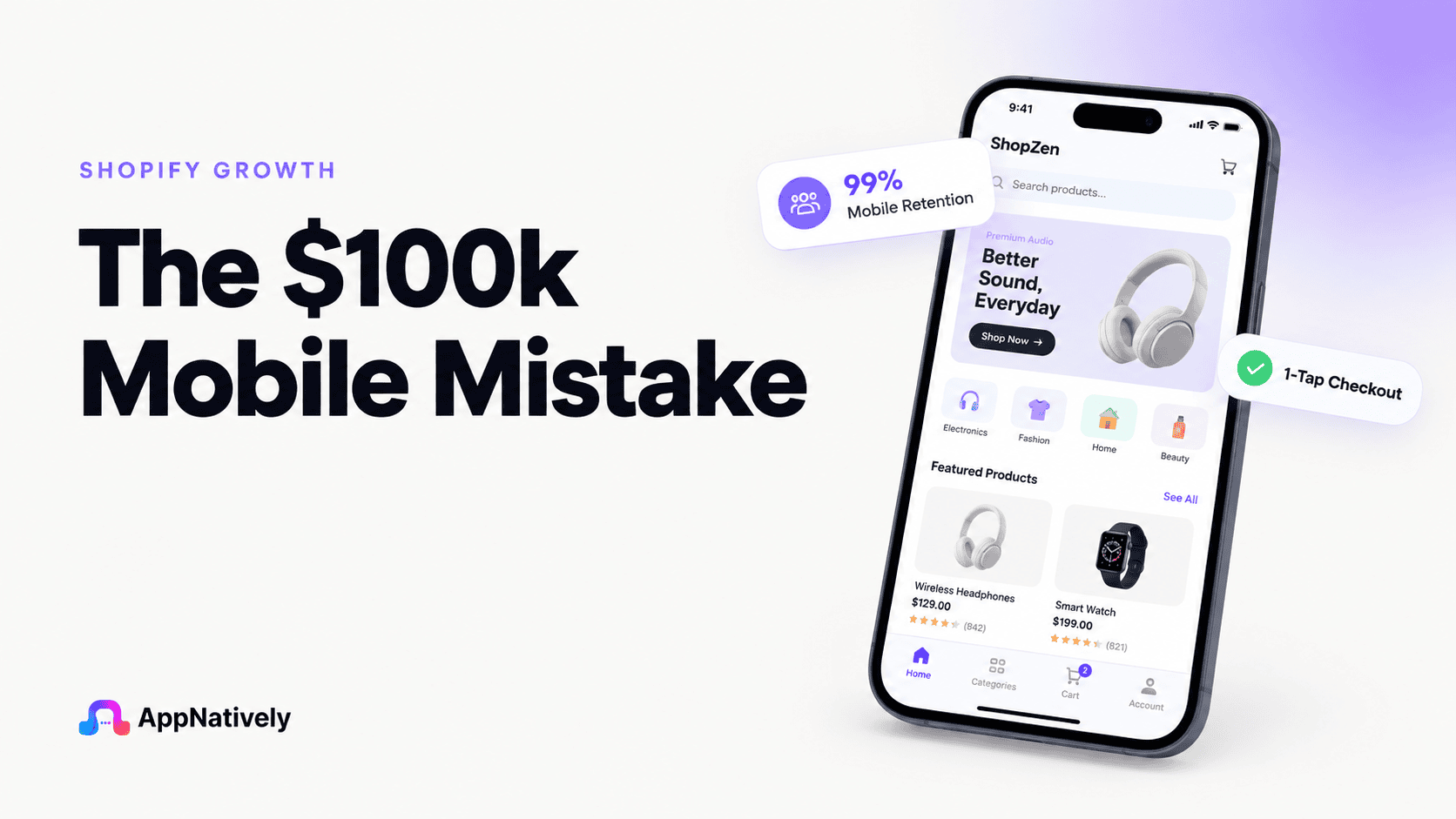
Every Shopify store owner knows that mobile commerce is dominating online shopping. With the majority of customers browsing, comparing, and purchasing products from their smartphones, many brands believe that having a responsive mobile website is enough to stay competitive. Unfortunately, that’s where a costly mistake begins.
While mobile websites provide convenience, they often fail to deliver the speed, engagement, personalization, and customer retention that today’s shoppers expect.
As a result, countless Shopify stores unknowingly leave thousands or even hundreds of thousands of dollars in revenue on the table every year. From abandoned carts and lost repeat customers to missed opportunities for push notifications and loyalty-building experiences, relying solely on a mobile website can significantly limit growth.
The most successful eCommerce brands have discovered a critical advantage: mobile apps consistently outperform mobile websites when it comes to customer engagement, repeat purchases, and lifetime value.
In this article, we’ll uncover the $100,000 mistake many Shopify stores make. So, without further ado, let’s dig deeper.
Build your Shopify app instantly with drag & drop- Join Waitlist
Why Mobile Websites Are No Longer Enough
Consumer behavior has changed dramatically over the last decade. Mobile shoppers now expect instant experiences, personalized recommendations, and seamless purchasing journeys.
While responsive websites can provide accessibility, they often cannot match the convenience and engagement features available through mobile applications.
Common limitations of mobile websites include:
- Slower loading times
- Higher cart abandonment rates
- Limited personalization
- No direct push notifications
- Lower customer retention
- Reduced brand visibility
- Dependence on email marketing
When customers close a browser tab, reconnecting with them becomes significantly more difficult.
A mobile app changes that equation.
The Real Cost of Relying Only on a Shopify Mobile Website
Imagine a Shopify store generating $500,000 annually.
If the business loses:
- 10% of potential repeat customers
- 5% in abandoned carts
- 8% in missed promotional opportunities
- 7% in reduced customer engagement
The combined revenue loss can easily exceed $100,000 annually.
Many merchants focus heavily on acquiring new customers while overlooking retention opportunities that already exist within their customer base.
Because acquiring a new customer often costs far more than retaining an existing one, every missed repeat purchase becomes increasingly expensive.
$100,000 Mistake Shopify Stores Make by Relying Only on Mobile Websites
The “$100,000 mistake” Shopify stores make by relying only on a mobile website usually comes down to one core issue: treating the mobile browser experience as the final product instead of just one channel.
Here’s what that really means in practical terms.
Many Shopify merchants assume that because their store is “mobile-optimized,” they’re fully covered. After all, most traffic is mobile.
But a mobile website (even a responsive one) still sits inside a browser environment, which has limits that directly affect conversions, retention, and repeat purchases.
The hidden cost shows up in a few ways:
1. Losing high-intent repeat customers
A mobile website requires users to:
- open a browser
- search or retype the URL
- wait for the site to load
- log in again (often)
That friction quietly kills repeat buying behavior. Apps, on the other hand, keep users logged in and one tap away from checkout.
2. Lower conversion rates from push traffic
With only a mobile website, you can’t effectively use:
- push notifications
- home screen presence
- app-exclusive drops or reminders
So even if someone is interested, you lose easy re-engagement paths that drive impulse purchases.
3. Weaker brand “stickiness”
A website is temporary; an app icon on a phone is persistent.
Stores relying only on mobile web often struggle with:
- lower return frequency
- weaker customer lifetime value (LTV)
- higher dependence on paid ads
4. Higher customer acquisition costs over time
Because customers don’t come back as often, you keep paying to re-acquire them through ads. That’s where the “$100,000 mistake” framing comes from—lost repeat revenue compounds quickly at scale.
5. Missed personalization opportunities
Apps allow deeper personalization like:
- behavior-based notifications
- saved preferences
- faster checkout flows
- loyalty integration
Mobile web is more limited in how “sticky” and personalized it can become.
How Mobile Apps Increase Shopify Revenue
1. Higher Conversion Rates
Mobile apps remove many of the friction points associated with websites.
Customers can:
- Stay logged in
- Save payment methods
- Browse faster
- Checkout with fewer clicks
The result is a smoother shopping experience that often leads to higher conversion rates.
2. Push Notifications Drive Repeat Sales
One of the biggest advantages of a Shopify mobile app is push notifications.
Unlike email campaigns that may never be opened, push notifications appear directly on customers’ devices.
Store owners can instantly notify customers about:
- Flash sales
- New arrivals
- Back-in-stock products
- Exclusive discounts
- Abandoned carts
This creates a direct communication channel that mobile websites simply cannot replicate effectively.
3. Improved Customer Retention
Retention is often the biggest growth lever in eCommerce.
When customers install a store’s mobile app, the brand gains a permanent place on their smartphone.
This visibility creates ongoing engagement opportunities and increases the likelihood of repeat purchases.
Customers who regularly interact with an app often become more loyal than website-only shoppers.
4. Faster User Experience
Speed matters.
Research consistently shows that even small delays in page loading can reduce conversions.
Mobile apps typically offer:
- Faster navigation
- Better performance
- Reduced loading times
- Offline browsing capabilities
These improvements create a more enjoyable shopping experience and encourage users to complete purchases.
5. Personalized Shopping Experiences
Modern consumers expect personalization.
Mobile apps can deliver:
- Product recommendations
- Personalized promotions
- Purchase history tracking
- Behavior-based offers
This level of customization helps increase customer satisfaction and average order value.
Shopify Mobile App vs Mobile Website: Which Performs Better?
For most growing eCommerce brands, the answer isn’t either/or—it’s both.
A mobile website is essential for attracting visitors through search engines, while a Shopify mobile app excels at retaining customers, increasing engagement, and driving repeat purchases.
The key difference is that a mobile website helps customers find your store, while a mobile app helps them keep coming back.
Performance Comparison
| Feature | Shopify Mobile Website | Shopify Mobile App |
|---|---|---|
| SEO Visibility | Excellent | Limited |
| App Store Presence | No | Yes |
| Loading Speed | Good | Excellent |
| Push Notifications | No | Yes |
| Customer Retention | Moderate | High |
| Repeat Purchases | Moderate | High |
| Personalized Experience | Basic | Advanced |
| Offline Access | No | Limited |
| Cart Recovery | Limited | Strong |
| User Engagement | Moderate | Very High |
| Checkout Experience | Good | Excellent |
| Brand Visibility | Browser-Based | Always on Customer’s Device |
Key Takeaway
A mobile website is your customer acquisition tool. It helps shoppers discover your products through Google and other search engines.
However, once a customer makes a purchase, a mobile app becomes significantly more powerful for building loyalty and encouraging repeat sales.
Mobile apps offer several advantages that websites cannot easily replicate:
- Instant push notifications
- Faster navigation and checkout
- Personalized product recommendations
- Higher customer retention
- Better customer lifetime value
- Increased repeat purchase rates
Which Option Should Shopify Stores Choose?
| Business Goal | Best Solution |
|---|---|
| Increase Organic Traffic | Mobile Website |
| Improve Customer Retention | Mobile App |
| Reduce Cart Abandonment | Mobile App |
| Build Brand Loyalty | Mobile App |
| Rank on Google | Mobile Website |
| Drive Repeat Purchases | Mobile App |
| Maximize Revenue Growth | Both |
Turn Your Website Into a Native Mobile App in Minutes with AppNatively
Signs Your Shopify Store Needs a Mobile App
Your store may benefit from a mobile app if:
- You receive substantial mobile traffic.
- Customer retention is lower than expected.
- Cart abandonment rates remain high.
- You run frequent promotions.
- Repeat purchases drive a large percentage of revenue.
- Customer acquisition costs continue increasing.
- You want stronger customer loyalty.
The larger your customer base becomes, the greater the potential return from app-based engagement.
How to Transition Beyond a Mobile-Only Strategy
The most successful Shopify brands do not replace their websites.
Instead, they create a complete mobile commerce ecosystem:
- Use SEO to attract organic traffic.
- Convert visitors through a high-performing website.
- Encourage customers to install the mobile app.
- Use push notifications for retention.
- Personalize offers based on customer behavior.
- Increase lifetime value through repeat purchases.
This approach creates multiple growth channels instead of relying on a single customer touchpoint.
Build Shopify App at Reasonable Price: Join AppNatively Waitlist
Final Thoughts
The biggest mistake many Shopify merchants make is assuming a responsive website is the final step in mobile optimization.
In reality, a mobile website is only the beginning.
As competition increases and customer acquisition costs rise, retention becomes the true driver of long-term profitability. Mobile apps provide advantages that websites simply cannot match, including push notifications, deeper personalization, stronger engagement, and improved customer loyalty.
For many Shopify stores, continuing to rely solely on a mobile website can quietly cost tens of thousands or even hundreds of thousands—of dollars in missed revenue every year.
The brands that recognize this gap early are often the ones that achieve faster growth, stronger retention, and greater lifetime customer value.
Frequently Asked Questions (FAQs)
Is a mobile website enough for a Shopify store?
A mobile website is essential, but it may not be enough for stores seeking higher retention, engagement, and repeat purchases. Mobile apps provide additional advantages such as push notifications and personalized experiences.
Why do Shopify stores need a mobile app?
A mobile app helps increase customer retention, improve conversions, strengthen loyalty, and create direct communication channels through push notifications.
Do mobile apps convert better than mobile websites?
In many cases, yes. Mobile apps often provide faster experiences, simpler checkout processes, and personalized shopping journeys that encourage purchases.
How much revenue can a Shopify mobile app generate?
Results vary by store size and customer base. However, many merchants see improvements in repeat purchases, retention, and customer lifetime value after launching a mobile app.
What are the benefits of push notifications?
Push notifications help stores instantly communicate promotions, product launches, abandoned cart reminders, and personalized offers directly to customers’ devices.
Can small Shopify stores benefit from a mobile app?
Yes. While larger stores often see the biggest impact, smaller stores can also improve retention, customer engagement, and repeat sales through mobile apps.
Related posts