
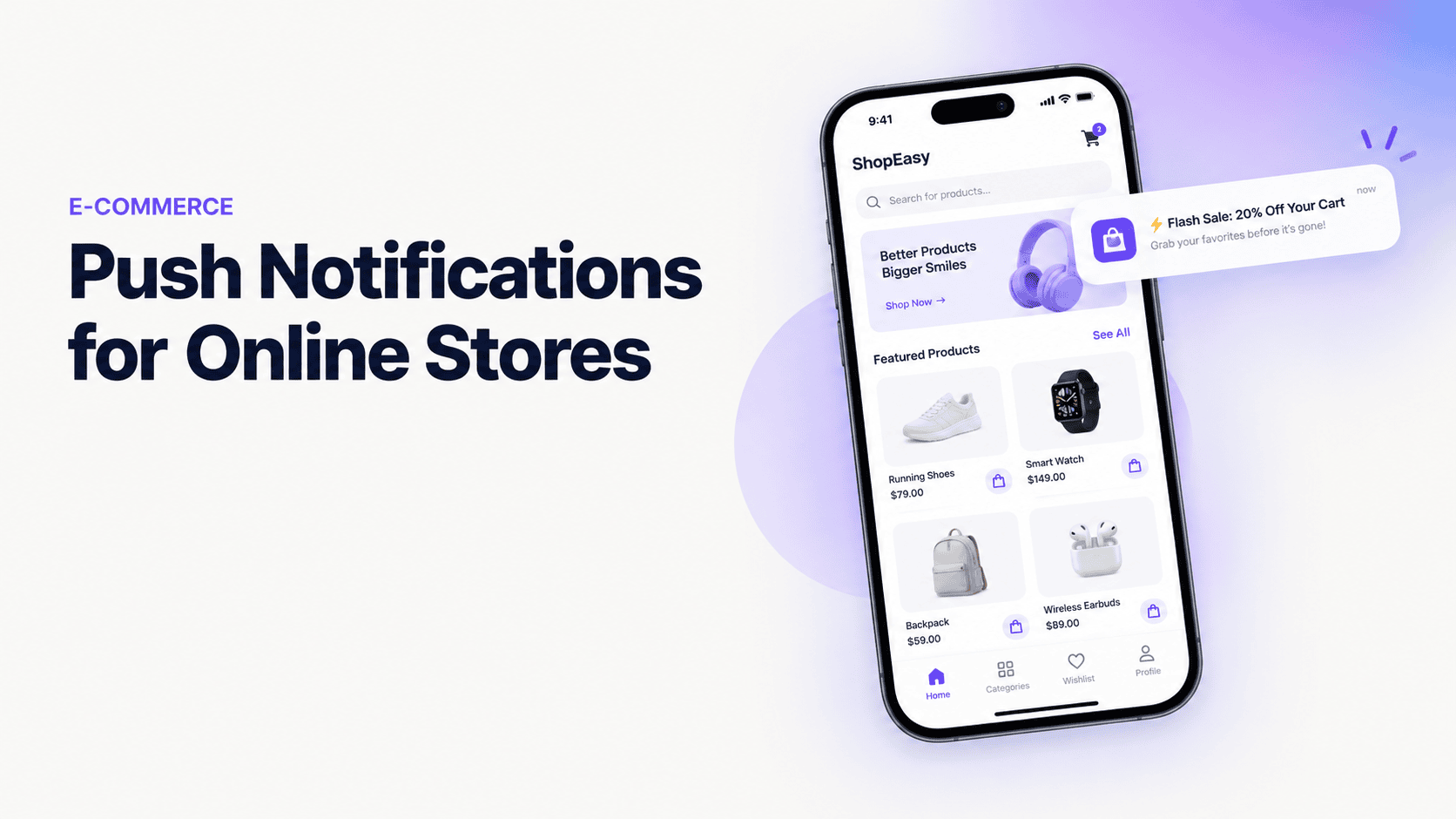
Running an online store is exciting, but keeping customers engaged after they leave your website is a constant struggle.
Shoppers browse, add products to their carts, and then disappear without completing their purchase.
Emails go unopened, social media posts get lost in crowded feeds, and your promotions fail to reach the right audience at the right time.
Push notifications solve this problem by delivering instant, personalized messages directly to your customers’ devices.
Whether it’s a flash sale alert, back in stock update, or abandoned cart reminder, push notifications help you reconnect with shoppers in real time.
They cut through the noise and bring customers back to your store with a single click.
For online stores looking to increase conversions, boost repeat purchases, and build stronger customer relationships, push notifications are no longer optional.
They are a powerful, direct communication channel that keeps your brand visible, relevant, and ready to convert whenever your customers are.
What Are Push Notifications?
Push notifications are short, clickable messages sent directly to a user’s device either through a mobile app or a web browser.
Unlike email or social media posts, they appear instantly on the user’s screen, even when the user is not actively browsing your store.
There are three primary types:
- Mobile app push notifications
- Web push notifications (browser-based)
- Desktop push notifications
Their biggest advantage lies in visibility and immediacy. They don’t compete with inbox clutter the way email does, and they don’t rely on algorithmic feeds like social platforms.
Types of Push Notification Channels for eCommerce
Choosing the right push notification channel is not just a technical decision; rather, it directly impacts reach, engagement, and revenue.
Different channels serve different stages of the customer journey, and successful online stores often combine multiple channels for maximum impact.
Below are the primary push notification channels used in ecommerce.
1. Mobile app push notifications
Mobile app push notifications are messages sent directly to users who have installed your e-commerce app. These appear on the lock screen, in the notification center, or as banners inside the app.
This channel offers the highest level of personalization and engagement because users have already demonstrated strong intent by downloading the app.
Brands can send behavioral triggers like cart abandonment alerts, price drops, loyalty rewards, and flash sales.
Since mobile app users are often repeat customers, this channel typically delivers higher conversion rates and customer lifetime value.
Best for:
High-intent shoppers, loyalty members, repeat buyers, and personalized offers.
2. Web push notifications (Browser-Based)
Web push notifications are sent through browsers like Chrome, Firefox, Edge, or Safari after users grant permission.
Unlike app notifications, users do not need to install a mobile application.
This makes web push ideal for ecommerce brands that do not have a mobile app or want broader reach.
These notifications can be sent to both desktop and mobile browser users, bringing shoppers back even when they are not actively browsing the website.
Web push is especially powerful for flash sales, back-in-stock alerts, and limited-time promotions.
Because subscription is quick and frictionless, opt-in rates can be higher compared to app installs.
Best for:
Stores without apps, quick promotional alerts, and re-engaging website visitors.
3. Desktop push notifications
Desktop push notifications are a subset of web push but specifically target users on laptops and desktop computers.
These appear in the system notification area, even when the browser is minimized.
For B2B ecommerce or stores targeting office-hour shoppers, desktop notifications can be highly effective.
They are particularly useful for time-sensitive offers, webinar invites, or product launches aimed at professionals.
Since desktop usage often correlates with research-oriented buying behavior, these notifications can help move users from consideration to conversion.
Best for:
Work-hour promotions, B2B ecommerce, high-ticket product launches.
4. Progressive Web App (PWA) push notifications
Progressive Web Apps combine the accessibility of web push with an app-like experience.
Users can install the website on their device home screen without downloading from an app store.
PWA push notifications offer deeper engagement than traditional web push because they mimic native app functionality.
For ecommerce brands that want app-level interaction without the cost of full native development, this channel provides a powerful middle ground.
Best for:
Mid-sized ecommerce brands seeking app-like engagement without building a native app.
5. In-app push notifications
In-app notifications appear while users are actively using the app. Unlike traditional push notifications, these do not show on the lock screen but instead appear inside the application interface.
These are highly effective for guiding users through promotions, recommending products, announcing loyalty milestones, or encouraging upsells during browsing sessions.
Because they engage customers during active sessions, in-app notifications help increase average order value and improve the shopping experience.
Best for:
Upselling, cross-selling, onboarding flows, loyalty engagement.
6. Wearable device push notifications
With the rise of smartwatches and connected devices, ecommerce brands can now reach users through wearable push notifications.
These appear on devices like smartwatches and are designed for quick-glance engagement.
Although limited in text length, wearable notifications are effective for flash sales, delivery alerts, and limited-time deals where immediacy is crucial.
Best for:
Urgent offers, delivery updates, and highly time-sensitive promotions.
Why Push Notifications Matter for Online Retail
In online retail, attention is currency. Customers are constantly exposed to ads, emails, and social content competing for the same limited focus.
Push notifications cut through that noise by delivering real-time, direct messages to a customer’s device without relying on algorithms or inbox placement.
When used strategically, push notifications become one of the most powerful growth tools for ecommerce brands.
They influence buying decisions, recover lost revenue, and increase long-term customer value.
They capture immediate attention
Unlike email campaigns that may sit unread for hours, push notifications appear instantly on a user’s screen.
Whether it’s a flash sale or a restock alert, the immediacy creates urgency and drives quick action.
For online retail, timing often determines revenue. A notification sent at the right moment can turn browsing intent into a completed purchase within minutes.
They reduce cart abandonment
Cart abandonment is one of the biggest revenue leaks in ecommerce.
Many shoppers add items to their cart but leave before completing checkout. Push notifications allow retailers to bring those customers back with timely reminders.
A simple message like “Your items are almost gone” or “Complete your purchase and get 10% off” can significantly recover otherwise lost sales.
Because the message is behavior-triggered, it feels relevant rather than promotional.
They increase repeat purchases
Customer retention is more profitable than customer acquisition. Push notifications help maintain consistent communication with existing buyers through:
Reorder reminders
New arrival alerts
Exclusive loyalty offers
Personalized product suggestions
By staying visible without being intrusive, brands increase repeat purchases and customer lifetime value.
They drive higher engagement than many channels
Push notifications typically generate faster engagement compared to email because they appear directly on the device screen.
They require minimal effort from the user — just a tap.
This frictionless interaction shortens the buying cycle and improves conversion rates, especially during limited-time campaigns.
They enable hyper-personalization
Modern ecommerce platforms allow segmentation based on browsing history, purchase behavior, location, and engagement patterns.
Push notifications can be tailored to individual preferences, increasing relevance and click-through rates.
For example, a fashion retailer can notify a customer when their preferred size is back in stock.
That level of personalization builds trust and improves conversion probability.
They support omnichannel retail strategies
Push notifications complement email and SMS marketing. While email works well for detailed storytelling and SMS for urgent alerts, push notifications balance immediacy and convenience.
Together, these channels create a seamless customer journey across devices and touchpoints.
They are cost-effective and scalable
Compared to paid advertising, push notifications require no cost per click.
Once users opt in, retailers can send automated, behavior-driven messages at scale without increasing marketing spend.
This makes push notifications one of the highest ROI tools in an ecommerce growth strategy.
Building a High-Performing Push Notification Strategy for Online Stores
A push notification strategy is not about sending more alerts. It is about sending smarter, data-driven messages that increase engagement without overwhelming customers.
For online stores, a high-performing push strategy blends segmentation, timing, personalization, and continuous optimization into a structured growth system.
Below is a step-by-step framework to build a push notification engine that drives consistent retail revenue.
i. Start with clear revenue goals
Before launching campaigns, define what success looks like. Are you trying to reduce cart abandonment, increase repeat purchases, promote flash sales, or improve retention?
Each objective requires a different type of message. For example, abandoned cart recovery needs urgency and incentives, while retention campaigns focus on loyalty and product discovery.
Clear goals prevent random messaging and align notifications with measurable outcomes.
ii. Segment your audience intelligently
Sending the same notification to all subscribers reduces effectiveness and increases opt-outs. Segmentation ensures relevance.
You can segment users based on:
- Purchase history
- Browsing behavior
- Product categories viewed
- Location
- Device type
- Engagement frequency
For instance, high-value customers can receive early access to sales, while first-time visitors may receive onboarding offers.
The more relevant the message, the higher the conversion rate.
iii. Use behavioral triggers instead of manual blasts
The highest-performing push notifications are automated and behavior-based. These include:
- Cart abandonment reminders
- Browse abandonment alerts
- Back-in-stock updates
- Price drop alerts
- Replenishment reminders
Triggered notifications reach customers at the exact moment their intent is strongest.
This increases engagement while reducing the need for constant manual campaigns.
iv. Optimize timing and frequency
Even the best message fails if delivered at the wrong time. Analyze customer activity patterns to determine peak engagement windows.
Avoid notification fatigue by limiting frequency. Too many alerts lead to opt-outs.
A balanced strategy maintains visibility without becoming intrusive. Testing different send times helps identify optimal engagement periods.
v. Craft clear, action-oriented copy
Push notifications are short by nature, so clarity is critical. High-converting notifications typically include:
- A strong value proposition
- Urgency or scarcity
- Personalization when possible
- A direct call to action
Instead of saying “New Collection Available,” a stronger message would be “Your Favorite Jackets Are Back — 15% Off Today Only.”
Every word must justify its place.
vi. Personalize using customer data
Personalization significantly increases performance. Use data such as past purchases, product views, or category preferences to tailor messages.
For example, instead of promoting general footwear, notify a user about running shoes if they previously browsed athletic gear. Relevance increases trust and improves click-through rates.
vii. Incorporate rich media where possible
Adding product images or emojis can improve visibility and engagement.
Visual cues help notifications stand out on crowded screens and reinforce the message instantly.
However, visuals should enhance clarity, not distract from the offer.
viii. Implement lifecycle-based campaigns
A structured push notification strategy follows the customer journey:
- Welcome notifications for new subscribers
- Cart recovery sequences
- Post-purchase upsell suggestions
- Replenishment reminders
- Loyalty reward notifications
- Win-back campaigns for inactive users
Lifecycle automation ensures continuous engagement without excessive manual intervention.
ix. Continuously test and optimize
A high-performing strategy is built on experimentation. Test different:
- Headlines
- Offers
- Send times
- Personalization levels
- Frequency caps
Track metrics such as click-through rate, conversion rate, revenue per subscriber, and opt-out rate. Small improvements compound over time.
x. Maintain Permission and Trust
Always prioritize user consent and transparency. Make opt-in prompts clear about the value customers will receive. Provide simple opt-out options to maintain brand trust.
Respecting user preferences improves long-term retention and reduces churn.
xi. Integrate with Your Omnichannel Marketing
Push notifications work best when integrated with email, SMS, and retargeting ads. For example:
- Send a push reminder first
- Follow up with email if unopened
- Use retargeting ads for high-intent visitors
This layered approach strengthens message reinforcement across channels.
Measuring Push Notification Performance
Sending push notifications without tracking performance is like running paid ads without analytics.
If you don’t measure impact, you can’t optimize revenue. For online stores, performance measurement ensures that push notifications drive growth rather than fatigue or unsubscribes.
A structured measurement framework turns push notifications from simple alerts into a predictable revenue channel.
1. Track the core engagement metrics
The first layer of measurement focuses on engagement. These metrics reveal how users interact with your notifications.
Click-through rate (CTR)
CTR measures the percentage of users who clicked the notification after receiving it. This is the primary indicator of message relevance and strength.
A low CTR may signal weak copy, poor timing, or lack of personalization.
A high CTR indicates strong alignment between message and audience intent.
Delivery rate
Delivery rate shows how many notifications were successfully delivered versus failed attempts.
Technical issues, expired tokens, or disabled permissions can reduce delivery rates.
Monitoring this metric ensures your push infrastructure is functioning properly.
Opt-in rate
Opt-in rate measures how many visitors subscribe to push notifications.
If this rate is low, your permission prompt may lack a compelling value proposition.
Improving opt-in messaging directly expands your reachable audience.
2. Measure revenue-driven metrics
Engagement alone is not enough. For ecommerce brands, performance must connect to revenue.
Conversion rate
Conversion rate tracks how many users completed a purchase after clicking the notification.
This metric shows how effective the landing page and offer are.
A strong CTR but weak conversion rate may indicate friction in checkout or mismatched expectations.
Revenue per subscriber
Revenue per subscriber calculates how much income each push subscriber generates over time.
This helps measure long-term ROI and compare push against other channels like email or SMS.
Cart recovery rate
For behavioral campaigns, measure how many abandoned carts were recovered after a push reminder. This directly quantifies recovered revenue.
3. Monitor retention and churn signals
Push notifications should increase loyalty, not cause fatigue.
Opt-out rate
If opt-outs spike after campaigns, it signals over-sending or irrelevant messaging. Monitoring opt-out trends protects long-term audience health.
Customer retention impact
Track whether push subscribers return more frequently or purchase more often than non-subscribers. This reveals the true lifetime value impact.
4. Analyze timing and frequency performance
Performance often depends on when notifications are sent. Compare:
- Morning vs evening campaigns
- Weekday vs weekend results
- High-frequency vs limited-frequency strategies
Over time, patterns emerge that help optimize scheduling.
5. Use A/B testing for continuous improvement
Testing is essential for growth. You can experiment with:
- Different headlines
- Personalization vs generic copy
- Discount vs no discount
- Emoji usage
- Urgency wording
- Send time variations
Even small improvements in CTR or conversion rate can significantly increase revenue at scale.
6. Implement proper attribution
Push notifications often assist conversions rather than close them instantly.
For example, a customer may click a notification but purchase later through another channel.
Use attribution models to understand assisted conversions and cross-channel influence.
This prevents undervaluing push as a marketing driver.
7. Build a push performance dashboard
A centralized dashboard should track:
- CTR
- Conversion rate
- Revenue generated
- Opt-out rate
- Subscriber growth
- Campaign comparisons
Having all data in one place simplifies decision-making and reveals long-term trends.
8. Focus on revenue, not just clicks
High clicks mean attention. High conversions mean impact. High revenue per subscriber means sustainable growth.
The goal of measuring push notification performance is not vanity metrics. It is identifying which strategies produce measurable retail growth.
Push Notifications vs Email & SMS: A Strategic Comparison
In modern digital marketing, the real question isn’t which channel is best. Instead, it’s which channel is best for a specific objective.
Push notifications, email, and SMS each serve different stages of the customer journey.
When used strategically, they complement rather than compete with one another.
1. Push Notifications
Push notifications are short, real-time messages sent to users via apps or web browsers.
Tools like OneSignal and Firebase enable businesses to automate and personalize these alerts based on user behavior.
Strengths
Push notifications are immediate and highly visible. They appear directly on lock screens or browsers, which makes them effective for flash sales, abandoned cart reminders, and time-sensitive updates.
Because users must opt in, the audience is often more engaged compared to traditional email lists.
Limitations
Push messages are brief and can be easily disabled if overused. They require precise timing and strong personalization to avoid notification fatigue.
2. Email Marketing
Email remains one of the highest ROI channels in digital marketing. Platforms such as Mailchimp and Klaviyo allow deep segmentation, automation workflows, and rich content delivery.
Strengths
Email supports detailed storytelling, product showcases, educational sequences, and long-form promotional campaigns.
It works exceptionally well for nurturing leads, onboarding users, and building long-term brand relationships.
Limitations
Inbox competition is intense. Open rates depend on subject lines, sender reputation, and timing.
Engagement may not be immediate, as users check emails at their convenience.
3. SMS Marketing
SMS marketing delivers text messages directly to a user’s phone number.
Services like Twilio and Attentive help brands automate and scale SMS communication.
Strengths
SMS has extremely high open rates and fast response times. It is ideal for urgent notifications, limited-time offers, delivery updates, and two-factor authentication codes.
Limitations
SMS can feel intrusive if misused. It has strict character limits, higher per-message costs, and requires careful compliance with opt-in regulations.
Direct Strategic Comparison
Speed and attention
SMS and push notifications dominate in immediacy. Both appear directly on the user’s device, making them ideal for urgent or time-sensitive messaging.
Email is slower but better suited for thoughtful engagement.
Content depth
Email provides the most flexibility in design and messaging. Push and SMS are concise and action-oriented, best for driving quick clicks rather than detailed communication.
Cost efficiency
Push notifications are generally the most cost-effective at scale, especially for app-based businesses.
Email is affordable and scalable. SMS typically carries higher direct costs but delivers strong short-term ROI when used strategically.
Personalization potential
All three channels support personalization. However, email offers deeper segmentation capabilities, while push notifications excel at real-time behavioral triggers.
Future Trends in Push Notifications for Ecommerce
Push notifications are evolving from simple alerts into intelligent, revenue-driving engagement engines for ecommerce brands.
As technology, privacy standards, and customer expectations shift, the future of push messaging is becoming smarter, more personalized, and more strategic.
1. Smarter personalization through AI and predictive signals
One of the biggest shifts will be the use of AI to drive predictive personalization rather than reactive segmentation.
Today’s push messaging is often based on static segments (e.g., “users who clicked product X”).
Tomorrow’s push will leverage machine learning to predict future behavior, such as the likelihood to purchase, churn risk, or optimal engagement windows and automatically tailor pushes based on predicted intent.
For example, instead of sending a generic sale alert, AI could craft a push that targets users predicted to be on the verge of purchase with personalized incentives or urgency framing.
Impact on ecommerce: Higher conversion rates, fewer opt-outs, lower fatigue.
2. Contextual automation (Beyond Basic Triggers)
Ecommerce push triggers today are primarily event-based (abandoned carts, browse abandonment).
The next wave is contextual triggers that account for a wider range of behavioral and environmental signals, including:
- Device type and app usage patterns
- Local time of day and timezone behavior
- Weather or seasonality
- Inventory levels and price volatility
- Cross-channel engagement history
This means push notifications will become not just reactive but context-aware, increasing relevance and timeliness.
Impact on ecommerce: More personalized journeys, higher engagement efficiency.
3. Deep integration with conversational AI and chat interfaces
Push notifications will increasingly serve as entry points into conversational experiences.
Instead of a single CTA like “View Cart,” users might engage with an AI chatbot embedded in the app or within web UI that replies contextually based on user queries.
For example:
User taps push → chatbot asks “Would you like 10% off now or reminders later?”
These experiences blend push with two-way conversational flows and guided assistance.
Impact on ecommerce: Better user experience, upsell opportunities, conversational commerce.
4. Richer push modalities (Interactive & Visual Push)
Static text push messages will evolve into richer, interactive push formats, including:
- Carousel pushes (multiple images or products)
- Action buttons beyond a single CTA
- Embedded short videos or animation
- Dynamic pricing information
These will make push more analogous to mini-ads but delivered to opted-in users.
Impact on ecommerce: Higher click-through, better product discovery.
5. Cross-channel orchestration platforms
Rather than managing push in isolation, brands will adopt unified orchestration platforms that sync push with email, SMS, web personalization, AND advertising channels.
These platforms will ensure consistent frequency capping, unified user profiles, and engagement optimization.
So instead of siloed campaigns like “Push Blast at 3 PM,” the system will decide dynamically:
“User gets either an email, push, or SMS based on context and expected lift.”
Impact on ecommerce: Lower oversaturation, higher ROI per contact.
6. Privacy-first targeting and on-device intelligence
As privacy regulations tighten and users demand more control, push strategies will shift from server-side profile tracking to device-level intelligence. Push campaigns may rely more on:
- Local on-device segmentation
- Machine-learning classifiers stored locally
- Differential privacy approaches
This reduces dependency on third-party cookies and intrusive tracking.
Impact on ecommerce: Better compliance with regulations and improved user trust.
7. Predictive engagement scoring for optimal delivery
Rather than sending pushes on preset schedules, future ecommerce platforms will use predictive scoring to determine when a specific user is most likely to engage.
This could adjust delivery timing dynamically on a per-user basis.
For example, if the model predicts User A engages most at 7:42 PM on weekdays and User B at 8:15 AM, pushes will automatically align.
Impact on ecommerce: Reduced noise, higher CTR, improved retention.
8. Loyalty-driven push campaigns
Push will become a primary channel in loyalty and rewards ecosystems. Users will get tailored pushes about:
- Rewards earned
- Tier promotions
- Personalized offers based on loyalty status
- Gamification prompts
This transforms push from promotional messaging to relationship reinforcement.
Impact on ecommerce: Longer lifetime value (LTV), stronger emotional brand connection.
9. Voice-responsive push and IoT connectivity
With voice assistants (e.g., smart speakers, wearables), push notifications may evolve into multi-modal alerts that integrate audio and IoT cues.
For example, a smartwatch push paired with a voice prompt:
“Your favorite shoes are back in stock — say ‘View’ to see them online.”
This expands push beyond screens.
Impact on ecommerce: More accessible engagement, broader reach.
10. Ethical messaging and frequency intelligence
Future push platforms will include frequency optimization to prevent fatigue and respect user preferences.
Combined with sentiment analysis, these systems will:
- Detect when users find pushes annoying
- Automatically reduce frequency
- Shift messaging tone based on past responses
This leads to more ethical, user-centric communication.
Impact on ecommerce: Higher long-term retention and lower opt-out rates.
Conclusion
Push notifications for online stores are most effective when treated as a precision tool rather than a broadcast channel.
The true power of push lies in personalization, timing, and behavioral relevance.
Brands that rely on generic blasts risk fatigue and opt-outs, while those that invest in intelligent triggers and contextual messaging unlock measurable increases in conversion and customer lifetime value.
As ecommerce continues shifting toward real-time, app-driven experiences, push notifications will play an even more central role in revenue strategy.
The future belongs to online stores that balance urgency with relevance, automation with empathy, and frequency with value.
When executed thoughtfully, push notifications become more than alerts and they become a competitive advantage.