
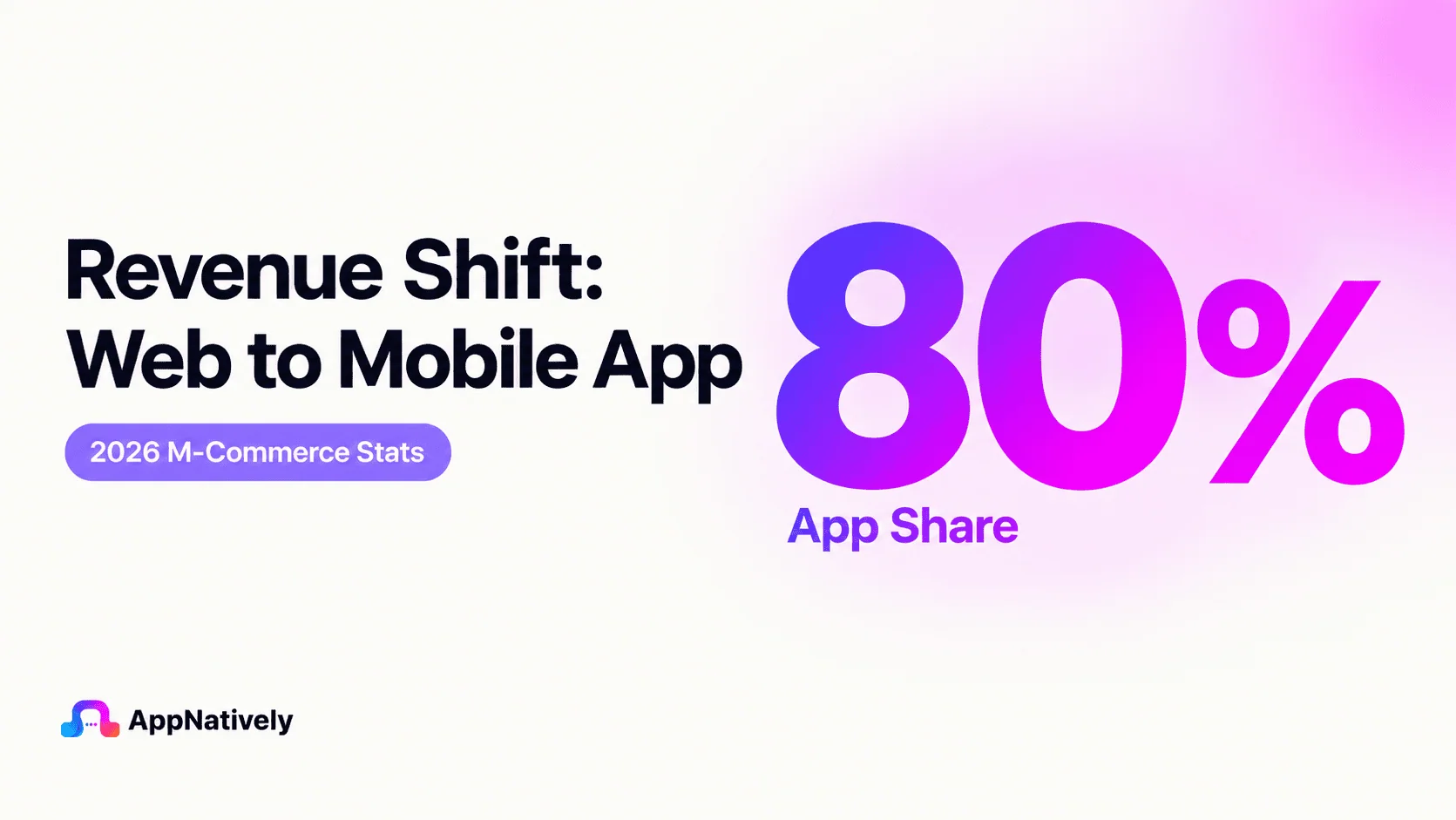
In 2026, the center of digital shopping has quietly moved from the browser to the palm of the hand.
Mobile traffic may still begin on the web, but revenue increasingly ends inside apps, where speed, simplicity, and personalization feel effortless.
What once served as a supporting channel has now become the main stage for modern commerce.
The shift is driven by experience. Native apps powered by ecosystems from Apple and Google and perfected by retail leaders like Amazon offer one-tap checkouts, smart recommendations, and instant engagement that mobile websites struggle to match.
Shoppers stay longer, browse deeper, and buy faster, turning convenience into conversions.
For businesses, this isn’t just a trend; it’s a revenue realignment. Understanding the mobile commerce statistics behind the web-to-app migration reveals where customers truly spend and where growth now lives.
In an app-first world, the brands that adapt quickly are the ones that capture the future of mCommerce.
Mobile Commerce Market Overview
Mobile commerce (m-commerce) refers to online buying, selling, and payment activities conducted through smartphones and tablets.
It has evolved from being a subset of traditional e-commerce into a primary digital retail channel, driven by widespread smartphone adoption, faster mobile internet, and seamless payment technologies.
Today, many consumers prefer completing purchases directly from mobile apps rather than desktop websites, making mobile the dominant touchpoint across retail, travel, entertainment, and financial services.
i. Market size and growth
Current market position
Mobile commerce now accounts for more than half of global e-commerce transactions.
Retailers report that the majority of traffic and a growing share of conversions come from mobile devices.
Increased app usage, improved user experience, and integrated payment systems have accelerated this shift.
Growth outlook
The market is expanding at a strong double-digit compound annual growth rate.
Industry forecasts expect total transaction value to reach multiple trillions of dollars within the next decade.
Growth is particularly strong in emerging markets where mobile phones are often the primary way people access the internet.
ii. Key growth drivers
Smartphone and Internet Penetration
Affordable smartphones and broader 4G/5G coverage allow consumers to shop from anywhere at any time. In many regions, mobile devices are the first and only digital access point, which naturally supports m-commerce adoption.
Digital payments and wallets
Secure, one-tap payment solutions have reduced checkout friction and increased trust.
Platforms such as Apple Pay, Google Pay, and Paytm make transactions fast and convenient, encouraging more frequent purchases.
Changing consumer behavior
Consumers increasingly expect instant, app-based experiences. Mobile shopping fits daily habits such as browsing on social media, watching videos, or commuting, leading to more impulse and on-the-go purchases.
Technology advancements
Artificial intelligence, personalization engines, and augmented reality tools help users discover products, visualize items, and receive tailored recommendations, improving conversion rates.
iii. Major Market Trends
App-first shopping
Retailers prioritize dedicated mobile apps because they offer better performance, higher engagement, and stronger customer loyalty compared to mobile browsers.
Social and in-app commerce
Shopping features are embedded directly within social and messaging platforms, allowing users to browse and purchase without leaving the app. This shortens the buying journey and increases impulse sales.
Wallet and QR payments
Contactless payments and QR code transactions are becoming standard, especially in Asia-Pacific markets where mobile wallets dominate everyday purchases.
Personalization
Data analytics and AI provide customized offers, product suggestions, and dynamic pricing, creating more relevant shopping experiences.
iv. Challenges
User experience constraints
Small screens and varying device types make it harder to design intuitive interfaces. Poor navigation or slow loading times often lead to cart abandonment.
Security and Privacy
As mobile transactions increase, so do concerns about fraud, data breaches, and payment security. Businesses must invest heavily in encryption and authentication technologies.
Competition and Customer Retention
With many apps competing for attention, maintaining engagement and loyalty requires continuous innovation and strong customer experiences.
v. Regional insights
Asia-Pacific
This region leads global adoption due to strong digital payment ecosystems and super-app platforms that combine shopping, banking, and services within a single app.
North America and Europe
These markets show steady growth supported by established retail brands, high smartphone penetration, and advanced logistics networks.
Emerging Markets
Regions in Latin America, Africa, and Southeast Asia are experiencing rapid expansion as mobile devices enable first-time online shoppers.
Traffic vs Revenue: The Growing Gap
The traffic–revenue gap in mobile commerce is not just a device issue; it reflects a broader shift in how consumers discover, evaluate, and purchase products across digital channels.
Mobile has become the primary gateway to shopping, but revenue realization still depends on multiple factors such as user intent, experience quality, trust, and purchasing context.
In simple terms, mobile dominates attention, while revenue still concentrates where buying feels easiest.
Holistic Comparison of Traffic and Revenue
Role in the customer journey
| Stage | Mobile’s Role | Desktop’s Role |
|---|---|---|
| Discovery | Social media, ads, browsing | Limited |
| Research | Reviews, comparisons, search | Moderate |
| Evaluation | Short sessions, multitasking | Focused sessions |
| Checkout | Often abandoned or delayed | Frequently completed |
| Order value | Smaller, impulse buys | Larger, planned purchases |
This shows that mobile often starts the journey, while desktop often finishes it.
Behavioral differences
Mobile behavior
Mobile shopping tends to be quick and fragmented. Users browse during commutes, breaks, or while multitasking.
Sessions are shorter, attention is divided, and purchases are often impulsive or postponed.
Mobile is strongly linked with discovery through platforms like Instagram and TikTok.
Desktop behavior
Desktop sessions are more intentional. Users sit down with time to compare options, enter details comfortably, and complete higher-value purchases. This leads to stronger conversion rates and larger cart sizes.
Economic impact comparison
Traffic metrics
Mobile generates the majority of impressions, clicks, and sessions. Marketing campaigns therefore appear highly successful on mobile in terms of reach and engagement.
Revenue metrics
Desktop often delivers:
- Higher conversion rates
- Higher average order values
- Lower abandonment rates
This creates a situation where fewer visitors generate more money.
Cost implications
Because brands pay for traffic acquisition (ads, promotions, SEO), high mobile traffic with low conversion can increase customer acquisition cost and reduce profitability.
Experience factors behind the gap
Interface constraints
Small screens, typing difficulty, and complex navigation create friction on mobile that does not exist on desktop.
Payment friction
Although solutions such as Apple Pay and Google Pay simplify checkout, not all users adopt them, leading to manual entry and drop-offs.
Trust and perceived risk
Consumers often feel more secure making expensive purchases on larger devices.
Context of use
Mobile is used everywhere; desktop is used in more stable, focused environments. Focus directly affects purchase completion.
Strategic interpretation
From a broader business perspective:
- Mobile = reach, awareness, engagement
- Desktop = efficiency, conversions, revenue
So mobile drives the top of the funnel, while desktop strengthens the bottom of the funnel.
Organizations that treat mobile only as a smaller version of desktop often struggle.
Instead, mobile must be optimized for speed, simplicity, and instant checkout to capture revenue at the same moment as intent.
Revenue Shift from Web to App (Core Statistics)
The mobile commerce landscape is no longer just about “mobile vs desktop.” A more important shift is happening within mobile itself: revenue is steadily moving from mobile web browsers to dedicated mobile apps.
While mobile web still brings large volumes of visitors, apps are increasingly responsible for most mobile purchases, higher conversion rates, and stronger customer lifetime value.
In broader terms, the browser drives reach, but the app drives money.
Mobile’s share of E-commerce
Mobile devices now account for roughly 55–60% of total global e-commerce sales, meaning more than half of online purchases start and finish on smartphones.
App vs mobile web
Within mobile commerce:
- Around 50–60% of mobile revenue comes from apps
- Around 40–50% comes from mobile browsers
This indicates that apps already generate more revenue than mobile web, even when they attract fewer users.
Core performance comparison
Traffic vs revenue vs conversion
| Platform | Traffic Share | Revenue Share | Conversion Strength |
|---|---|---|---|
| Mobile Web | Highest | Lowest | Weak |
| Mobile App | Moderate | Highest | Strongest |
| Desktop | Moderate | High | Strong |
What this shows
Mobile web dominates visits, but apps dominate sales efficiency. Desktop remains strong for high-value purchases, but apps are closing that gap quickly.
Key statistics that explain the shift
Conversion rates
Mobile apps convert 2–4× higher than mobile websites.
If a mobile website converts about 1–2% of visitors, an app often converts 5–6% or more.
This single factor has the biggest impact on revenue growth.
Average order value
Orders placed in apps are typically 10–30% larger than those on mobile web.
Saved addresses, stored cards, and personalized offers encourage customers to buy more per transaction.
Engagement time
Users spend most of their mobile time inside apps, not browsers. More time spent means:
- more product discovery
- more repeat visits
- more purchase opportunities
Customer retention
Apps enable:
- push notifications
- loyalty rewards
- saved preferences
- faster reordering
These features increase repeat purchases and lifetime value, which mobile web struggles to match.
Why Apps Outperform Mobile Web
Frictionless checkout
Apps often support one-tap payments through services like Apple Pay and Google Pay. Eliminating manual typing significantly reduces cart abandonment.
Personalization
Apps remember behavior and preferences, enabling tailored recommendations and offers that increase conversion probability.
Speed and stability
Apps load faster and feel smoother than mobile websites, reducing drop-offs caused by slow pages.
Direct communication
Push notifications re-engage users instantly, bringing them back to complete purchases or respond to promotions.
Challenges of Mobile Web in 2026
Mobile web has evolved significantly, but in 2026 it still faces structural and behavioral challenges that limit its effectiveness compared to native or modern app-based experiences.
As user expectations rise and performance standards tighten, even small friction points can drastically affect engagement, retention, and conversions.
Below are the most pressing challenges shaping the mobile web landscape this year.
Performance limitations in real-world conditions
Even with improved 5G coverage, mobile web performance is still inconsistent across regions and devices.
Network throttling, low-end smartphones, heavy JavaScript frameworks, and third-party scripts often result in slower load times and delayed interactivity.
Core Web Vitals remain critical, yet many websites struggle with Largest Contentful Paint (LCP) and Interaction to Next Paint (INP).
In competitive markets, a delay of even one second can significantly increase bounce rates.
Limited access to device capabilities
Mobile browsers still cannot fully leverage device-level features the way native apps can.
Access to advanced sensors, background processes, deep hardware integrations, and certain APIs remains restricted or inconsistent across browsers.
While Progressive Web Apps (PWAs) have narrowed the gap, browser fragmentation and platform restrictions, especially between iOS and Android ecosystems—continue to limit full parity with native functionality.
Weaker user retention and engagement
Unlike apps that live on a user’s home screen, mobile websites rely heavily on repeat discovery through search, ads, or direct URL entry.
There is no guaranteed presence or persistent notification channel unless users opt in.
Push notifications via browsers exist but adoption and permission rates remain lower compared to native apps. This makes lifecycle marketing and long-term engagement more challenging for mobile-first businesses.
UX friction and conversion drop-offs
Mobile web still struggles with micro-frictions: autofill inconsistencies, payment redirects, session timeouts, pop-up interference, and form fatigue.
Checkout processes are often longer and less optimized than in-app experiences.
Additionally, mobile browsers handle complex flows like onboarding, authentication, and multi-step purchases with more risk of abandonment due to tab switching and memory limitations.
Browser and platform fragmentation
Developers must optimize for multiple browsers such as Google Chrome, Safari, Mozilla Firefox, and Samsung Internet, each with different rendering engines and API support.
In 2026, cross-browser compatibility is still not perfect. Certain PWA features, storage limits, background sync capabilities, and push notification behaviors vary significantly, especially on iOS devices.
Security and privacy constraints
Stricter privacy regulations and browser-level tracking prevention systems reduce marketers’ ability to track user behavior effectively.
Third-party cookie deprecation and enhanced privacy controls make attribution modeling more complex.
While this shift is positive for user privacy, it forces businesses to rethink personalization, retargeting, and performance measurement strategies on mobile web platforms.
Monetization and app-like competition
The biggest strategic challenge is competition from modern app solutions.
Super apps, lightweight native apps, and hybrid solutions offer smoother experiences, faster load times, and better personalization.
Mobile users increasingly expect app-level performance everywhere. When a mobile website fails to deliver instant responsiveness and seamless navigation, users are quick to switch to competitors offering app-first experiences.
Business Strategy: Moving to App-First Commerce
In 2026, app-first commerce is no longer just a tech upgrade rather it’s a strategic shift in how businesses acquire, engage, and retain customers.
As consumer behavior increasingly favors app-based interactions, brands are restructuring their digital ecosystems around mobile applications rather than traditional websites.
Here’s how modern businesses are building and executing an app-first strategy.
1. Understanding the shift in consumer behavior
Consumers now expect instant loading, seamless navigation, and personalized experiences.
Native and hybrid apps outperform mobile web in speed, offline capabilities, and frictionless checkout flows.
Platforms like Amazon and Shein have trained users to expect AI-driven recommendations, one-click purchasing, and persistent shopping carts.
This behavioral shift is pushing mid-size and even small businesses to rethink their digital foundation.
2. Building owned distribution channels
App-first commerce reduces dependence on third-party platforms and volatile ad algorithms.
Instead of constantly reacquiring traffic, brands focus on building a retained user base with home-screen presence.
Push notifications, in-app messaging, and loyalty integrations allow businesses to control communication directly.
Unlike email or social media, app notifications achieve significantly higher engagement rates when used strategically.
3. Designing frictionless in-app conversion flows
One of the strongest advantages of app-first commerce is reduced checkout friction. Saved payment details, biometric authentication, and persistent sessions streamline purchasing.
Technologies such as Apple Pay and Google Pay enable secure one-tap transactions, dramatically lowering cart abandonment compared to mobile web redirects.
Leveraging data for deeper personalization
Apps generate richer behavioral data than mobile websites. Session tracking, browsing patterns, repeat purchase cycles, and engagement frequency can be analyzed in real time.
With proper analytics infrastructure, businesses can create hyper-personalized recommendations, time-sensitive offers, and behavior-triggered campaigns.
This transforms the app from a simple shopping tool into a growth engine.
Strengthening retention through loyalty ecosystems
App-first brands embed loyalty programs directly into the user experience.
Points, rewards, exclusive access, and gamified engagement are seamlessly integrated into the app interface.
Companies like Starbucks demonstrate how loyalty-driven apps can significantly increase purchase frequency and customer lifetime value through rewards automation and personalized promotions.
Operational considerations and infrastructure
Moving to app-first commerce requires backend readiness. Businesses must align inventory management, CRM systems, payment gateways, and customer support tools to support real-time synchronization.
Cloud-based solutions, API-driven architecture, and scalable microservices make it easier to maintain performance as user demand grows.
Without this infrastructure alignment, even the best-designed app will struggle under traffic spikes.
Balancing web and app ecosystems
App-first does not mean web abandonment. Instead, the website becomes an acquisition and discovery channel, while the app becomes the primary engagement and conversion hub.
Search engines still drive awareness. However, smart brands encourage users to transition from mobile web to app environments through incentives, exclusive features, and improved user experience.
Future Outlook (2027 and Beyond
As we move beyond 2026, digital commerce and mobile experiences are entering a phase where speed, intelligence, and ecosystem integration define success.
The competition will no longer be between web and app alone. It will be between static platforms and adaptive, AI driven ecosystems.
Here is what 2027 and the years ahead are likely to reshape.
AI native app experiences become standard
Artificial intelligence will shift from being a feature to becoming the foundation of user experience.
Apps will predict intent, pre load relevant content, and personalize interfaces dynamically based on behavior patterns.
Companies like Amazon are already leveraging predictive recommendations, but future systems will go further by adjusting pricing, offers, and navigation layouts in real time. Personalization will feel invisible yet deeply intuitive.
Rise of super apps and ecosystem consolidation
Inspired by platforms such as WeChat and Grab, more regions will move toward super app ecosystems.
Instead of downloading multiple apps, users will rely on multifunctional platforms that combine shopping, payments, messaging, and services.
This will force businesses to choose between building standalone brand apps or integrating into dominant ecosystems for visibility and scale.
Seamless voice and conversational commerce
Voice assistants and conversational interfaces will mature significantly.
Platforms like Google Assistant and Siri are expected to integrate deeper into commerce workflows.
Search, product discovery, and reordering may increasingly happen through natural language commands rather than typed queries.
Businesses will need to optimize for voice intent and conversational UX, not just visual interfaces.
Augmented reality and immersive shopping
AR shopping experiences will become lighter, faster, and more accessible.
Trying products virtually from furniture to cosmetics will shift from novelty to expectation.
Retail innovators such as IKEA have already experimented with AR visualization.
By 2027 and beyond, immersive previews may become a default feature for high consideration purchases.
Hyper personalized loyalty ecosystems
Future commerce will focus less on transactions and more on lifecycle ecosystems.
Apps will integrate subscription models, community features, gamification, and AI driven rewards.
Brands that successfully create emotional and habitual engagement similar to how Starbucks built loyalty through app rewards will outperform those relying purely on discounts.
Privacy first infrastructure and first party data
As privacy regulations strengthen globally, businesses will rely more on consent driven, first party data ecosystems.
Apps will become central data hubs, replacing traditional cookie based tracking systems.
Transparent value exchange where users clearly understand what data is collected and why will become a competitive advantage rather than just a compliance obligation.
The narrowing gap between native, hybrid, and web
Technological advancements will blur the boundaries between native apps, hybrid frameworks, and advanced Progressive Web Apps.
Performance differences will shrink, but strategic differences in retention, distribution, and ecosystem control will remain.
The winners in 2027 and beyond will not be those who simply build an app. They will be those who build intelligent, adaptive, and scalable digital ecosystems.
The future of commerce is not platform specific. It is experience specific.
Businesses that prioritize speed, personalization, ecosystem thinking, and long term user relationships will define the next generation of digital growth.
Conclusion: Mobile Commerce Stats
In 2026, the real shift in mobile commerce is not happening on screens. It is happening in habits. Consumers are no longer browsing their way to purchases. They are returning to ecosystems that already know them, remember them, and anticipate them.
The revenue movement from web to app is not a trend spike. It is a behavioral realignment.
The mobile web opened the door to digital shopping. Apps are now building the house.
With faster journeys, smarter recommendations, and frictionless payments, apps have become the natural destination for high intent buyers.
Businesses that still treat apps as optional are competing for traffic. Brands that embrace app first thinking are building relationships.
The numbers of 2026 tell a clear story. Revenue follows convenience. Loyalty follows experience.
And the future of mobile commerce belongs to platforms that live in the palm of the customer, not just in the search results.