Best No-Code E-commerce App Builders in 2026

Launching an e-commerce app used to require hiring developers, managing complex code, and spending thousands of dollars before making a single sale.
For many entrepreneurs, small businesses, and online store owners, these technical barriers made mobile commerce seem out of reach.
The challenge is even greater in 2026. Mobile shopping continues to dominate online sales, customers expect fast and seamless app experiences, and competition is stronger than ever.
Businesses that rely solely on websites risk losing valuable customers who prefer shopping through dedicated mobile apps. Yet building a custom e-commerce app from scratch remains expensive, time-consuming, and difficult to maintain.
Fortunately, modern no-code e-commerce app builders have changed the game. These platforms allow anyone to create, customize, and launch professional shopping apps without writing a single line of code.
In this blog post, we’ll explore the best no-code e-commerce app builders in 2026 & beyond. It’ll help you choose the right platform to turn your online store into a high-converting mobile shopping experience.
What Is a No-Code E-commerce App Builder?
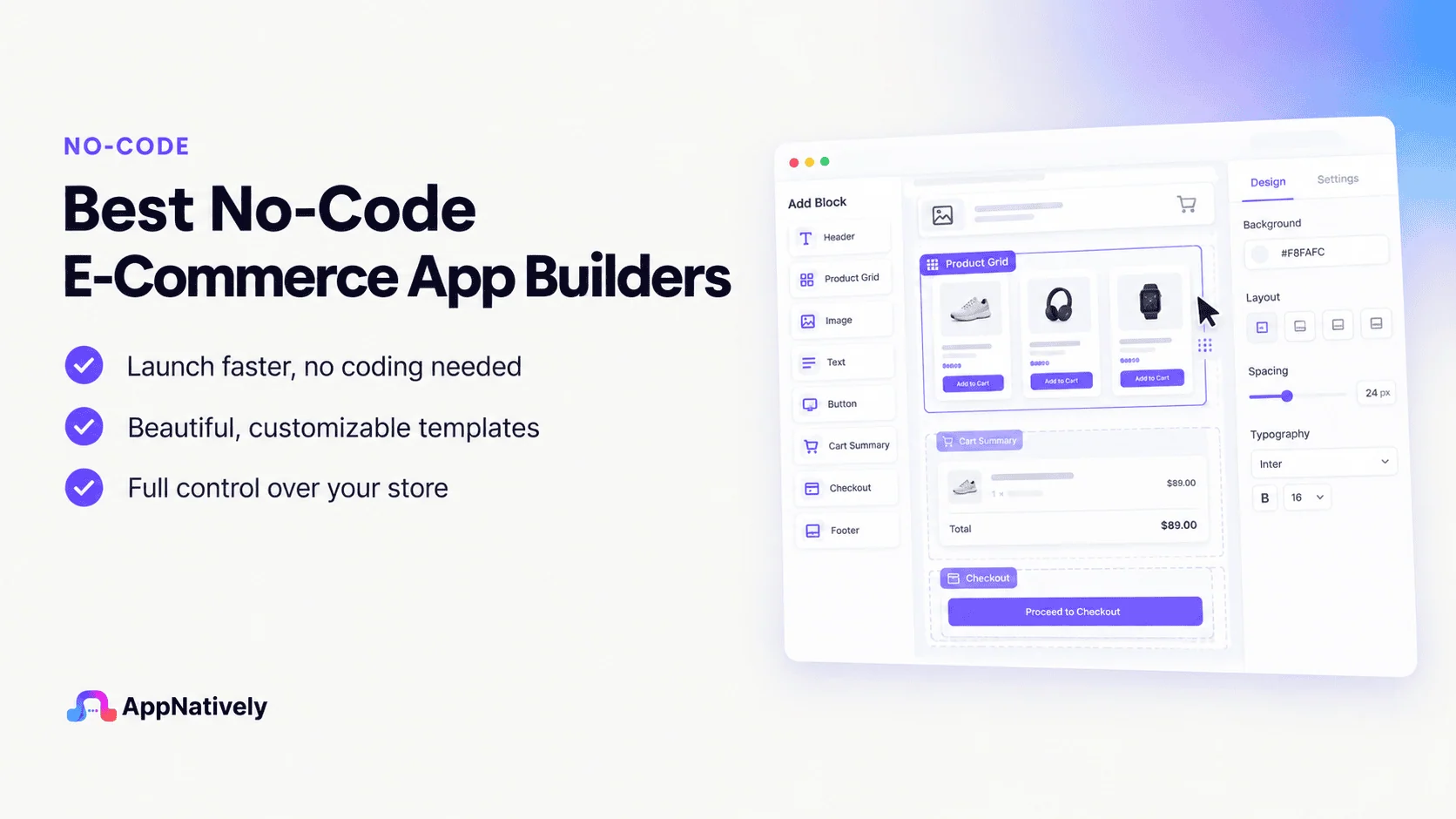
A no-code e-commerce app builder is a software platform that allows users to create and manage online shopping applications without writing any programming code.
It provides visual development tools, drag-and-drop interfaces, and prebuilt templates that make it easy for individuals and businesses to quickly design, customize, and launch e-commerce apps.
These platforms typically include essential e-commerce features such as product catalogs, shopping carts, payment gateway integration, inventory management, and order tracking.
By eliminating the need for coding skills, no-code e-commerce app builders help entrepreneurs and small businesses reduce development time and costs while making online selling more accessible.
Who Should Use No-Code E-commerce Builders?
No-code e-commerce builders are best for people who want to sell online without dealing with coding, servers, or complex technical setup.
They’re designed to make launching and running an online store fast and manageable.
Here’s who benefits most:
1. First-time entrepreneurs
If you’re starting your first online business, platforms like Shopify or WordPress let you launch quickly without hiring developers. You can focus on products and marketing instead of technical setup.
2. Small business owners
Local shops, home-based businesses, and small brands use no-code tools to expand online. It’s especially useful if you already sell offline and just want an online storefront without having to rebuild everything from scratch.
3. Creators and freelancers
Artists, designers, writers, and content creators can sell digital products, merchandise, or services directly. No-code tools handle payments, product pages, and delivery systems.
4. Dropshippers and print-on-demand sellers
These models rely on fast setup and easy scaling. No-code platforms integrate with suppliers, so you can launch products without holding inventory.
5. Non-technical teams and startups
Early-stage startups often use no-code builders to validate ideas quickly before investing in custom development.
Best No-Code E-commerce App Builders in 2026 & Beyond
No-code e-commerce app builders are transforming how brands launch mobile stores—faster, cheaper, and without technical barriers.
Whether you’re a startup, Shopify seller, or WordPress store owner, these tools help you turn ideas into revenue-generating apps in record time.
1. AppNatively Powered By AI
Best for: Shopify + WordPress store owners who want next-gen mobile commerce apps
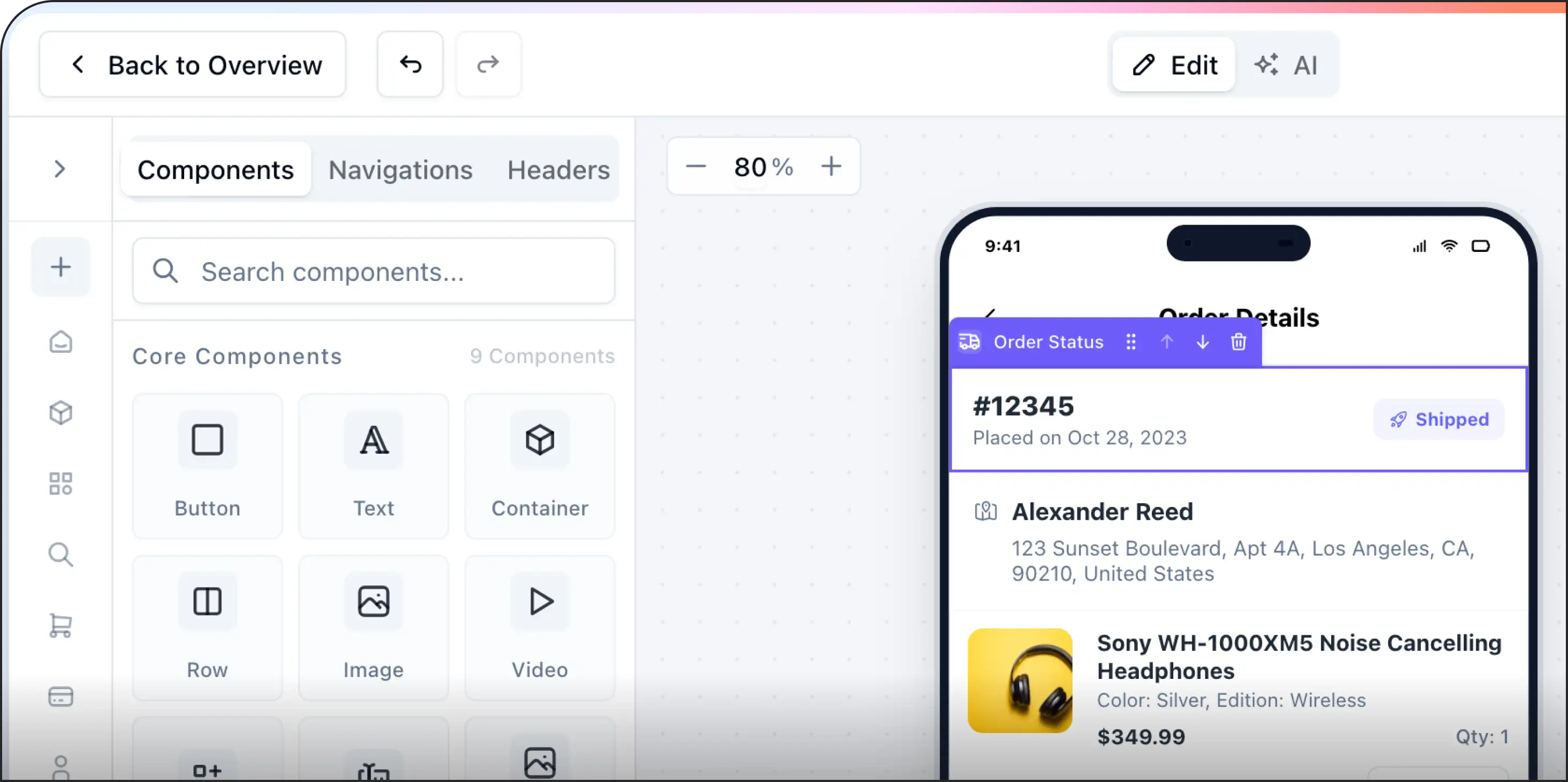
AppNatively is an upcoming powerhouse designed to bridge Shopify and WordPress ecosystems into fully native mobile apps. It focuses on making e-commerce app creation seamless, scalable, and conversion-driven.
Why it stands out:
- Built specifically for Shopify + WordPress integration
- Designed for high-conversion mobile shopping experiences
- No-code approach with future-ready flexibility
- Focus on speed, simplicity, and monetization
- Many more integrations like Firebase
- Unlimited push notification
Perfect for merchants who want a modern, app-first sales channel without technical complexity.
2. FlutterFlow
Best for: Highly customizable, production-level mobile apps
FlutterFlow gives creators the power of Flutter without coding. It’s ideal for teams that want deeper control while still staying in the no-code/low-code space.
Highlights:
- Drag-and-drop UI builder
- Firebase integration
- Exportable production code
- Strong for scalable e-commerce apps
Ideal when you want design freedom + developer-grade output without full coding.
3. Bubble
Best for: Web-based e-commerce marketplaces and SaaS-style stores
Bubble is one of the most powerful no-code platforms for building logic-heavy applications.
Highlights:
- Advanced workflow automation
- Fully customizable database
- Huge plugin ecosystem
- Strong for marketplaces and custom checkout flows
Best for entrepreneurs building complex, feature-rich e-commerce ecosystems.
Get the best bubble alternatives at affordable price
4. Glide
Best for: Simple, fast mobile apps from spreadsheets
Glide turns data into apps instantly—perfect for lightweight e-commerce setups.
Highlights:
- Spreadsheet-powered backend
- Extremely fast deployment
- Clean mobile-first design
- Great for MVP stores
Ideal for quick launches and small product catalogs.
5. Adalo
Best for: Beginner-friendly mobile e-commerce apps
Adalo makes app building feel effortless with its visual interface.
Highlights:
- Simple drag-and-drop builder
- Built-in database
- Native mobile publishing
- Payment integrations available
Perfect for first-time founders testing product ideas quickly.
6. Softr
Best for: Turning Airtable data into storefronts
Softr is great for building lightweight e-commerce sites and portals.
Highlights:
- Airtable-powered backend
- Membership + gated content support
- Clean UI templates
- Fast deployment
Best for data-driven e-commerce or membership-based stores.
7. Thunkable
Best for: Cross-platform mobile apps (Android + iOS)
Thunkable focuses on true mobile app development without coding.
Highlights:
- Native mobile app output
- Visual logic builder
- API integrations
- Real-time testing
Ideal for brands targeting both Android and iOS users equally.
8. AppMySite
Best for: Converting WordPress/WooCommerce stores into apps
AppMySite is built for store owners who already have a website and want an app fast.
Highlights:
- WordPress & WooCommerce integration
- One-click app conversion
- Push notifications
- Real-time sync with website
Perfect for turning existing stores into mobile apps quickly.
9. MobiLoud
Best for: High-performance apps for established websites
MobiLoud helps brands convert existing websites into premium mobile apps.
Highlights:
- Full website-to-app conversion
- Strong performance optimization
- Push notification support
- Minimal maintenance required
Best for established businesses scaling mobile sales.
10. Tapcart
Best for: Shopify-focused mobile commerce apps
Tapcart is one of the most popular Shopify app builders in the market.
Highlights:
- Deep Shopify integration
- High-converting mobile UX
- Built-in push marketing tools
- Designed for revenue growth
Ideal for serious Shopify brands focused on mobile sales optimization.
Quick Comparison Table
| Platform | Best For | Ease of Use | Customization | Shopify Support | WordPress Support | Scalability | Key Strength |
|---|---|---|---|---|---|---|---|
| AppNatively (Dev) | Shopify + WordPress mobile apps | 5/5 | 4/5 | 5/5 | 5/5 | 5/5 | Future-ready commerce-focused apps |
| FlutterFlow | Advanced custom mobile apps | 3/5 | 5/5 | 3/5 | 3/5 | 5/5 | High control + scalable apps |
| Bubble | Complex web apps & marketplaces | 2/5 | 5/5 | 4/5 | 4/5 | 5/5 | Powerful logic & workflows |
| Glide | Simple MVP apps | 5/5 | 2/5 | 2/5 | 3/5 | 3/5 | Fast spreadsheet-based apps |
| Adalo | Beginner mobile apps | 5/5 | 3/5 | 3/5 | 3/5 | 4/5 | Easy drag-and-drop builder |
| Softr | Airtable-based apps | 5/5 | 3/5 | 2/5 | 4/5 | 3/5 | Quick Airtable integration |
| Thunkable | Cross-platform apps | 4/5 | 4/5 | 3/5 | 3/5 | 4/5 | Android + iOS app support |
| AppMySite | WordPress/WooCommerce apps | 4/5 | 3/5 | 4/5 | 5/5 | 4/5 | Website-to-app conversion |
| MobiLoud | Website-to-app conversion | 4/5 | 3/5 | 4/5 | 5/5 | 5/5 | Premium performance apps |
| Tapcart | Shopify mobile commerce | 4/5 | 3/5 | 5/5 | 2/5 | 5/5 | High-conversion Shopify apps |
Key Trends Shaping No-Code E-commerce in 2026
No-code e-commerce in 2026 is moving from “startup shortcut” to a core operating model for modern commerce teams.
The biggest shifts are being driven by AI, composability, and the push for faster experimentation without engineering bottlenecks.
Here are the latest trends shaping the space right now:
1. AI is becoming the “co-builder” of stores
No-code platforms are no longer just drag-and-drop tools—they’re increasingly AI-assisted storefront generators.
Instead of manually building pages, merchants now:
- Describe a store or campaign in plain language
- Let AI generate layouts, product pages, and copy
- Continuously optimize based on conversion data
AI is also powering:
- Product descriptions and SEO content
- Automated merchandising and bundling
- Smart A/B testing and layout suggestions
This shifts no-code from manual building → AI-guided commerce creation.
Check the article: AI in eCommerce Apps
2. “Headless + no-code” is becoming the default stack
A major trend is the merging of no-code tools with headless commerce architectures.
This means:
- Frontends (storefronts) are built visually with no-code tools
- Backends (payments, inventory, CMS) stay modular and API-driven
Why it matters:
- Teams can redesign storefronts without touching backend systems
- Faster experimentation across channels (web, mobile, social)
- Less dependency on developer bottlenecks
3. Non-technical teams are running full commerce operations
In 2026, no-code is no longer just for “building pages”—it’s for running the entire commerce workflow.
Marketers and operators now:
- Launch landing pages and funnels
- Manage catalogs and pricing rules
- Trigger automated campaigns and workflows
This is reducing reliance on engineering teams for day-to-day commerce changes
4. Agentic commerce is reshaping storefront design
A major structural shift: customers are increasingly shopping through AI agents rather than browsing manually.
This means no-code platforms must support:
- Structured product data (for AI discovery)
- API-first catalogs
- Machine-readable pricing, inventory, and attributes
Instead of designing only for humans, stores must now be designed for:
humans + AI agents acting on their behalf
5. Hyper-personalization is now built-in, not optional
No-code platforms are integrating real-time personalization engines:
- Dynamic storefront layouts per user
- AI-driven product recommendations
- Adaptive pricing and content
This is becoming standard because shoppers now expect “Netflix-level” personalization everywhere
6. “Composable commerce” is replacing all-in-one builders
Instead of single platforms doing everything, no-code e-commerce is shifting toward composable stacks:
- Shopify / headless backend
- No-code frontend builder
- Plug-in AI tools for marketing, pricing, analytics
This reduces lock-in and lets brands swap tools quickly as they scale.
7. Faster experimentation is the main competitive advantage
The biggest strategic change isn’t technical—it’s cultural:
Winning brands now:
- Launch and test in days, not months
- Run continuous storefront experiments
- Treat e-commerce like a “live product,” not a static site
No-code is the infrastructure that enables this velocity.
8. AI-driven automation of operations (not just design)
Beyond storefronts, no-code platforms are expanding into:
- Inventory forecasting
- Dynamic pricing rules
- Automated returns handling
- Customer support workflows
This is turning no-code tools into end-to-end commerce operating systems, not just website builders.
Final Verdict
No-code e-commerce builders have matured into full-scale commerce platforms, not just website creators. The best ones now combine ease of use, AI automation, and scalable infrastructure, allowing businesses to launch and grow without relying heavily on developers.
What stands out across the top platforms is a clear shift toward AI-assisted building, integrated marketing tools, and flexible (often headless) architectures. This means users can design storefronts visually while still supporting advanced customization, automation, and multi-channel selling.