The Mobile-First Reality: 85% of Consumers Prefer Apps Over Mobile Websites

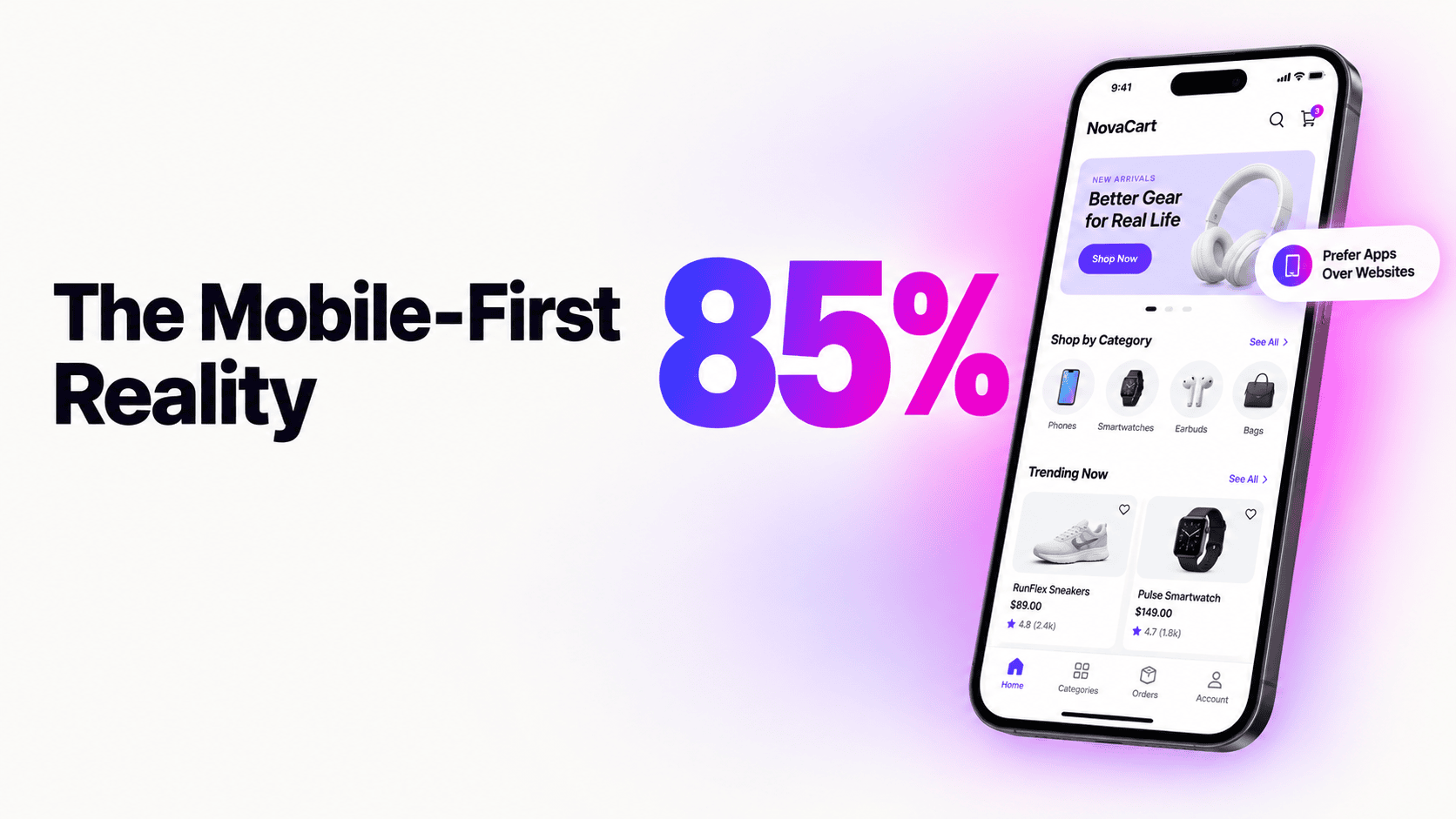
Mobile has taken over and apps are leading the charge.
Today, 85% of consumers prefer mobile apps over websites, choosing faster load times, smoother navigation, and more reliable performance over clunky browser experiences.
Apps deliver what users actually want: instant access, personalized content, offline functionality, and a frictionless journey that keeps them coming back.
The result? Higher engagement, stronger loyalty, and more conversions.
If your business is still betting on mobile web alone, it’s time to rethink your strategy. Build app-first because that’s where your customers already are.
In this article, we break down the mobile-first reality transforming digital experiences, where apps, not websites, dominate consumer preference.
Let’s dig deeper.
The Rise of a Mobile-First World
Mobile has become the default screen
Smartphones are no longer just a convenience. They are now the primary gateway to the internet for billions of users. More than half of global web traffic comes from mobile devices, and for many people, their phone is the first and often only screen they use to browse, shop, and interact with brands.
Desktop usage continues to decline as everyday digital tasks move to handheld devices.
Consumer expectations have accelerated
With constant connectivity comes higher expectations. Users want pages to load instantly, navigation to feel effortless, and transactions to be completed in seconds.
Studies show that even a one second delay in load time can significantly increase bounce rates, meaning slow or clunky experiences quickly cost businesses potential customers. Convenience has become the baseline rather than a bonus.
Behavior is shifting toward apps
As mobile usage grows, preferences are clearly leaning toward apps. Around 85 percent of consumers say they prefer mobile apps over mobile websites because apps feel faster, smoother, and more reliable. Features like personalization, saved preferences, and offline access make apps easier for repeat use and daily interactions.
Why businesses must adapt
For businesses, this shift changes the rules entirely. Mobile can no longer be treated as an afterthought or a scaled-down version of desktop.
Brands that prioritize mobile first and increasingly app first experiences are better positioned to capture attention, strengthen loyalty, and stay competitive in a market where speed and simplicity define success.
Why Consumer Behavior Now Favors Apps Over Browsers
Faster and smoother user experiences
Apps are built to run directly on a device’s operating system, which allows them to load faster and operate more smoothly than most mobile websites. They can cache data, pre-load content, and reduce server round trips.
As a result, interactions feel instant and fluid. Since modern consumers have very little tolerance for delays, even small improvements in speed make apps more appealing than browser-based experiences.
Deeper personalization and smarter recommendations
Apps collect behavioral data over time, allowing them to understand user preferences in detail. This enables personalized home screens, curated recommendations, and adaptive content feeds.
While browsers can store cookies and session data, they do not typically offer the same level of persistent personalization across interactions. Consumers increasingly expect experiences that feel tailored, and apps are better positioned to deliver that.
Stronger engagement through push notifications
Push notifications play a major role in why consumers favor apps. Apps can send real-time alerts about updates, messages, offers, and reminders directly to a user’s device. These notifications appear prominently and encourage immediate action.
Although browsers can send notifications, they are more limited and less impactful. Apps maintain continuous engagement even when they are not actively open.
Offline access and reliability
Many apps allow users to access saved content and essential features without an active internet connection. This makes them more reliable in areas with weak connectivity.
Browsers typically depend on consistent internet access, which can create friction. The ability to function offline increases trust and convenience, especially for media consumption, productivity tools, and travel services.
Seamless integration with device features
Apps integrate deeply with smartphone capabilities such as camera, GPS, biometric authentication, and background processing. This allows richer functionality, including navigation services, secure payments, health tracking, and real-time messaging.
Browsers have limited access to hardware features and cannot match the same level of system integration.
Habit formation and ecosystem loyalty
Once consumers download an app and invest time in setting preferences, saving information, and building usage history, they are more likely to return.
Opening an app becomes a habitual action that requires less effort than searching through a browser. Over time, users develop loyalty to app ecosystems, reinforcing repeat engagement.
Monetization and exclusive incentives
Apps often provide exclusive discounts, loyalty rewards, subscription perks, and in-app purchase options. These incentives encourage users to install and continue using the app rather than accessing services through a browser.
Businesses also design app experiences to streamline conversions, making transactions faster and simpler.
Evolving consumer expectations
Today’s consumers expect speed, personalization, convenience, and seamless digital experiences. Apps align closely with these expectations by offering integrated, responsive, and engaging environments.
As mobile usage continues to dominate digital interactions, consumer behavior naturally gravitates toward platforms that minimize friction and maximize convenience, which is why apps increasingly outperform browsers in many industries.
The Built-In Advantages That Make Apps Faster and Smoother
Apps perform better when they fully leverage the device’s hardware and operating system.
Native features, optimized libraries, and smart resource management all contribute to a faster, more responsive experience.
Optimized operating system integration
Apps built with platform-specific tools can directly use system resources such as memory, CPU, and GPU.
This tight integration allows apps to run smoothly and reduces the chance of lag during heavy operations.
By taking full advantage of OS-level features like background processing and system optimizations, apps can provide faster load times and better responsiveness.
Users experience fewer crashes and smoother navigation because the app works harmoniously with the device.
Hardware acceleration
Built-in APIs allow apps to offload graphics, animations, and video rendering to the GPU.
This reduces the strain on the CPU and ensures that visual transitions remain smooth.
Animations, scrolling, and touch interactions feel more fluid because the device’s hardware is fully utilized.
Hardware acceleration also improves battery efficiency by handling intensive tasks more intelligently.
Pre-loaded libraries and frameworks
Modern platforms come with optimized libraries for common tasks like networking, image handling, and data storage.
Using these pre-built tools reduces the need for custom code, making apps lighter and faster.
These libraries are tested and optimized for performance, helping developers avoid inefficiencies.
As a result, apps can perform complex operations without slowing down or consuming excessive resources.
Caching and memory management
Apps can store frequently accessed data locally or in memory to allow instant retrieval.
This minimizes waiting time and keeps the interface responsive even under heavy use.
Smart memory management prevents the app from consuming too much RAM, which reduces crashes.
Efficient caching also allows repeated tasks or views to load instantly, improving the user experience.
Asynchronous processing
Background tasks such as fetching data or updating content can run without interrupting the interface.
Users can continue interacting with the app while these processes happen silently.
This approach prevents freezing or lag during heavy operations and keeps the app responsive.
It also allows apps to update content in real-time without disrupting the user’s flow.
Touch and gesture optimization
Native frameworks handle gestures like scrolling, swiping, and pinch-to-zoom more efficiently.
This makes interactions feel natural and reduces input lag.
By using optimized touch handling, apps respond quickly to user actions.
Animations and transitions feel fluid, creating a smoother and more enjoyable experience.
Smarter updates and resource management
Apps load only the resources they need and can manage memory and battery usage efficiently.
This prevents slowdowns and keeps the app running optimally over time.
Automatic optimization during updates ensures that performance improvements reach users seamlessly.
Overall, this makes the app faster, smoother, and more reliable on all devices.
How Apps Drive Higher Engagement, Loyalty, and Conversions
1. Driving higher engagement
Apps excel at keeping users active because they are always accessible, personal, and interactive. Key mechanisms include:
- Push Notifications & Alerts
Timely, personalized messages remind users to return. Example: a fitness app sending a daily workout reminder. - Personalized Experiences
Apps track user behavior and preferences to deliver relevant content, offers, or recommendations. Example: Spotify curating playlists based on listening habits. - Gamification
Features like points, badges, and challenges increase user interaction. Example: Duolingo motivating daily practice with streaks. - Frictionless Access
Apps open faster than mobile websites, and offline functionality allows users to engage anywhere.
2. Building loyalty
Loyalty comes from consistent value and emotional connection:
- Rewards and Loyalty Programs
Apps integrate point systems, discounts, or exclusive access. Example: Starbucks Rewards app. - Personal Connection
Tailored content, reminders, and personalized messaging create a sense of recognition. - Regular Updates & Value
Apps that continuously add features or content keep users invested. - Community Features
Social interaction or user communities within apps increase attachment. Example: Strava or Reddit communities.
3. Increasing conversions
Apps convert engagement into tangible business results more effectively than websites:
- Simplified Purchase Flows
Stored payment info, one-tap checkout, and cart reminders reduce friction. - Targeted Offers
Data-driven recommendations increase the likelihood of purchase. Example: Amazon suggesting products based on browsing history. - Behavioral Triggers
Push notifications for abandoned carts or personalized promotions prompt conversions. - Exclusive App-Only Benefits
Special discounts or early access incentivize users to act via the app.
Deciding Between Mobile Web, Native Apps, and Hybrid Solutions
A strategic mobile decision requires more than understanding definitions. You need to compare performance, cost, scalability, user experience, and long-term business impact side by side. Below is a clear, practical comparison designed to help you choose with confidence.
1. Mobile web
Mobile web applications run inside a browser and are accessed through a URL. They are built with standard web technologies and adapt responsively across devices.
Mobile web offers maximum accessibility. Users do not need to install anything, which reduces friction in the acquisition stage. Updates are instant, SEO is fully supported, and development costs are typically lower because you maintain a single codebase.
However, performance depends on browser capabilities. Access to advanced device hardware is limited, offline functionality is restricted compared to apps, and user retention tools like push notifications are not as powerful as in native apps.
Mobile web works best for content platforms, SaaS dashboards, blogs, ecommerce stores focused on traffic acquisition, and businesses prioritizing discoverability.
2. Native apps
Native applications are built specifically for iOS or Android using platform-specific programming languages.
They provide the highest performance because they interact directly with the operating system. Animations are smoother, load times are faster, and access to hardware features like GPS, camera, sensors, and background processing is seamless. Native apps also support powerful engagement tools such as push notifications and deep system integrations.
The trade-off is cost and complexity. Separate development cycles are often required for each platform, maintenance demands more resources, and app store approvals can slow deployment.
Native is ideal for fintech, ride-sharing, social media, gaming, health tracking, and any product where speed, security, and performance define user experience.
3. Hybrid solutions
Hybrid apps use a shared codebase that runs across multiple platforms. Frameworks like React Native and Flutter bridge web technologies with native components.
They strike a balance between cost and capability. Development is faster than fully native builds, and much of the code can be reused across iOS and Android. Modern hybrid frameworks offer near-native performance for most business use cases.
While performance has improved significantly, hybrid apps may still face limitations in highly complex graphics processing or advanced hardware interactions. Custom native modules are sometimes required.
Hybrid is well suited for startups, MVP launches, ecommerce brands expanding to app stores, and businesses seeking efficiency without sacrificing app presence.
Side-By-Side Comparison
Development cost
Mobile web is generally the most affordable because one codebase serves all users.
Hybrid sits in the middle, offering shared code across platforms.
Native is the most expensive due to separate development paths.
Performance
Native delivers the highest performance and smoothest user experience.
Hybrid performs very well for most business applications.
Mobile web depends on browser optimization and network speed.
User acquisition
Mobile web has the strongest SEO advantage and instant access via links.
Hybrid and native rely on app store discovery and downloads.
Access to device features
Native provides full hardware integration.
Hybrid offers broad access but may need plugins for advanced features.
Mobile web has limited device capability access.
Maintenance
Mobile web and hybrid simplify maintenance with shared codebases.
Native requires separate updates for each platform.
Key Steps to Building a Successful App-First Experience
An app-first experience is not simply about launching a mobile application. It means designing your product, workflows, and growth strategy around mobile behavior from the very beginning. In a world where users expect speed, personalization, and seamless interaction, building app-first requires clarity, discipline, and long-term thinking.
Below are the essential steps to building a high-performing app-first ecosystem.
Start with mobile-native user behavior
An app-first strategy begins with understanding how users behave inside apps compared to browsers. App users expect instant load times, intuitive gestures, offline access, and minimal friction. They are less patient and more action-oriented.
Design journeys around thumb-friendly navigation, simplified flows, and contextual interactions. Remove unnecessary steps. Every tap should move users closer to value. When your product mirrors natural mobile behavior, engagement rises significantly.
Define a clear core value proposition
Successful apps focus on one primary promise. Whether it is convenience, speed, savings, or community, the core benefit must be immediately clear upon first launch.
Avoid overloading your initial version with too many features. Instead, prioritize one powerful use case and perfect it. A focused app delivers clarity, while a cluttered one creates confusion and drop-offs.
Strong app-first products solve one main problem exceptionally well before expanding.
Prioritize performance and speed
Performance defines perception. Even minor delays can increase churn. App-first platforms must optimize load times, animation smoothness, and backend response speed.
Use lightweight assets, reduce unnecessary background processes, and ensure stable API performance. Offline support, where possible, adds a significant advantage because users do not always operate on perfect networks.
In mobile environments, speed equals trust.
Design for retention, not just downloads
Downloads are vanity metrics. Retention drives revenue.
Integrate onboarding that demonstrates value within the first session. Use push notifications thoughtfully to re-engage users without overwhelming them. Personalization based on behavior makes interactions more relevant and meaningful.
Loyal users form habits when your app consistently solves their problem with minimal friction.
Build seamless cross-channel integration
Even in an app-first strategy, your ecosystem should remain connected. Users may discover you via web, social media, email, or ads before installing the app.
Ensure smooth transitions between web and app environments. Deep linking, universal links, and consistent branding across channels reduce friction and increase conversions. The experience should feel unified rather than fragmented.
An app-first model works best when every touchpoint supports the mobile journey.
Focus on scalable architecture
Long-term success depends on scalability. Choose technologies that support growth in user base, feature expansion, and data processing needs.
Plan backend infrastructure carefully. Ensure your system can handle increased traffic without performance degradation. Modular development allows you to expand features without rebuilding the entire app.
App-first success is not about launch day. It is about sustained growth.
Measure, iterate, and optimize continuously
An app-first approach requires data-driven refinement. Track session duration, retention rate, churn rate, feature usage, and conversion metrics.
Use analytics to identify friction points. A small UX improvement can dramatically impact engagement. Regular updates signal reliability and keep the experience fresh.
Iteration is not optional. It is the foundation of mobile success.
Final Thoughts: The Mobile-First Reality
The fact that 85% of consumers prefer apps over mobile websites highlights the undeniable shift toward a mobile-first reality. Users increasingly value speed, convenience, and personalized experiences, qualities that apps deliver far more effectively than traditional mobile sites.
This trend signals that businesses cannot rely solely on mobile websites to engage customers; a well-designed app has become a critical channel for interaction, retention, and satisfaction.
To remain competitive in this landscape, companies must embrace an app-centric strategy that prioritizes user experience, seamless functionality, and consistent updates.