

Latest Trends in eCommerce App Development

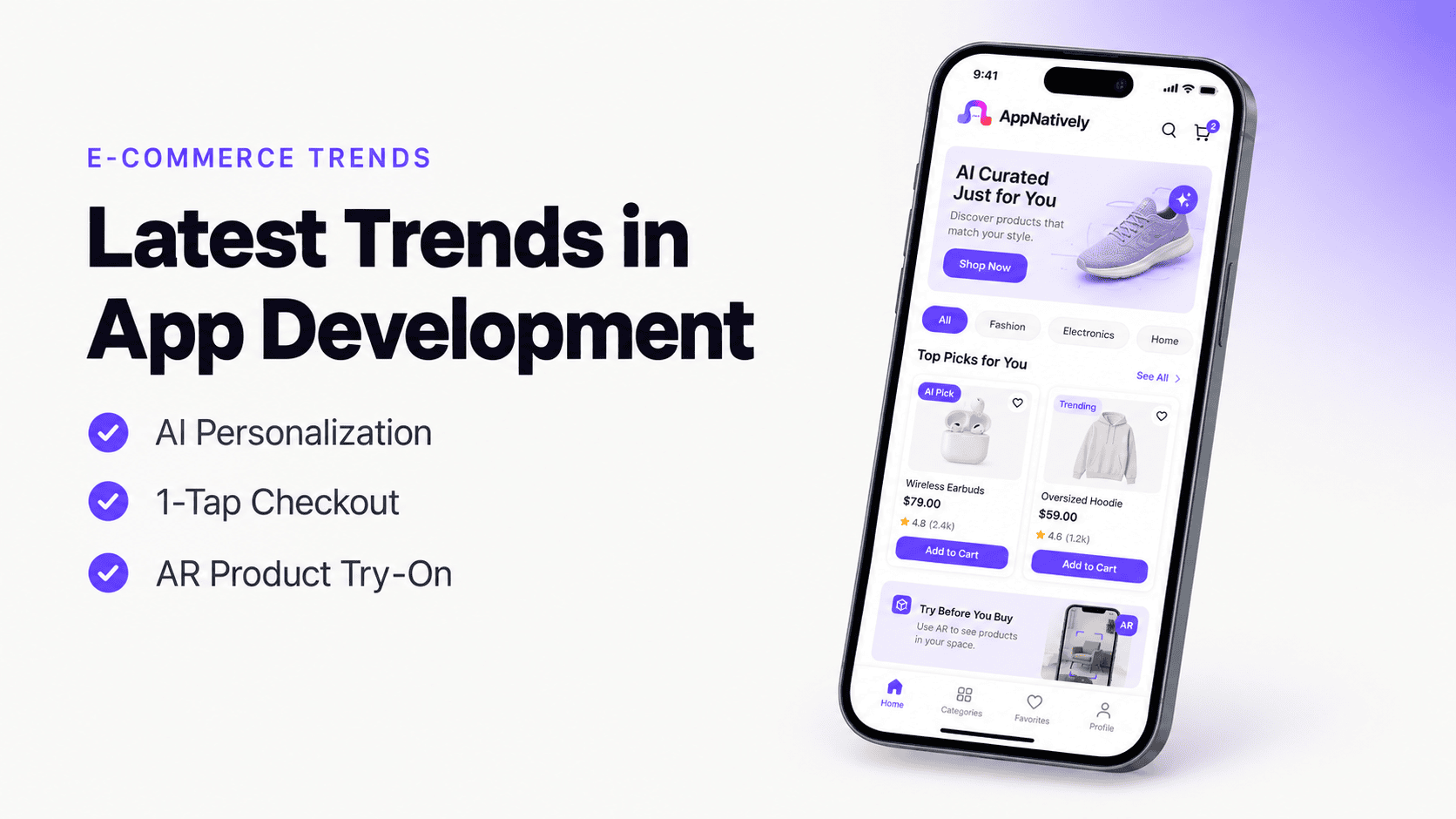
The latest trends in eCommerce app development focus on AI-driven personalization, mobile-first design, augmented reality (AR), voice commerce, and headless architecture.
These innovations help businesses deliver faster, smarter, and more engaging shopping experiences, increasing conversions and customer retention.
As online shopping continues to evolve, modern eCommerce apps must go beyond basic functionality.
Today’s successful apps leverage automation, real-time data, and immersive technologies to meet rising user expectations and stay competitive in a rapidly changing digital landscape.
Latest Trends in eCommerce App Development
eCommerce app development is rapidly evolving as businesses shift toward smarter, faster, and more personalized digital shopping experiences.
Below are the latest trends shaping how modern eCommerce apps are built and used in 2026 and beyond.
1. AI-driven personalization
AI is now the core engine behind modern eCommerce apps. It helps apps understand user behavior and personalize the entire shopping experience.
For example, Amazon uses AI to recommend products based on browsing and purchase history.
Shopify apps also use AI tools like product recommendation engines to increase conversions by showing relevant items automatically.
Some newer apps go further by acting like shopping assistants. A user can say, “I need running shoes for flat feet,” and the app filters and suggests the best matches instantly.
Build your Shopify app instantly with drag & drop [Join AppNatively Waitlist]
2. Headless and composable commerce
Headless commerce separates the frontend from the backend, allowing more flexibility and speed in development.
For example, Nike uses a composable architecture to deliver consistent experiences across its mobile app, website, and in-store systems. This allows them to update the UI without touching backend logic.
Brands using platforms like BigCommerce or commercetools benefit from this flexibility when scaling globally.
3. Mobile first experience
Most eCommerce traffic now comes from mobile devices, so apps are designed for speed and simplicity.
For example, Alibaba’s mobile app is optimized for fast browsing with minimal clicks to purchase.
Similarly, Zara’s app focuses on clean design and fast product discovery to reduce friction.
Progressive Web Apps are also used by brands like Starbucks to deliver app-like experiences without requiring downloads.
4. Frictionless checkout
Modern apps focus heavily on reducing checkout steps.
For example, Apple Pay and Google Pay allow one-tap payments in apps like Shopify-powered stores.
Amazon’s “Buy Now” button is one of the most famous examples of frictionless checkout, allowing users to purchase instantly without going through cart pages.
5. Social commerce integration
Shopping is increasingly happening inside social platforms.
For example, TikTok Shop allows users to buy products directly from videos. Instagram Shopping lets brands tag products in posts so users can purchase without leaving the app.
Many fashion brands now generate significant sales directly from influencer-driven content.
6. Augmented reality shopping
AR helps users visualize products before buying.
For example, IKEA Place lets users see how furniture will look in their room using AR. Sephora’s app allows customers to try makeup virtually before purchasing.
This reduces uncertainty and improves buyer confidence.
7. Omnichannel integration
Customers expect seamless shopping across all platforms.
For example, Walmart allows users to buy online and pick up in-store with real-time inventory syncing.
Nike also syncs customer profiles across app, web, and physical stores for a unified experience.
8. No code and AI-assisted development
App development is becoming faster and more accessible.
For example, tools like FlutterFlow and Webflow allow startups to build eCommerce apps without heavy coding.
AI coding assistants like GitHub Copilot help developers generate UI and backend logic faster.
This significantly reduces time to launch.
9. Voice-based shopping
Voice commerce is growing as smart assistants improve.
For example, users can reorder products using Alexa by saying “reorder my shampoo.” Google Assistant also supports product searches and shopping lists through voice commands.
10. Predictive analytics
Apps now use data to predict what customers will want next.
For example, Amazon and Flipkart use recommendation systems that suggest products before users even search for them.
This improves retention and increases repeat purchases.
AI in eCommerce Apps: How Personalization Drives Sales
eCommerce apps are becoming more competitive, and personalization is now the key factor that separates average stores from high-converting brands.
Artificial intelligence plays a central role in understanding users and turning browsing behavior into sales.
AI-powered product recommendations
AI analyzes user behavior such as clicks, search history, and purchases to suggest relevant products.
For example, Amazon’s recommendation system shows “Frequently bought together” and “Recommended for you” sections that significantly increase average order value.
Netflix-style recommendation engines are now widely used in eCommerce apps to keep users engaged and buying.
Personalized search results
Instead of showing the same results for everyone, AI customizes search outcomes based on user intent.
For example, if one user frequently buys premium products, a search for “headphones” will prioritize high-end brands.
Another user looking for budget options will see affordable listings first. Shopify-based stores use AI search tools like Algolia to achieve this level of personalization.
AI shopping assistants
Modern eCommerce apps now include chat-based shopping assistants that guide users through the buying process.
For example, Sephora’s chatbot helps customers choose skincare products based on skin type and preferences.
Some AI assistants can even complete the purchase process by adding items to the cart and suggesting bundles.
Dynamic pricing and offers
AI helps adjust prices and discounts based on demand, competition, and user behavior.
For example, airline apps and Uber already use dynamic pricing models.
In eCommerce, similar systems are used to offer personalized discounts to users who are likely to abandon their cart, increasing conversion rates.
Predictive customer behavior
AI can predict what a user is likely to buy next based on patterns.
For example, if a customer regularly buys skincare products every 30 days, the app can send reminders or auto-suggest a refill. Amazon uses this type of predictive modeling to increase repeat purchases.
Personalized email and push notifications
AI improves retention by sending targeted messages instead of generic promotions.
For example, instead of sending a “10 percent discount for everyone,” the app might send a personalized message like “Your favorite sneakers are back in stock.”
This type of communication significantly improves click-through and conversion rates.
Visual and voice personalization
AI is also enhancing how users interact with apps visually and through voice.
For example, Pinterest uses visual AI to recommend similar products based on images.
Voice assistants like Alexa allow users to reorder products using natural speech commands, making shopping faster and more intuitive.
Must-Have eCommerce App Features in 2026
Below are the must-have features every modern eCommerce app needs to stay competitive.
i. Smart and predictive search
Search is no longer keyword-based. AI understands intent and predicts what users want.
For example, when a user types “running shoes,” the app may prioritize brands based on budget, previous purchases, or location-based trends.
Platforms like Algolia and ElasticSearch power this intelligent search experience in many modern apps.
ii. One tap checkout and digital wallets
A slow checkout process is one of the biggest reasons for cart abandonment, so frictionless payment is essential.
For example, Apple Pay, Google Pay, and PayPal Express Checkout allow users to complete purchases with one tap. Amazon’s “Buy Now” feature is another benchmark for instant purchasing.
iii. Personalized user dashboard
Every user should see a customized home screen.
For example, fashion apps like Zalando show different product feeds based on user style preferences, browsing history, and past purchases. This makes the shopping experience feel unique for every customer.
iii. Social commerce integration
Shopping is heavily influenced by social content.
For example, TikTok Shop and Instagram Shopping allow users to buy products directly from videos and posts. Many brands now generate large revenue through influencer-driven storefronts and shoppable content.
iv. AI shopping assistant or chatbot
AI assistants help users discover products, compare options, and complete purchases.
For example, Sephora’s chatbot recommends skincare products based on user preferences.
Some advanced systems act like virtual shopping agents that guide users from discovery to checkout.
v. Order tracking and real-time notifications
Users expect complete visibility after purchase.
For example, apps like Amazon and Flipkart provide real-time tracking with delivery updates, estimated arrival times, and push notifications for each stage of the order journey.
vi. Augmented reality product preview
AR allows users to visualize products before buying.
For example, IKEA Place lets users see how furniture fits in their space, while beauty apps like Sephora Virtual Artist let users try makeup digitally. This reduces uncertainty and returns.
vii. Wishlist and smart cart
A modern wishlist is more than saving items.
For example, Zara and Nike apps notify users when wishlisted products go on discount or come back in stock.
Smart carts can also suggest bundles or complementary products before checkout.
viii. Secure authentication and trust features
Security is a core feature in modern apps.
For example, biometric login using fingerprint or face ID is now standard. Apps also use fraud detection systems and secure payment gateways to protect transactions.
ix. Analytics and seller dashboard
For marketplace apps, seller tools are essential.
For example, Amazon Seller Central provides insights on sales, inventory, and customer behavior.
This helps sellers optimize listings and improve performance.
x. Multi-language and multi-currency support
Global eCommerce requires localization.
For example, Shopify stores automatically adapt currency, language, and tax settings based on user location, helping brands scale internationally.
Mobile Commerce Trends: Why Mobile-First Apps Win
Mobile commerce now accounts for the majority of global eCommerce traffic, and mobile apps consistently outperform desktop in key performance metrics.
Apps typically show higher conversion rates due to faster navigation, simplified user flows, and optimized checkout experiences.
One tap payment systems like Apple Pay and Google Pay significantly reduce checkout time and improve purchase completion rates.
Mobile apps also generate higher user retention because of push notifications, saved preferences, and personalized feeds.
Compared to websites, apps tend to produce higher average order values driven by recommendation engines and in app upselling.
Cart abandonment is generally lower in apps because checkout processes are shorter and more streamlined.
Overall, mobile-first commerce leads in traffic share, engagement, conversion efficiency, and customer lifetime value compared to desktop and mobile web channels.
How AR is Transforming eCommerce Apps (With Examples)
Augmented Reality is changing eCommerce apps by reducing uncertainty in online shopping and making product experiences feel closer to real life.
Instead of just viewing images, customers can now interact with products in their own environment before buying.
1. Virtual try before you buy
AR allows users to try products digitally before making a purchase, which reduces hesitation and returns.
For example, Sephora uses AR in its app to let customers try makeup shades on their face in real time.
Similarly, L’Oreal’s AR tools help users test lipstick and foundation colors instantly, improving purchase confidence.
2. Furniture placement in real spaces
One of the most popular uses of AR in eCommerce is interior visualization.
For example, IKEA Place lets users place virtual furniture in their homes using their smartphone camera. Customers can see how a sofa or table fits in terms of size, color, and style before buying.
This reduces one of the biggest problems in furniture shopping, which is the mismatch between expectation and reality.
3. Fashion and virtual fitting rooms
AR is also reshaping fashion shopping by allowing virtual try-ons.
For example, Zara and Nike apps use AR to help users visualize clothing and shoes on their body or feet.
Some advanced systems even simulate movement and fit to improve accuracy.
This helps reduce return rates, which is a major issue in online fashion retail.
4. Beauty and skincare visualization
Beauty brands are using AR to personalize product selection.
For example, Sephora Virtual Artist allows users to test different makeup looks, while Maybelline’s AR filters let customers see how products look under different lighting conditions.
This makes online beauty shopping more interactive and decision-friendly.
5. Interactive product demonstrations
AR is not just for try-ons; it is also used to explain product features.
For example, car brands like BMW use AR in apps to show internal car features, engine details, and customization options.
Users can explore the product in 3D instead of reading static descriptions.
6. Increased conversion rates
AR directly impacts sales performance by reducing uncertainty.
For example, Shopify reports that AR-enabled products can significantly increase conversion rates because customers feel more confident about what they are buying.
Brands using AR also see higher engagement time inside apps.
7. Lower return rates
One of the biggest benefits of AR in eCommerce is fewer returns.
For example, furniture and fashion brands using AR tools report fewer size and expectation mismatches because customers can visualize products before purchase.
This reduces operational costs for businesses.
8. More immersive shopping experience
AR turns shopping into an interactive experience rather than a passive one.
For example, Snapchat and Instagram AR filters allow users to explore branded products in a fun and engaging way, which increases brand awareness and purchase intent.
How Much Does It Cost to Build an eCommerce App?
The cost to build an eCommerce app in 2026 and beyond varies widely depending on features, complexity, and technology choices.
Most projects fall into different tiers based on business size and functionality.
Simple MVP or basic app
A basic eCommerce app with standard features like product listing, cart, user login, and payment integration usually costs between 10,000 and 40,000 US dollars.
For example, a small startup app built with a template-based UI and limited features often stays in this range.
Medium complexity app
A more advanced app with personalization, push notifications, analytics, multiple payment options, and better UI/UX typically costs between 40,000 and 150,000 US dollars.
For example, Shopify-based custom apps or mid-level D2C brand apps fall into this category.
Advanced or enterprise-level app
Large-scale apps with AI recommendations, AR features, multi-vendor marketplace, real-time tracking, and headless architecture usually cost between 150,000 and 300,000 plus US dollars.
For example, platforms similar to Amazon or Alibaba require large backend systems, multiple integrations, and ongoing infrastructure costs.
Key factors that affect cost
The final cost depends on several important factors:
- Number and complexity of features
- UI and UX design quality
- Native app vs. cross-platform development
- Backend infrastructure and scalability needs
- AI, AR, or advanced integrations
- Development team location and experience
For instance, adding AI product recommendations or AR try-on features can significantly increase both development time and budget.
Ongoing costs
Beyond development, there are continuous expenses:
- Maintenance and updates
- Server and hosting costs
- API and third-party service fees
- Security and compliance updates
Typically, businesses spend around 15 to 20 percent of the original development cost every year on maintenance.
Launch fully native apps in minutes without high development costs. Get early access to AppNatively.
Best Tech Stack for eCommerce App Development in 2026
The best tech stack for eCommerce apps in 2026 is focused on speed, scalability, AI integration, and seamless user experience.
Most successful apps now use a composable or headless architecture instead of monolithic systems.
1. Frontend (Mobile and Web UI)
Modern eCommerce apps prioritize fast, responsive, and app-like experiences.
Popular choices
- React Native (mobile apps)
- Flutter (cross-platform apps)
- Next.js (web frontend with SEO support)
Why it is used
- Single codebase for multiple platforms
- High-performance UI
- Better user experience and faster development
For example, many Shopify storefront apps and D2C brands use React Native for mobile apps and Next.js for web storefronts because of its SEO and speed benefits.
2. Backend (Core business logic)
The backend handles products, users, orders, payments, and APIs.
Popular choices
- Node.js with Express or NestJS
- Python with Django or FastAPI
- Java Spring Boot for enterprise-scale systems
Why it is used
- Node.js is widely used for real-time features like live tracking and notifications
- Python is preferred for AI-driven eCommerce features like recommendations
- Java is used in large enterprise marketplaces for stability
For example, Amazon-style systems rely heavily on distributed backend services for handling millions of transactions.
3. Database (Data storage layer)
Popular choices
- PostgreSQL (structured relational data)
- MongoDB (flexible product catalogs)
- Redis (caching and performance optimization)
- Firebase (real time apps and MVPs)
Why it is used
- PostgreSQL ensures strong consistency for orders and payments
- MongoDB handles dynamic product catalogs efficiently
- Redis improves speed for cart and session data
For example, Shopify apps often combine PostgreSQL with Redis for fast checkout performance.
4. Frontend architecture (Modern rendering approach)
Popular choices
- Next.js (SSR and SEO optimized React framework)
- Nuxt.js (Vue-based alternative)
- Jamstack architecture for static plus dynamic rendering
Why it is used
- Faster page loading
- Better SEO for product pages
- Improved conversion rates
For example, many high-traffic e-commerce stores use Next.js to improve Google rankings and reduce page load time.
5. Payment and checkout systems
Popular choices
- Stripe
- PayPal
- Apple Pay and Google Pay
- Razorpay (popular in Asian markets)
Why it is used
- One tap checkout increases conversion rates
- Secure and PCI-compliant payment processing
- Supports global transactions
For example, Amazon-style checkout flows inspired the “Buy Now” one-click experience used widely today.
6. Cloud and hosting infrastructure
Popular choices
- AWS (most scalable)
- Google Cloud Platform
- Microsoft Azure
- Vercel (for frontend hosting)
- Docker and Kubernetes for containerization
Why it is used
- Auto scaling for traffic spikes
- High availability for global users
- Easy deployment pipelines
For example, large marketplaces use AWS microservices architecture to handle global traffic loads.
7. AI and personalization layer
This is now a must-have in 2026 eCommerce apps.
Popular tools
- OpenAI APIs for recommendation engines and chat assistants
- TensorFlow or PyTorch for custom ML models
- Vector databases like Pinecone for product search
Use cases
- Personalized product recommendations
- AI shopping assistants
- Predictive search and dynamic pricing
For example, Amazon-style recommendation systems and Sephora-style AI assistants significantly increase conversions.
8. Real-time and engagement tools
Popular choices
- WebSockets (real-time updates)
- Firebase Cloud Messaging
- Pusher or Socket.io
Use cases
- Live order tracking
- Push notifications
- Cart abandonment reminders
Recommended modern stack (2026 standard)
A widely used high-performance stack looks like this:
- Frontend: Next.js or React Native
- Backend: Node.js (NestJS) or Python (FastAPI)
- Database: PostgreSQL + Redis
- Hosting: AWS or Vercel
- Payments: Stripe or Apple Pay
- AI layer: OpenAI APIs + vector database
PWA vs Native Apps: Which is Better for eCommerce?
Progressive Web Apps and Native apps both work well for eCommerce, but they solve slightly different problems.
The right choice depends on your budget, growth stage, and how advanced your shopping experience needs to be.
What is a PWA in eCommerce?
A Progressive Web App is a website that behaves like an app. It runs in the browser but can be installed on a device, work offline, and send push notifications.
For example, Starbucks uses a PWA to let users browse menus, customize orders, and use the app even with poor internet connectivity. Twitter Lite is another example of a fast, lightweight PWA experience.
What is a Native app in e-commerce?
A Native app is built specifically for mobile platforms like iOS and Android using technologies such as Swift or Kotlin.
For example, Amazon and Alibaba use native apps to deliver highly optimized performance, smooth animations, and advanced features like AR shopping and deep device integration.
Performance comparison
Native apps generally perform better because they are built directly for the operating system. They offer smoother animations, faster interactions, and better access to device hardware.
PWAs are improving quickly, but they still depend on the browser, which can limit performance in high-complexity apps like AR-based shopping or heavy animations.
User experience
Native apps provide a more polished and immersive experience. They support gestures, offline storage, background processes, and advanced UI components.
PWAs provide a simpler experience that works across all devices without installation barriers. Users can access them instantly through a browser.
Development cost and time
PWAs are significantly cheaper and faster to build.
For example, a single PWA can serve both desktop and mobile users, reducing development effort. Native apps require separate development for iOS and Android, increasing cost and time.
Maintenance and updates
PWAs are easier to maintain because updates are deployed instantly through the web.
Native apps require app store approvals for updates, which can slow down release cycles.
SEO and discoverability
PWAs have a strong advantage in SEO because they are web-based.
For example, product pages in a PWA can be indexed by Google, driving organic traffic. Native apps rely on app store optimization instead of search engine visibility.
Push notifications and engagement
Both support push notifications, but native apps have more reliable and advanced notification capabilities.
For example, Amazon uses native app notifications to send real-time order updates and personalized offers, which improves retention.
Advanced features like AR and AI
Native apps are better suited for advanced features.
For example, IKEA and Sephora use native apps for AR-based product visualization and real-time camera interactions.
These features are still limited in PWAs due to browser constraints.
When to choose PWA for eCommerce
Choose PWA if:
- You are a startup or small business
- You want low development cost
- You need fast launch and easy maintenance
- SEO and web traffic are important
For example, new D2C brands often start with PWAs to validate their product quickly.
When to choose Native apps for eCommerce
Choose Native if:
- You are building a large marketplace
- You need advanced features like AR or AI assistants
- You want high performance and smooth UX
- You already have strong user base and revenue
For example, Amazon, Walmart, and Zalando use native apps for scale and performance.
| Factor | PWA (Progressive Web App) | Good, depends on the browser |
|---|---|---|
| Development Cost | Low, single codebase | High, separate iOS and Android builds |
| Development Time | Fast | Slower |
| Performance | Large marketplaces, high-performance apps | Excellent, highly optimized |
| User Experience | App like but browser based | Fully immersive, smooth, and native feel |
| Installation | No app store needed, instant access | Requires app store download |
| SEO Visibility | Strong, indexable by Google | None, not searchable on the web |
| Offline Support | Limited offline caching | Strong offline capabilities |
| Push Notifications | Supported but limited in some browsers | Fully supported and reliable |
| Device Features Access | Limited access to hardware | Full access to camera, GPS, AR, etc |
| AR and Advanced Features | Limited or experimental | Fully supported and optimized |
| Maintenance | Easy, instant updates | Requires app store approval |
| Scalability | Great for startups and mid-level apps | Best for large scale platforms |
| Security | Moderate, browser dependent | High, OS level security |
| User Retention | Moderate | High |
| Best For | Startups, D2C brands, fast MVP launch | Large marketplaces, high performance apps |
How to Market Your eCommerce App (Proven Strategies)
Honestly, marketing an eCommerce app in 2026 is less about “launch and advertise” and more about building continuous acquisition loops across search, social, and retention channels.
The apps that win are the ones that combine strong positioning with data-driven growth systems.
1. App store optimization for organic installs
Your App Store and Google Play pages are often your first conversion point.
Focus on:
- Keyword-rich title and description
- High-quality screenshots showing real use cases
- Short preview video demonstrating shopping flow
- Strong ratings and early reviews
For example, apps like Amazon and Shopify stores invest heavily in ASO because even small ranking improvements lead to massive install growth.
2. Influencer and creator-driven marketing
Creators now drive more conversions than traditional ads in many eCommerce niches.
For example, TikTok creators often showcase products in real use, and users can directly install apps to purchase them.
Fashion and beauty apps especially benefit from influencer-led discovery because trust is already built through the creator.
3. Social commerce integration
Instead of sending users to your app, bring your app experience into social platforms.
For example:
- Instagram product tagging
- TikTok Shop integrations
- Shoppable reels and videos
This reduces friction and turns content into direct sales channels.
4. Paid advertising with intent targeting
Paid ads still work, but targeting matters more than volume.
Best performing channels:
- Google Search Ads for high-intent keywords like “buy running shoes app”
- Meta Ads for interest-based targeting
- TikTok Ads for impulse buying behavior
For example, many Shopify brands run conversion-focused campaigns with dynamic product ads instead of generic banners.
5. Referral and reward systems
Word of mouth remains one of the most powerful growth channels.
For example, apps like Meesho and Airbnb use referral rewards to encourage users to invite friends.
Offering discounts, credits, or cashback for referrals can significantly reduce customer acquisition cost.
6. Push notifications and retention marketing
Acquiring users is only half the job. Retaining them is where revenue is made.
For example:
- Abandoned cart reminders
- Price drop alerts
- Back in stock notifications
- Personalized offers based on browsing behavior
Amazon heavily uses this strategy to bring users back into the app repeatedly.
7. Email marketing automation
Email remains a high ROI channel when done correctly.
For example:
- Welcome sequences for new users
- Product recommendation emails
- Re-engagement campaigns for inactive users
AI tools now personalize email content based on user behavior, making campaigns more effective.
8. Content marketing and SEO
Even mobile apps benefit from web visibility.
For example:
- Blog posts targeting product-related searches
- Landing pages for specific categories
- Comparison content like “best running shoes app.”
This drives organic traffic that converts into app installs over time.
9. App onboarding optimization
First impressions determine retention.
For example:
- Simple signup process
- Personalized onboarding questions
- Guided product discovery
Apps like Spotify and Netflix show how personalization during onboarding increases long-term engagement.
10. Loyalty programs and gamification
Reward systems increase repeat purchases.
For example:
- Points for every purchase
- Tier-based membership benefits
- Badges or achievement systems
This is widely used by brands like Starbucks to increase customer lifetime value.
11. Data-driven growth optimization
Successful apps constantly test and improve.
For example:
- A/B testing product pages
- Analyzing drop-off points in checkout
- Optimizing push notification timing
Apps like Amazon continuously refine user journeys based on real-time data.
Build Native Apps Without Code Using AppNatively
Creating powerful mobile applications no longer requires complex coding or expensive development teams.
With AppNatively, you can design, build, and launch fully functional native apps using a simple drag-and-drop experience, making app development faster, more accessible, and scalable for everyone.

Whether you’re building an eCommerce app, a booking platform, or a content-based mobile experience, AppNatively helps you turn ideas into production-ready apps without technical barriers.
This eCommerce app builder is designed for creators, startups, and businesses who want to move fast while maintaining performance, flexibility, and a native mobile experience.
Frequently Asked Questions (FAQs)
What is a no-code drag-and-drop native app builder?
A no-code drag-and-drop native app builder is a platform that allows users to create fully functional mobile applications without writing code.
Users can design interfaces visually using drag-and-drop tools while the platform handles backend logic, databases, and native app compilation.
Can I build a real native mobile app without coding?
Yes, modern no-code platforms allow you to build real native apps for iOS and Android without coding.
These apps can include features like push notifications, payments, user authentication, and API integrations.
Are no-code apps scalable for business use?
Yes, many no-code apps are scalable for startups and SMEs. However, scalability depends on the platform’s architecture, backend capabilities, and integration support.
Some platforms also offer hybrid or enterprise-grade solutions for higher performance needs.
What types of apps can I build using a no-code app builder?
You can build a wide range of apps, including:
- eCommerce apps
- Booking and appointment apps
- Marketplace apps
- SaaS products
- Social networking apps
- Internal business tools
What are the advantages of drag-and-drop app builders?
The main advantages include faster development, lower cost, ease of use, and no need for technical skills.
They also allow rapid prototyping and quick deployment to app stores.
How much does it cost to build an app using no-code tools?
Costs vary depending on the platform and features. Most no-code app builders offer subscription plans ranging from free tiers to enterprise pricing.
Overall, they are significantly cheaper than traditional custom app development.
Are no-code apps secure?
Yes, most reputable no-code platforms implement strong security measures such as encryption, secure authentication, and compliance with standards like GDPR.
However, security also depends on how the app is configured and maintained.
What is the difference between native and hybrid apps in no-code platforms?
Native apps are built specifically for iOS or Android, offering better performance and user experience.
Hybrid apps run on multiple platforms using a shared codebase but may have slightly lower performance compared to native apps.
Do no-code app builders support integrations with APIs?
Yes, most modern no-code platforms support API integrations, allowing you to connect third-party services like payment gateways, CRMs, analytics tools, and more.
Will no-code app builders replace developers?
No-code tools are not replacing developers but reducing dependency on them for simple to medium-complexity applications.
Developers are still needed for complex systems, custom backend logic, and large-scale enterprise solutions.
Related posts
Can You Turn a Website Into a Mobile App? Here’s How It Works

AppNatively vs MobiLoud vs AppMySite: Which Mobile App Builder Is Best in 2026?

AppNatively vs Shopney vs Tapcart: Which Shopify App Builder Is Best in 2026?