What is an eCommerce App and How Does It Work?

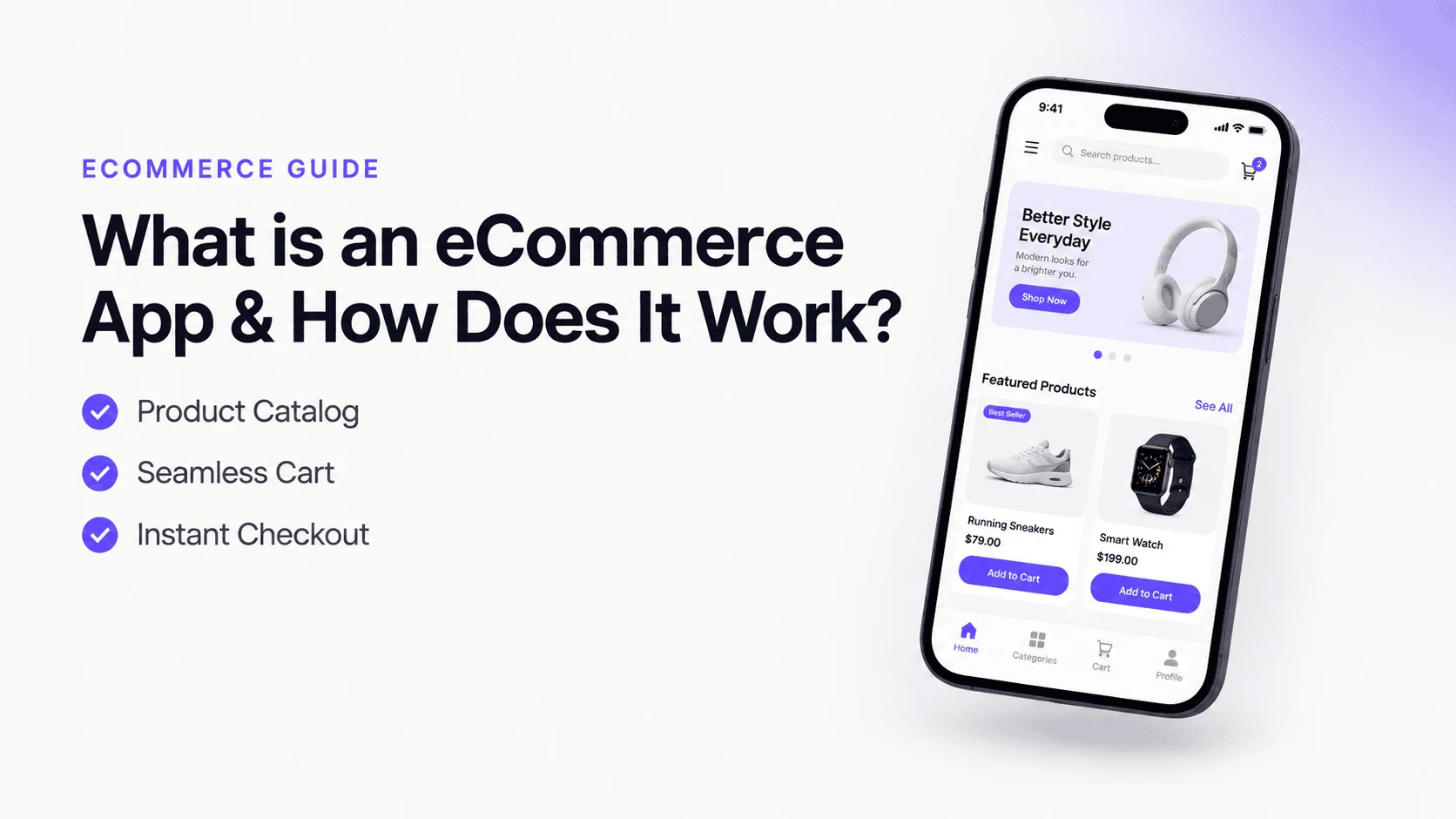
An eCommerce app is a mobile or web application that allows businesses to sell products or services online.
It works by enabling users to browse products, add items to a cart, make secure payments, and track orders—all from their device.
With the rapid growth of mobile shopping, eCommerce apps have become essential for businesses looking to increase sales, improve customer experience, and build brand loyalty.
What is an eCommerce App?
An eCommerce app is a digital platform designed to enable online buying and selling of goods or services. Unlike traditional websites, it is optimized for mobile-first experiences, faster navigation, and personalized shopping.
These apps are used by:
- Retail businesses
- Marketplaces (like multi-vendor stores)
- Direct-to-consumer (D2C) brands
- Service-based companies
Simple definition:
An eCommerce app is a digital storefront in your pocket.
How Does an eCommerce App Work?
An eCommerce app works by connecting users, products, payments, and delivery into one smooth digital flow.
When someone browses products, adds items to a cart, and completes checkout, the app processes the order, confirms payment, and triggers shipping almost instantly.
Platforms like Shopify and WooCommerce follow a similar structure behind the scenes, even though the user experience feels simple.
Product catalog and database
Every eCommerce app relies on a database that stores product details such as images, descriptions, prices, and inventory levels. When a user browses the app, it is actually pulling this information in real time from the backend system.
User interface and browsing
The interface is what customers interact with directly. It includes product pages, categories, search options, and filters. A well designed interface makes it easy for users to find what they want quickly, which directly impacts conversions.
Cart and checkout process
When a customer adds a product to the cart, the app temporarily saves that selection. During checkout, it calculates the total cost, applies discounts or taxes, and prepares the final order summary before payment.
Payment processing
Secure payments are handled through gateways like Stripe or PayPal. These systems encrypt sensitive data and confirm transactions between the customer and the seller.
Order management and fulfillment
Once payment is successful, the app sends the order details to the backend. The seller then processes the order, packs the product, and ships it.
Many apps integrate with delivery services to automate tracking and updates.
Notifications and customer updates
After placing an order, customers receive confirmations, shipping updates, and delivery notifications. This keeps users informed and builds trust throughout the buying journey.
Why Are eCommerce Apps Important?
eCommerce apps are important because they turn your business into a 24 hour sales machine that customers can access anytime, from anywhere.
They remove physical limitations, streamline buying, and create a faster, more personalized shopping experience that drives more conversions.
They give your business constant availability
Unlike physical stores, an app never closes. Customers can browse and buy at their convenience, whether it is late at night or during a busy workday.
Platforms like Shopify and WooCommerce are built around this always on model, helping businesses capture sales at any time.
They improve customer experience
eCommerce apps are designed for speed, simplicity, and personalization. Features like saved preferences, quick checkout, and product recommendations make shopping easier and more enjoyable, which increases the chances of repeat purchases.
They boost sales and conversion rates
Mobile apps reduce friction in the buying journey. With fewer steps to complete a purchase and faster loading times, customers are more likely to convert.
Integrated payment solutions such as Stripe and PayPal make transactions quick and secure.
They provide valuable customer insights
Every interaction inside an app generates data. Businesses can track user behavior, popular products, and purchasing patterns to make smarter decisions and improve marketing strategies.
They enable direct marketing and engagement
With push notifications, in app messages, and exclusive offers, businesses can communicate directly with customers. This helps build stronger relationships and keeps users coming back.
They support business growth and scalability
As your business grows, an eCommerce app can scale with it. You can add new products, expand to new markets, and handle increased traffic without needing a physical expansion.
What Are the Key Features of an eCommerce App?
An eCommerce app succeeds when it makes browsing, buying, and managing orders feel effortless.
The key features are designed to reduce friction, build trust, and guide users smoothly from discovery to checkout.
1. User friendly interface
A clean and intuitive interface helps users navigate products without confusion. Apps built on platforms like Shopify and WooCommerce focus heavily on simple layouts, fast loading, and mobile first design to keep users engaged.
2. Advanced search and filtering
Customers should be able to find products quickly using search bars, categories, and filters such as price, size, or ratings. This feature reduces frustration and shortens the buying journey.
3. Product pages with rich details
Each product needs high quality images, clear descriptions, pricing, availability, and customer reviews. Detailed product pages build confidence and help users make informed decisions.
4. Shopping cart and smooth checkout
A reliable cart system allows users to add, remove, or update items easily. The checkout process should be quick, with minimal steps and options like guest checkout to reduce drop offs.
5. Secure payment integration
Trust is critical in eCommerce. Integrating secure payment gateways such as Stripe and PayPal ensures safe and seamless transactions.
6. Order tracking and management
Users expect to track their orders in real time. This feature provides updates from purchase to delivery, improving transparency and customer satisfaction.
7. Push notifications and alerts
Notifications help re engage users by sharing order updates, promotions, and reminders. This keeps the brand top of mind and encourages repeat purchases.
8. User accounts and personalization
Allowing users to create accounts enables features like saved addresses, order history, and personalized recommendations based on browsing behavior.
9. Reviews and ratings
Customer feedback builds trust and influences buying decisions. A review system adds credibility and helps highlight popular products.
10. Analytics and admin dashboard
On the business side, an admin panel tracks sales, customer behavior, and inventory. This data helps optimize marketing strategies and improve overall performance.
How Do eCommerce Apps Make Money?
eCommerce apps make money by turning user activity into revenue through product sales, fees, and strategic monetization models.
Whether it is a single brand app or a multi vendor marketplace, the goal is to capture value at different points in the buying journey.
Direct product sales
The most common model is simple. The app sells products directly to customers and earns profit from each sale.
Businesses using platforms like Shopify or WooCommerce typically follow this approach, where revenue comes from the margin between cost and selling price.
Commission based model
Marketplace apps earn money by taking a percentage from each transaction made by third party sellers.
This is how platforms like Amazon operate, earning commissions every time a product is sold through their ecosystem.
Subscription fees
Some eCommerce apps charge sellers a monthly or yearly fee to list and sell products on their platform.
This creates a predictable recurring revenue stream, especially for apps offering advanced tools and analytics.
Listing and featured product fees
Sellers may pay to highlight their products or appear at the top of search results.
These paid placements increase visibility and generate additional income for the app.
Advertising revenue
eCommerce apps can monetize traffic by displaying ads or sponsored products.
Brands pay to promote their items within the app, especially in high visibility areas like homepages or search results.
Transaction and payment fees
Apps often charge a small fee for processing payments. Integrations with services like Stripe and PayPal may include transaction based earnings or service charges.
Affiliate marketing
Some apps promote third party products and earn a commission for every sale made through referral links. This model works well for niche or content driven eCommerce apps.
Data driven upselling and cross selling
By analyzing user behavior, apps recommend related or premium products. This increases average order value and overall revenue without needing more traffic.
What Technologies Power eCommerce Apps?
eCommerce apps are powered by a mix of frontend, backend, database, and integration technologies that work together to deliver fast, secure, and scalable shopping experiences.
From what users see on screen to how payments and orders are processed, every layer relies on specific tools and systems.
1. Frontend technologies for user experience
The frontend is what users interact with directly. Technologies like React, Vue.js, and Angular are commonly used to build fast and responsive interfaces.
For mobile apps, frameworks like Flutter and React Native help create smooth cross platform experiences.
2. Backend technologies and server logic
The backend handles business logic, authentication, and order processing. Popular backend technologies include Node.js, Django, and Laravel.
These systems ensure that data flows correctly between users, databases, and external services.
3. Databases for storing data
eCommerce apps need reliable databases to store product details, user information, and transactions.
Solutions like MySQL, PostgreSQL, and MongoDB are widely used depending on the app’s structure and scalability needs.
4. Payment gateways and security
Secure payment processing is essential. Technologies from providers like Stripe and PayPal handle transactions, encryption, and fraud prevention to ensure safe purchases.
5. APIs and third party integrations
APIs connect the app with external services such as shipping providers, payment systems, and analytics tools. This allows features like real time tracking, inventory sync, and automated notifications.
6. Cloud hosting and infrastructure
Most modern eCommerce apps run on cloud platforms like Amazon Web Services and Google Cloud. Cloud infrastructure ensures scalability, uptime, and performance even during high traffic periods.
7. Analytics and AI tools
Data driven tools help businesses understand user behavior and optimize sales. AI powered recommendations, search optimization, and customer insights play a big role in improving conversions.
What Are the Challenges of eCommerce Apps?
eCommerce apps are powerful for scaling online businesses, but they come with a set of challenges that can impact performance, user experience, and long-term growth.
These challenges are not just technical but also strategic, affecting how businesses attract, convert, and retain customers in a highly competitive digital market.
High competition and user acquisition costs
One of the biggest challenges of eCommerce apps is intense competition. Thousands of brands are competing for the same audience, which makes it expensive to acquire new users through ads and marketing campaigns.
Paid channels like Google Ads, Facebook Ads, and influencer marketing often drive up customer acquisition costs, especially in saturated niches.
Even after attracting users, retaining them requires continuous engagement and value delivery, which adds further pressure on budgets and resources.
Performance, speed, and technical complexity
eCommerce apps must load quickly and function smoothly across different devices and network conditions. Even a delay of a few seconds can lead to abandoned carts and lost sales.
Behind the scenes, these apps depend on complex systems like databases, payment gateways, APIs, and inventory management tools that must all work together without failure.
Maintaining performance while scaling traffic during peak times such as sales events or holidays is a major technical challenge for development teams.
Security risks and payment reliability
Security is a critical concern in eCommerce apps because they handle sensitive customer data such as payment details, addresses, and personal information.
Any breach can damage brand trust and lead to financial loss. Ensuring secure transactions, preventing fraud, and maintaining compliance with data protection standards requires constant monitoring and updates.
At the same time, payment failures or unreliable gateways can directly affect conversions, making payment stability just as important as security itself.
User experience and retention difficulties
A smooth user experience is essential, but designing an intuitive and frictionless shopping journey is not easy. Users expect fast search results, personalized recommendations, easy navigation, and a seamless checkout process.
If the app feels complicated or slow, users quickly abandon it and switch to competitors. Retaining users is even harder because customer loyalty in eCommerce is often low, and users frequently compare prices and offers across multiple platforms before making a purchase decision.
Scalability and infrastructure limitations
As an eCommerce app grows, it must handle increasing traffic, product listings, and transactions without slowing down or crashing.
Many apps struggle when scaling from a small user base to a large audience. Infrastructure must be flexible enough to support sudden spikes in demand, especially during promotional campaigns.
Without proper scalability planning, businesses may face downtime, poor performance, and revenue loss at critical moments.
Logistics, inventory, and order management
Beyond the app itself, eCommerce businesses face operational challenges like inventory tracking, order fulfillment, and delivery coordination.
If inventory data is not updated in real time, it can lead to overselling or stockouts, which frustrate customers. Delays in shipping or poor logistics integration can also damage customer satisfaction.
Managing these backend operations efficiently requires strong system integration and reliable third-party partnerships.
What is the Future of eCommerce Apps?
The future of eCommerce apps is moving toward a much more intelligent, personalized, and frictionless shopping experience where apps don’t just sell products but actively understand and predict customer needs.
Instead of being simple digital storefronts, they are evolving into data-driven ecosystems powered by AI, automation, and real-time personalization.
1. AI-driven personalization will dominate
In the future, eCommerce apps will rely heavily on artificial intelligence to personalize every part of the shopping journey. From homepage product recommendations to dynamic pricing and personalized offers, everything will be tailored to individual user behavior.
Apps will learn from browsing history, purchase patterns, and even micro-interactions like scroll speed or time spent on products to predict what a user is most likely to buy next.
This level of personalization will significantly improve conversion rates and customer satisfaction.
2. Voice and visual search will replace traditional search
Typing will become less important as voice and visual search technologies become mainstream.
Users will simply speak what they need or upload an image to find similar products instantly. This shift will make shopping faster and more intuitive, especially for mobile-first users.
eCommerce apps will integrate more deeply with voice assistants and camera-based search tools, making discovery feel more natural and less keyword-dependent.
3. Faster, app-less experiences through headless commerce
The future will also move toward headless commerce, where the frontend experience is separated from the backend systems.
This allows brands to deliver faster, more flexible shopping experiences across multiple platforms like mobile apps, websites, smart devices, and even AR/VR environments.
Users may not even feel like they are “using an app” in the traditional sense because the experience will be seamless, lightweight, and highly responsive.
4. AR, VR, and immersive shopping experiences
Augmented reality and virtual reality will transform how users interact with products. Instead of just viewing images, customers will be able to try products virtually before buying.
For example, they can see how furniture looks in their home or how clothes fit on a virtual avatar.
This reduces uncertainty in buying decisions and lowers return rates, which is a major challenge in current eCommerce systems.
5. Smarter checkout and one-tap purchasing
Checkout processes will become almost invisible. With stored preferences, biometric authentication, and digital wallets, users will complete purchases in one tap or even automatically based on subscriptions and smart triggers.
Cart abandonment will decrease as friction in payment flows is reduced. The entire buying process will become faster, safer, and more automated.
6. Hyper-automation in operations and logistics
Behind the scenes, eCommerce apps will increasingly depend on automation for inventory management, order fulfillment, and delivery tracking.
AI will predict demand patterns, optimize stock levels, and even automate reordering.
Logistics systems will become more efficient with real-time tracking and smarter routing, improving delivery speed and reducing operational costs.
7. Stronger focus on privacy and trust
As data usage increases, privacy and transparency will become major priorities. Future eCommerce apps will need to balance personalization with strict data protection.
Users will expect more control over their data and clearer explanations of how it is being used. Trust will become a key differentiator between competing platforms.
Build Your eCommerce App Faster with AppNatively (Join the Waitlist)
If you’re planning to launch an eCommerce app, AppNatively is being built to help you do it faster, simpler, and without heavy development costs.
Instead of spending months on coding, infrastructure, and testing, you’ll be able to create a fully functional app using a streamlined, product-first approach.
AppNatively is currently under development but you can already secure early access by joining the waitlist.
Early users will get priority access, early feature updates, and a head start on building their app before public launch.
Why join the waitlist?
- Get early access before public release
- Build your eCommerce app faster with a simplified workflow
- Reduce dependency on expensive development teams
- Stay ahead with mobile-first commerce tools
- Receive exclusive launch updates and early feature previews
Who is it for?
- Founders launching a new eCommerce business
- Shopify or WooCommerce store owners going mobile-first
- Agencies building apps for clients
- Non-technical entrepreneurs who want to launch quickly
AppNatively is designed to remove the technical barriers of app development so you can focus on what actually matters—your product, your customers, and your growth.
👉 Join the waitlist today and be among the first to experience AppNatively when it launches.
Frequently Asked Questions (FAQs)
1. What is an eCommerce app in simple terms?
An eCommerce app is a mobile or web application that allows users to browse, purchase, and track products or services online. It acts as a digital store where everything from product discovery to payment happens in one place.
2. How does an eCommerce app work step by step?
An eCommerce app works by connecting four main systems: product listings, user interface, payment gateway, and delivery system. Users browse products, add items to a cart, make secure payments, and then track their orders until delivery.
3. Why should a business use an eCommerce app instead of only a website?
An eCommerce app provides faster performance, better user experience, and higher engagement through push notifications. It also helps businesses increase repeat purchases and customer loyalty compared to websites alone.
4. What features are essential in an eCommerce app?
Key features include product search, category filters, shopping cart, secure payment options, order tracking, user accounts, and push notifications. Advanced apps also include AI recommendations and personalized shopping experiences.
5. How much does it cost to build an eCommerce app?
The cost varies depending on complexity. A basic app can start from a few thousand dollars using no-code tools, while fully custom-built apps with advanced features can cost significantly more.
6. Can I build an eCommerce app without coding skills?
Yes, no-code and low-code platforms now allow users to build eCommerce apps without programming knowledge. Tools like AppNatively (coming soon) aim to make this process even easier.
7. How long does it take to launch an eCommerce app?
With traditional development, it can take 3–6 months or more. With modern no-code solutions, it can be reduced to a few days or weeks depending on features and customization.
8. How can AppNatively help in building an eCommerce app?
AppNatively is being designed to simplify app creation by removing technical complexity. It will help users build and launch eCommerce apps faster with a streamlined, user-friendly system—no heavy coding required.