Why Most No-Code App Builders Feel Great… Until You Need Customization

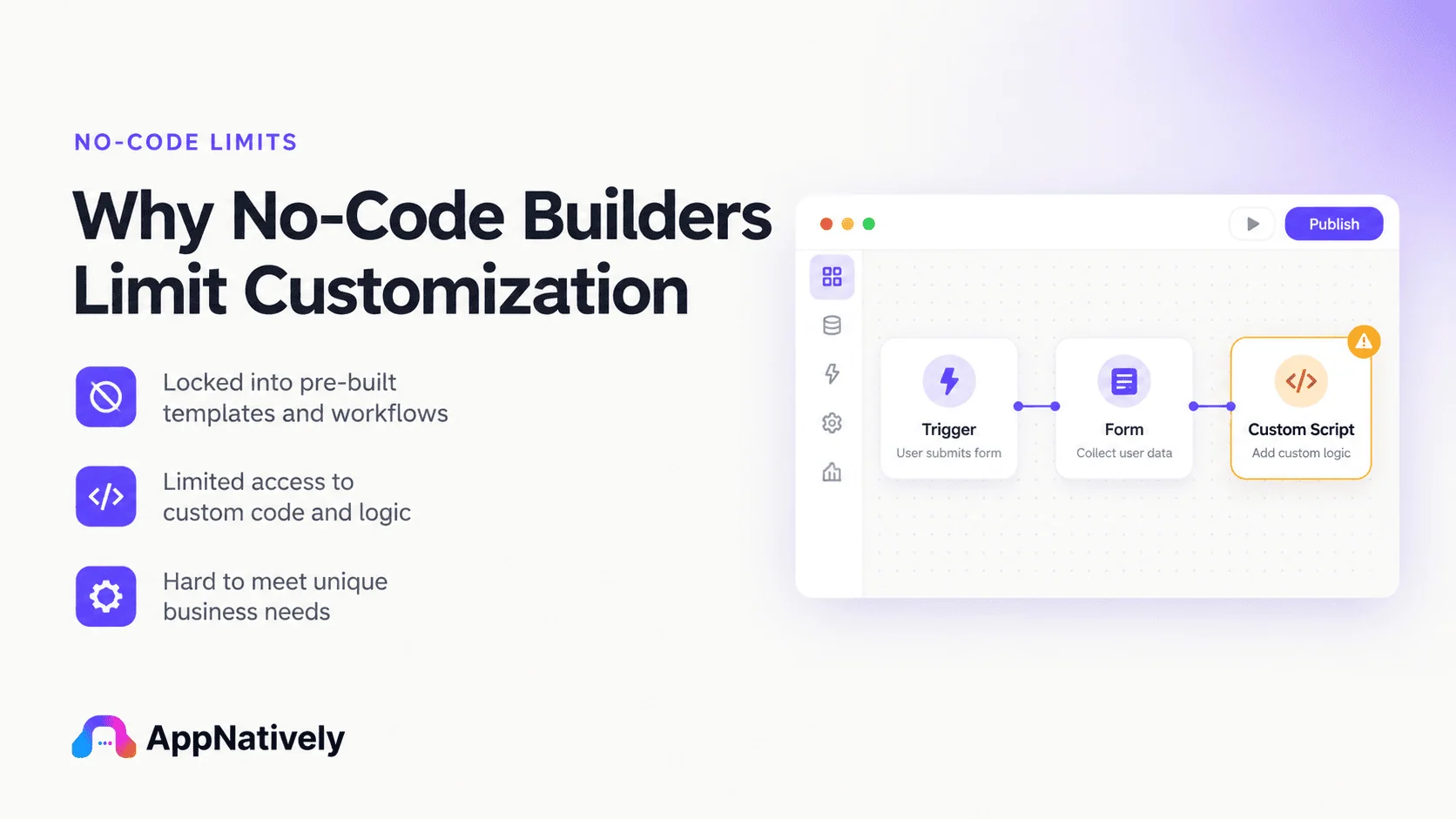
No-code app builders have changed how businesses approach mobile app development.
A few years ago, building a native mobile app meant hiring developers, managing long development cycles, fixing bugs, and spending thousands of dollars before your app even reached the App Store or Google Play.
Today, almost anyone can launch an app without writing a single line of code.
That’s a huge win.
But there’s a problem that many businesses don’t discover until months later.
Launching an app is easy.
Growing one is not.
The moment your business needs something unique, many no-code app builders start showing their limitations. What once felt simple becomes restrictive.
Features become impossible to implement. Customization requests get rejected. Workarounds pile up. Suddenly, the platform that saved you time starts slowing you down.
This isn’t a problem with no-code itself.
It’s a problem with platforms that prioritize simplicity over flexibility.
In this guide, we’ll explore why customization becomes the biggest challenge, the hidden costs of platform limitations, and how to choose a no-code app builder that can grow alongside your business.
Why Businesses Choose No-Code in the First Place
The popularity of no-code platforms isn’t surprising.
They solve several real problems.
Instead of spending months building an app from scratch, businesses can create one in days or even hours.
The advantages are obvious.
Development costs are dramatically lower.
Launching products becomes much faster.
Non-technical teams can manage updates themselves.
Businesses can validate ideas before investing heavily.
For startups and small businesses, these benefits are hard to ignore.
In many cases, they’re exactly what companies need.
The challenge begins after launch.
The Real Test Starts After Your First 10,000 Users
Most businesses don’t stop evolving after releasing an app.
They collect customer feedback.
They discover new opportunities.
They improve workflows.
They experiment with new revenue models.
Every improvement creates new requirements.
You may want to:
- Create a completely custom onboarding experience.
- Offer personalized user dashboards.
- Build a unique checkout process.
- Add subscription-based features.
- Integrate with specialized third-party services.
- Create advanced loyalty programs.
- Customize navigation for different user roles.
- Introduce industry-specific workflows.
These aren’t unusual requests.
They’re signs that your business is growing.
Unfortunately, this is where many no-code platforms begin saying no.
Templates Are Great Until You Need Something Different
Templates help users launch quickly.
That’s their purpose.
The problem is that some platforms are built almost entirely around templates.
Everything works well as long as your business fits inside predefined layouts.
The moment you need something outside those layouts, customization becomes difficult.
You may discover that:
- You can’t rearrange important sections.
- You can’t build custom user journeys.
- You can’t modify native components.
- You can’t create unique interactions.
- You can’t extend existing functionality.
Instead of building the experience your customers need, you’re forced to adapt your business to the software.
That’s the opposite of what technology should do.
The Hidden Cost of Limited Customization
Many businesses only compare platforms based on monthly pricing.
That’s understandable.
But pricing isn’t usually the biggest expense.
Limitations are.
Imagine launching your app only to discover six months later that your platform doesn’t support the feature your customers keep requesting.
Now you have difficult choices.
You delay the feature.
You build awkward workarounds.
You hire developers to create external solutions.
Or you migrate to another platform.
Every option costs time, money, and customer trust.
These costs rarely appear on a pricing page.
Every Business Is Different
A restaurant app has completely different requirements than an online marketplace.
A hotel booking app needs different functionality than a fitness platform.
A local directory serves users differently than an eCommerce store.
Yet many no-code builders try to fit every business into the same structure.
Real businesses don’t work that way.
Your competitive advantage often comes from doing something differently.
If your platform prevents differentiation, it also limits growth.
Integrations Matter More Than Most People Realize
Modern businesses rely on multiple software platforms.
- Payment gateways.
- CRMs.
- Marketing automation.
- Analytics.
- Inventory systems.
- Customer support tools.
- Shipping providers.
- Booking systems.
- Membership platforms.
Your mobile app shouldn’t exist in isolation.
It should become part of your entire business ecosystem.
Some no-code platforms offer only a handful of integrations.
Others provide APIs, webhooks, custom connectors, and developer-friendly extensions that enable almost any workflow.
The difference becomes enormous as your business grows.
Native Apps Should Feel Truly Native
Customization isn’t only about adding features.
It’s also about delivering a better user experience.
Customers expect smooth animations.
- Fast loading.
- Responsive navigation.
- Offline capabilities.
- Push notifications.
- Platform-specific interactions.
A mobile app should feel like it belongs on the device.
Not every no-code builder achieves this.
Some rely heavily on web views, which often create slower experiences and limit access to native device features.
Businesses investing in mobile should understand this distinction before choosing a platform.
Scalability Is More Than Performance
People often think scalability means handling more users.
That’s only one part of the equation.
A scalable platform should also handle:
- New business models.
- New product categories.
- New integrations.
- New customer journeys.
- New markets.
- New languages.
- New payment systems.
- New monetization strategies.
If your platform can’t evolve with your business, you’ll eventually outgrow it regardless of how fast it performs.
Questions to Ask Before Choosing Any No-Code App Builder
Before committing to a platform, ask yourself a few important questions.
- Can the interface be customized beyond templates?
- Can you create unique user experiences?
- Does it support deep integrations?
- Can features be extended as your business grows?
- Will the platform still meet your needs two years from now
The answers will tell you far more than any marketing page.
What a Future-Proof No-Code Platform Should Offer
The best no-code platforms don’t just eliminate coding.
They remove unnecessary barriers.
Look for solutions that combine speed with flexibility.
A future-ready app builder should provide extensive design control, native performance, scalable architecture, broad integrations, OTA updates where appropriate, reusable components, customizable navigation, and room for advanced features as your business evolves.
The goal isn’t simply to launch quickly.
It’s to keep improving without rebuilding everything from scratch.
Why We Built AppNatively Differently
When we started building AppNatively, we noticed the same pattern over and over again.
Businesses were excited to launch their first mobile app with a no-code builder. But as soon as they wanted something beyond the basics, they ran into limitations.
Custom layouts weren’t possible. Integrations were limited. Navigation couldn’t be changed. Adding unique business logic often meant waiting for the platform to support it, if it ever did.
We didn’t want businesses to face that trade-off.
AppNatively was built with a different philosophy: launching quickly shouldn’t mean sacrificing flexibility later.
Instead of locking users into rigid templates, AppNatively gives businesses the freedom to create native mobile apps that truly reflect their brand and business model.
Whether you’re running an eCommerce store, a marketplace, a directory, a booking platform, a restaurant, or another online business, you can customize the experience instead of settling for a one-size-fits-all solution.
Beyond design flexibility, AppNatively focuses on what growing businesses actually need. It delivers true native apps for better performance, supports extensive integrations, allows over-the-air (OTA) updates for many app changes without requiring a full app store release, and is designed to scale as your business evolves.
The goal isn’t simply to help you publish an app.
It’s to help you build a mobile experience that can continue growing alongside your business, without forcing you to rebuild everything when your requirements become more advanced.
That’s the difference between launching an app and building a mobile product that lasts.
Final Thoughts
No-code is no longer just a shortcut for startups. It’s becoming a serious way to build and scale digital products.
But not every no-code platform is built for long-term growth. Launching an app is only the beginning.
The real challenge is adapting your app as your customers, products, and business evolve.
Choose a platform that gives you the freedom to innovate instead of forcing you into predefined limits.
Because in the long run, the businesses that succeed aren’t always the ones that launch first.
They’re the ones that can keep improving long after everyone else has reached the limits of their platform.