

AppNatively vs BuildFire vs MobiRoller vs AppMySite vs AppPresser vs Thunkable vs GoodBarber: Which App Builder Is Best?

If you want to build a mobile app without hiring a development team, there are more options than ever. But choosing the right platform can be difficult because AppNatively, BuildFire, MobiRoller, AppMySite, AppPresser, Thunkable, and GoodBarber solve slightly different problems.
Some are designed primarily to turn existing websites into mobile apps. Others are general-purpose no-code app builders. Some focus heavily on WordPress, while others are built around ecommerce, content, agencies, or custom app development.
So, which app builder is best?
For a website owner who wants to turn an existing WordPress site, WooCommerce store, Shopify store, directory, or custom API into a highly customizable native iOS and Android app, AppNatively is one of the strongest options in this comparison.
For users building an app from scratch, Thunkable offers a more general-purpose visual and AI-driven development environment. BuildFire is particularly strong for businesses that want managed app development and enterprise-oriented services. GoodBarber is a mature choice for content, ecommerce, and branded apps. AppMySite is especially relevant to WordPress, WooCommerce, and Shopify users, while AppPresser is deeply focused on WordPress ecosystems. MobiRoller offers a traditional no-code builder with templates, modules, ecommerce capabilities, and reseller options.
The best choice ultimately depends on what you are building, where your data already lives, how much customization you need, and how you want to publish and maintain the app.
Quick Answer: Which App Builder Is Best?
| Platform | Best For | Native iOS | Native Android | Website-to-App | AI Building | WordPress | Shopify | Custom API | Visual Customization |
|---|---|---|---|---|---|---|---|---|---|
| AppNatively | Websites, ecommerce, directories, custom APIs | Yes | Yes | Yes | Yes | Yes | Yes | Yes | High |
| BuildFire | Businesses, enterprise, managed apps | Yes | Yes | Yes | Some | Yes | Yes | Yes | High |
| MobiRoller | SMBs, content, ecommerce, agencies | Yes | Yes | Yes | Limited/Developing | Yes | Yes | Developing | Medium |
| AppMySite | WordPress, WooCommerce, Shopify | Yes | Yes | Yes | Yes | Yes | Yes | Limited compared with API-first platforms | Medium-High |
| AppPresser | WordPress, memberships, LMS, communities | Yes | Yes | Yes | Limited | Yes | Yes | Limited | High within WordPress |
| Thunkable | Apps built from scratch, education, startups | Yes | Yes | Not its primary focus | Yes | Via APIs/integrations | Via APIs | Yes | High |
| GoodBarber | Content, ecommerce, agencies | Yes | Yes | Yes | Yes | Integrations | Yes | Yes | High |
Quick recommendation:
- Best for converting an existing website into a highly customizable native app: AppNatively
- Best for WordPress-focused apps: AppPresser or AppMySite
- Best for building a custom app from an idea: Thunkable
- Best for managed business and enterprise apps: BuildFire
- Best for content and ecommerce apps: GoodBarber
- Best for traditional no-code modules and reseller use: MobiRoller
Important: "Best" does not mean the same thing for every project. A WordPress membership site has very different requirements from a SaaS product, restaurant app, directory, ecommerce store, or educational app.
What Is an App Builder?
An app builder is a platform that lets individuals or businesses create mobile applications without developing everything from scratch with traditional programming.
Modern app builders generally fall into several categories:
- Website-to-app builders
- WordPress app builders
- Ecommerce app builders
- General-purpose no-code app builders
- AI app builders
- Enterprise app platforms
- Agency and white-label app builders
The seven platforms in this comparison overlap, but they are not identical.
For example, AppNatively is heavily focused on connecting an existing website or backend to a native mobile experience. Thunkable is more oriented toward creating custom applications from the ground up using visual development, AI, APIs, and device capabilities. AppPresser is deeply integrated with WordPress, while GoodBarber combines content, ecommerce, design, publishing, and business functionality in one platform.
AppNatively vs BuildFire vs MobiRoller vs AppMySite vs AppPresser vs Thunkable vs GoodBarber
1. AppNatively
Best for: Website owners, ecommerce businesses, directories, content sites, agencies, and businesses that want a native app connected to an existing backend.
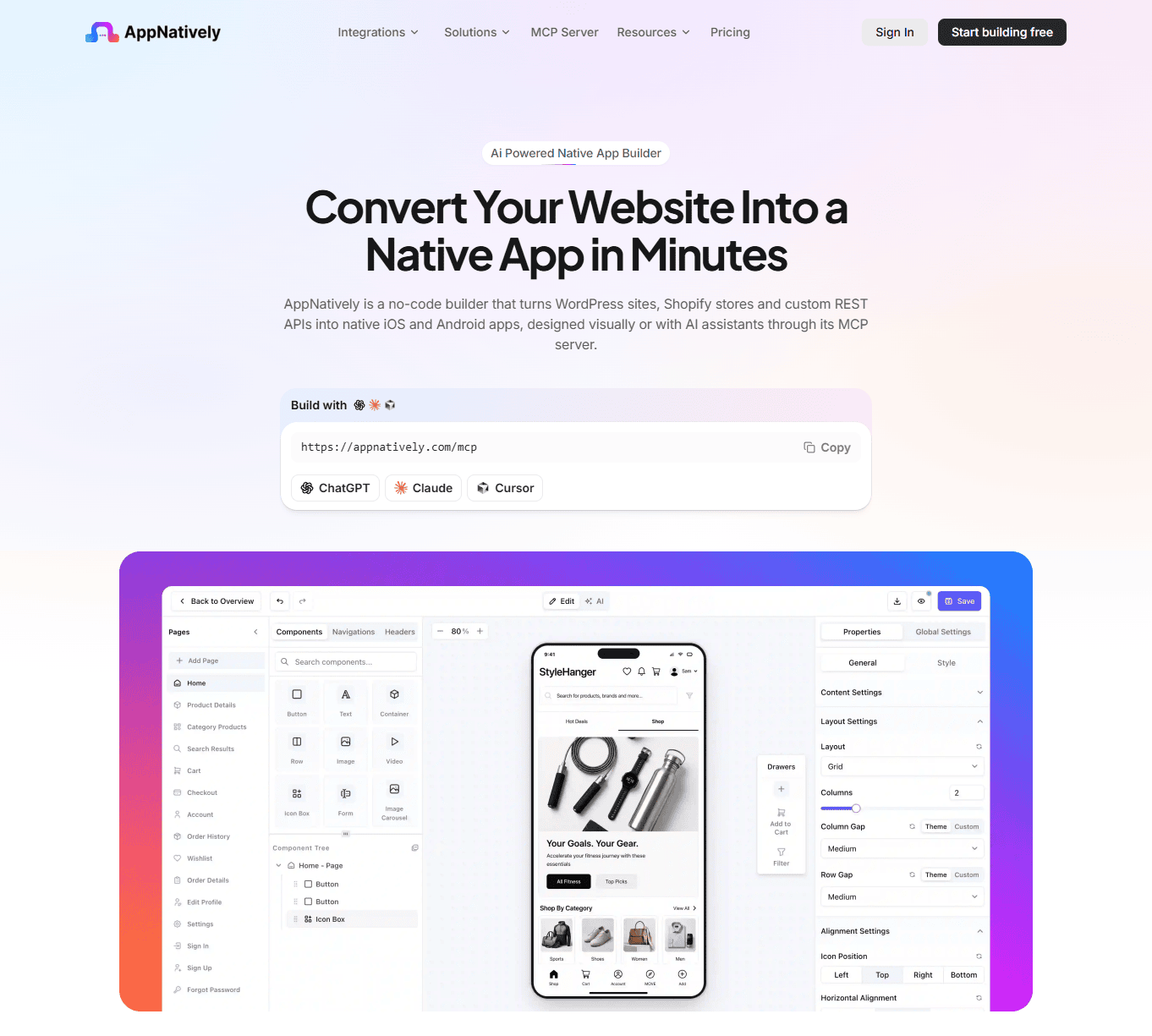
AppNatively is an AI-powered no-code native app builder designed around an important use case: turning an existing website or backend into a native mobile application without rebuilding the entire business infrastructure.
It supports WordPress, WooCommerce, SureCart, FluentCart, Shopify, directory plugins, and custom REST APIs. Users can visually design native screens and also use AI assistants through its MCP integration.
What makes AppNatively different?
The major distinction is its website/backend-first approach.
Instead of asking:
"What app should I build from scratch?"
AppNatively is often answering:
"How can I turn the system I already have into a native mobile experience?"
That distinction matters for businesses that already have:
- WordPress websites
- WooCommerce stores
- Shopify stores
- Directory websites
- Booking platforms
- LMS websites
- Custom APIs
- Existing databases and backend systems
AppNatively connects to existing systems and lets the app work with that existing data rather than requiring the business to rebuild its backend.
AppNatively key features
- Native iOS and Android apps
- Visual drag-and-drop builder
- AI-assisted app creation
- MCP integration
- WordPress integration
- WooCommerce support
- Shopify integration
- Custom REST API connectivity
- Directory integrations
- Real-time device preview
- Push notifications
- OTA updates
- App Store and Google Play publishing workflows
- Unlimited build and deployment workflows
- Custom branding
- Native components
One particularly interesting capability is its MCP integration, which allows compatible AI assistants to interact with the app-building environment.
Who should choose AppNatively?
AppNatively is particularly compelling if you already have a functioning website or backend and want the mobile app to become another native front end for that system.
It is especially relevant for:
- WooCommerce stores
- Shopify stores
- WordPress businesses
- Directory websites
- Booking platforms
- LMS websites
- Content publishers
- SaaS products with APIs
- Agencies
- Businesses that need frequent app updates
2. BuildFire
Best for: Businesses that want a mature app-building platform with extensive plugins, publishing assistance, support, and optional professional services.
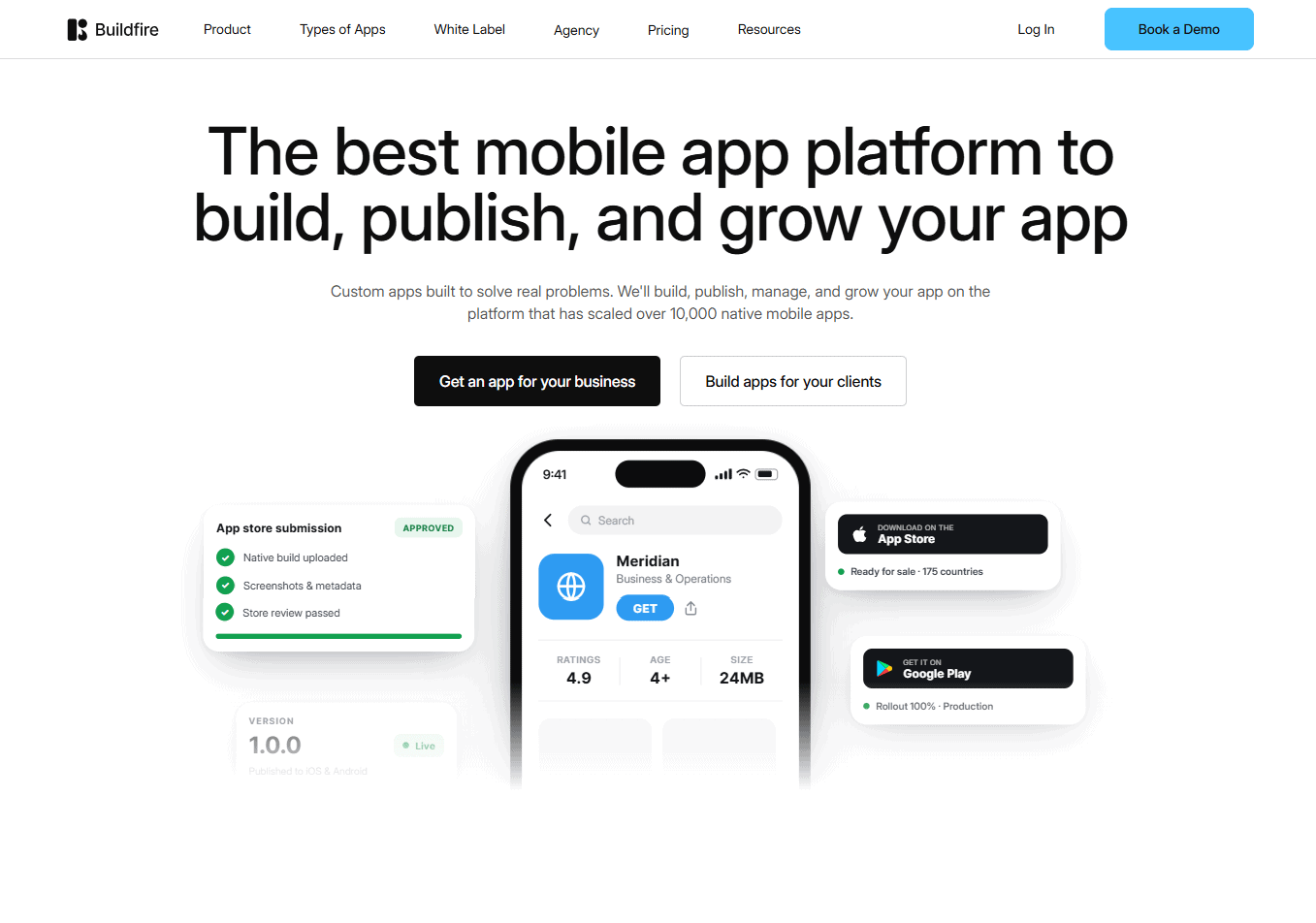
BuildFire takes a broader business-app approach.
Its current plans include native iOS and Android apps, PWA support, plugins, push notifications, storage, analytics, publishing support, and higher-tier business capabilities. Its Scale plan includes access to all plugins and additional enterprise controls.
BuildFire also offers professional services where its team can handle design, custom development, integrations, publishing, and ongoing support.
BuildFire strengths
- Mature platform
- Large plugin ecosystem
- Native iOS and Android
- Push notifications
- Analytics
- Monetization
- User management
- Professional services
- Publishing support
- White-label reseller options
- Enterprise-oriented features
Its white-label offering is particularly relevant to agencies that want to build and manage multiple client applications under their own brand.
BuildFire pricing
BuildFire currently lists:
- Standard: $165/month
- Growth: $315/month
- Scale: $440/month
Professional services and reseller solutions are priced separately.
Who should choose BuildFire?
BuildFire makes sense when:
- You want a mature business platform
- You need extensive plugins
- You want publishing assistance
- You need professional development services
- You operate an agency
- You need enterprise-oriented functionality
- You prefer a managed approach
The main tradeoff is cost. BuildFire sits at the higher end of this comparison.
3. MobiRoller
Best for: Small businesses, content publishers, ecommerce businesses, agencies, and users looking for a traditional no-code app builder.
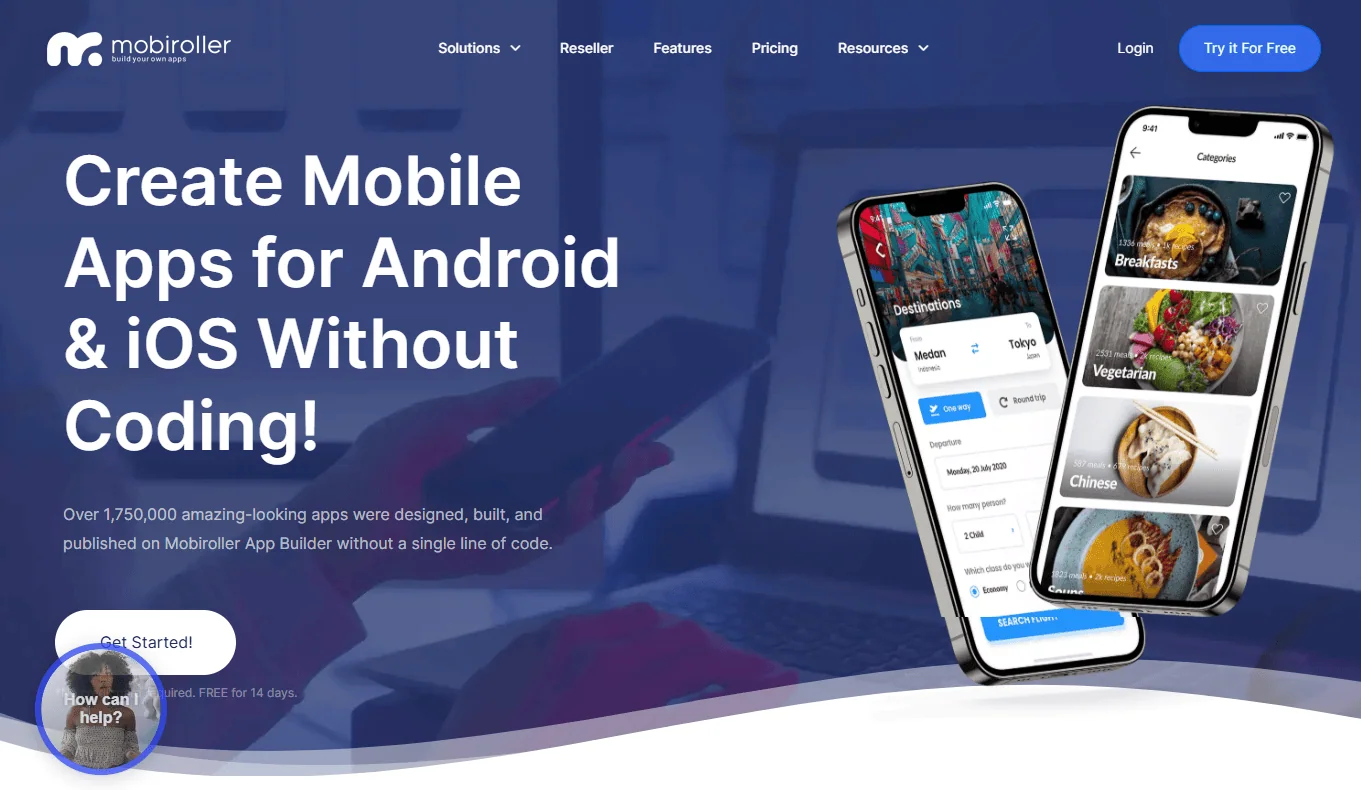
MobiRoller is a long-standing no-code mobile app platform that lets users create Android and iOS applications without traditional programming.
Its builder includes templates and modules for areas such as content, forms, maps, chat, ecommerce, restaurants, radio, RSS, and other business use cases.
MobiRoller says more than 1.75 million apps have been designed, built, and published using its platform.
MobiRoller strengths
- No-code building
- Android and iOS support
- Drag-and-drop workflow
- Large module library
- Ecommerce
- Push notifications
- Analytics
- Multilingual support
- App monetization
- Templates
- Reseller program
Its current pricing also makes it one of the more accessible options in this comparison. MobiRoller lists Android-only and Android+iOS packages, including annual and lifetime options.
For example, its current annual pricing page lists a Standard package at $99/year for one native Android app and an Advanced package at $299/year for one native Android and iOS app.
Ecommerce focus
MobiRoller also offers ecommerce-specific plans with features such as product catalogs, restaurant menus, Shopify ecommerce, chat, push notifications, analytics, and monetization.
Who should choose MobiRoller?
MobiRoller is a good fit for businesses that want:
- A traditional app builder
- Prebuilt modules
- Ecommerce functionality
- Content publishing
- Push notifications
- Multiple app monetization options
- Reseller capabilities
Its main limitation compared with a more API-oriented platform is that users seeking an extremely custom application architecture may need to work within its available modules and integrations.
4. AppMySite
Best for: WordPress, WooCommerce, Shopify, and other website owners looking for a relatively streamlined route from website to mobile app.
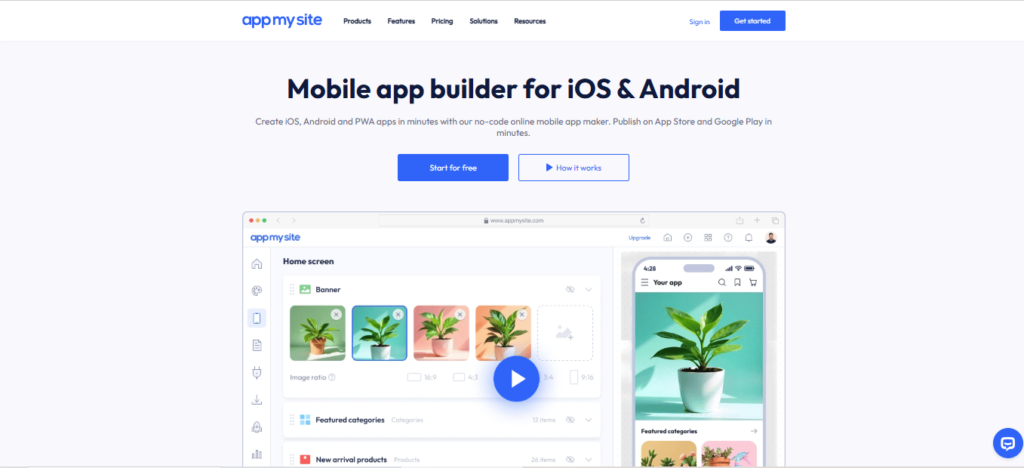
AppMySite is one of the strongest competitors in the website-to-app category.
Its current platform combines AI-assisted app creation with support for WordPress, WooCommerce, Shopify, and other website use cases.
AppMySite strengths
- WordPress
- WooCommerce
- Shopify
- AI app builder
- Native iOS and Android apps
- PWA
- Push notifications
- Ecommerce functionality
- Product synchronization
- Content management
- App customization
- White-label and agency functionality
AppMySite's feature set also includes pages, posts, categories, tags, attributes, filters, content blocks, chat integrations, analytics, and ecommerce features.
Where AppMySite stands out
AppMySite is particularly attractive if your website is already your primary business system.
For example:
WooCommerce website → AppMySite → mobile ecommerce app
or
WordPress website → AppMySite → content/community app
This makes it easier for website owners who do not want to create their mobile application architecture from scratch.
Who should choose AppMySite?
Choose AppMySite if:
- You use WordPress
- You run WooCommerce
- You use Shopify
- Your website already contains most of your business data
- You want an established website-to-app workflow
- You want AI-assisted app building
The key consideration is whether your application fits neatly into AppMySite's supported website and product models. Businesses requiring a highly unique application architecture may want to compare it with a more flexible API-first platform.
5. AppPresser
Best for: WordPress websites, memberships, LMS platforms, communities, WooCommerce, BuddyPress/BuddyBoss, and LearnDash.
AppPresser is perhaps the most WordPress-centric product in this comparison.
Its current plans explicitly include integrations such as:
- WooCommerce
- BuddyPress
- BuddyBoss
- LearnDash
- Membership functionality
- Push notifications
- Apple/Google login
- In-app purchases
- iOS and Android apps
AppPresser strengths
If your entire business lives inside WordPress, AppPresser can be a very logical choice.
For example:
WordPress + LearnDash → AppPresser
WordPress + BuddyBoss → AppPresser
WordPress + WooCommerce → AppPresser
The platform is designed around extending WordPress into mobile applications rather than functioning as a completely independent app-development environment.
AppPresser pricing
Its current pricing page lists:
- Standard: $59/month billed annually
- Professional: $79/month billed annually
- Advanced: $129/month billed annually
Monthly billing is higher.
Who should choose AppPresser?
AppPresser is particularly attractive for:
- WordPress communities
- Membership websites
- Online courses
- BuddyBoss sites
- LearnDash sites
- WooCommerce businesses
If your backend is not WordPress, however, the platform becomes much less compelling compared with more general-purpose builders.
6. Thunkable
Best for: Building custom apps from scratch using AI, visual tools, APIs, device features, and logic.
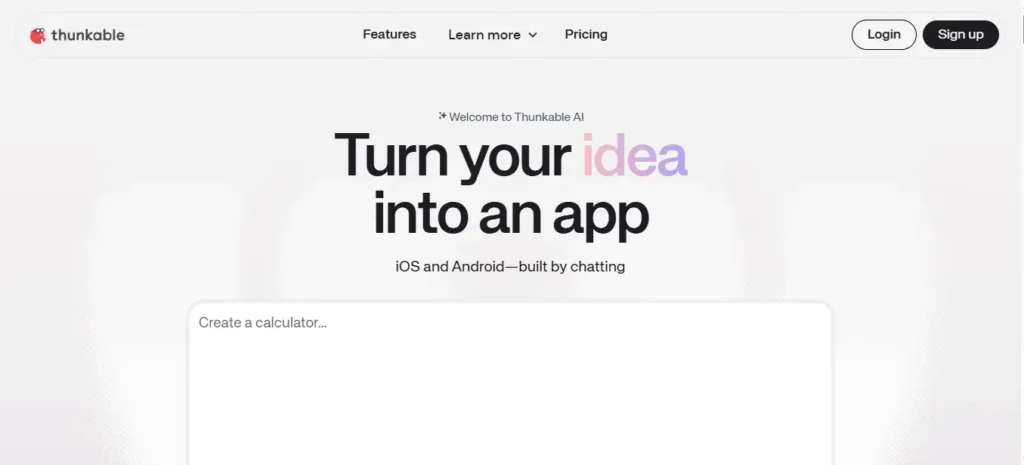
Thunkable is different from the website-to-app platforms in this list.
Instead of primarily saying:
"Connect your website and convert it into an app."
Thunkable says:
"Describe what you want to build, then create and refine the application."
Its current AI Builder can generate an initial app from a natural-language description. Users can then refine the project using visual tools, AI, data connections, device capabilities, and code editing.
Thunkable strengths
- AI app generation
- Visual app builder
- Native iOS
- Native Android
- APIs
- Databases
- Device features
- Real-device testing
- Code editing
- Version history
- App Store publishing
- Google Play publishing
Thunkable says its platform has been used to create millions of apps and supports users across many countries.
Thunkable vs website-to-app builders
This is one of the most important distinctions in this comparison.
If you say:
"I have a WooCommerce store and want an app."
AppNatively or AppMySite may be more natural starting points.
If you say:
"I have an idea for a mobile product and want to build the app itself."
Thunkable becomes much more interesting.
Thunkable pricing
Thunkable currently has a free tier and paid plans. Its published pricing information includes Builder and Advanced tiers, with annual pricing reported at approximately $37/month and $99/month, respectively, while monthly billing is higher.
Who should choose Thunkable?
Choose Thunkable when:
- You are creating an app from scratch
- You need custom logic
- You want device capabilities
- You need API connections
- You want AI-assisted development
- You want more control over application behavior
- You are an educator or student
- You are building an MVP
7. GoodBarber
Best for: Content publishers, ecommerce businesses, restaurants, retailers, communities, and agencies that want polished native applications.
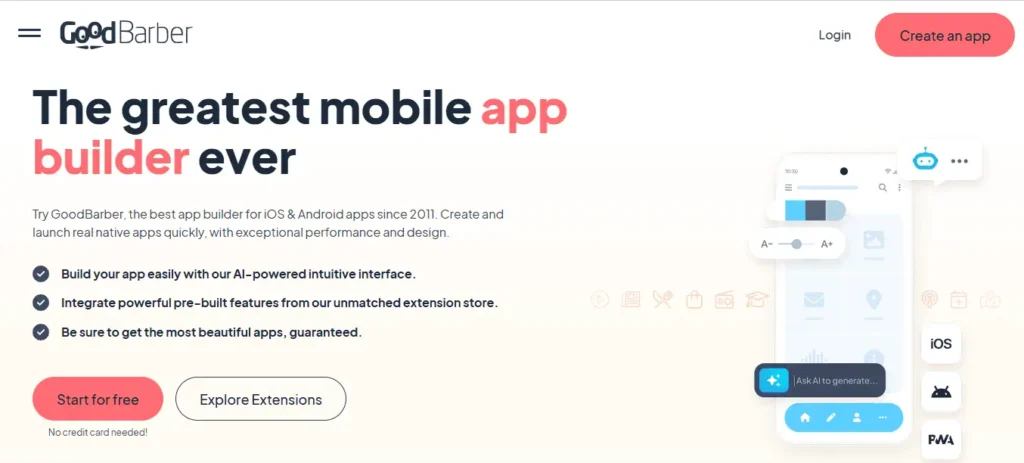
GoodBarber is one of the more mature products in the category.
The company positions its platform around native iOS and Android apps, with apps built using Swift and Kotlin. It also offers web versions, hosting, push notifications, payments, updates, and an extensive extension ecosystem.
GoodBarber strengths
- Native iOS
- Native Android
- PWA/web version
- Ecommerce
- Content publishing
- Restaurant apps
- Push notifications
- Payments
- Hosting
- App updates
- Extensions
- Reseller functionality
- AI tools
- MCP integration
GoodBarber currently says it has more than 190 extensions and 80 designs based on its design system.
Interestingly, GoodBarber now also offers an MCP server that can connect AI assistants such as ChatGPT, Claude, and Cursor to the platform.
GoodBarber pricing
Current pricing starts at:
- Content: $30/month billed yearly
- Ecommerce: $40/month billed yearly
- Reseller: $215/month billed yearly
GoodBarber also offers a 30-day free trial.
Who should choose GoodBarber?
GoodBarber is a strong option for:
- Publishers
- Restaurants
- Retailers
- Ecommerce businesses
- Communities
- Events
- Agencies
- Content-driven businesses
AppNatively vs BuildFire vs MobiRoller vs AppMySite vs AppPresser vs Thunkable vs GoodBarber: Feature Comparison
| Feature | AppNatively | BuildFire | MobiRoller | AppMySite | AppPresser | Thunkable | GoodBarber |
|---|---|---|---|---|---|---|---|
| Native iOS | ✅ | ✅ | ✅ | ✅ | ✅ | ✅ | ✅ |
| Native Android | ✅ | ✅ | ✅ | ✅ | ✅ | ✅ | ✅ |
| No-code | ✅ | ✅ | ✅ | ✅ | ✅ | ✅ | ✅ |
| AI builder | ✅ | Limited | Developing | ✅ | Limited | ✅ | ✅ |
| Website-to-app | Strong | Yes | Yes | Strong | Strong | Not primary | Strong |
| WordPress | Strong | Yes | Yes | Strong | Excellent | Via APIs | Via integrations |
| WooCommerce | Strong | Yes | Yes | Strong | Strong | Via APIs | Ecommerce |
| Shopify | Yes | Yes | Yes | Yes | Limited | Via APIs | Yes |
| Custom REST API | Yes | Yes | Developing | Limited/varies | Limited | Yes | Yes |
| Push notifications | ✅ | ✅ | ✅ | ✅ | ✅ | Via integrations | ✅ |
| OTA updates | Yes | Platform updates | Platform updates | Updates | Updates | Platform-dependent | Updates |
| MCP | Yes | Not core differentiator | Developing | Not core differentiator | No | AI workflow | Yes |
| Visual customization | High | High | Medium | Medium-High | High | High | High |
| Custom app from scratch | Yes | Yes | Limited | Yes | Limited | Excellent | Yes |
| Ecommerce | Yes | Yes | Yes | Excellent | Yes | Build it | Excellent |
| Directory use cases | Strong | Possible | Possible | Possible | WordPress-dependent | Build it | Possible |
| LMS | Yes | Possible | Yes | Yes | Strong | Build it | Possible |
| Agency/reseller | Yes | Strong | Strong | Strong | Yes | Yes | Strong |
| App publishing support | Guided | Strong | Yes | Yes | Yes | Yes | Yes |
| Best for | Website-to-native | Managed business apps | SMB/module apps | Website-to-app | WordPress | Custom apps | Content/ecommerce |
Which App Builder Has the Best Native App Experience?
If native mobile performance is a priority, you should first separate native apps from web apps or PWAs.
A native app is built specifically for mobile operating systems and can use platform capabilities such as:
- Push notifications
- Camera
- GPS
- Biometrics
- Native navigation
- Device storage
- Sensors
- Native UI interactions
Several platforms in this comparison explicitly position their output as native.
AppNatively describes its output as native iOS and Android applications.
Thunkable explicitly describes its apps as native iOS and Android applications rather than web wrappers.
GoodBarber states that its native applications are built with Swift for iOS and Kotlin for Android.
Therefore, if your primary requirement is native app output, all seven deserve consideration, but the more important question becomes how much control you need over the app architecture and how closely the platform matches your existing backend.
Which Is Best for WordPress?
For WordPress users, the shortlist becomes much smaller.
Best WordPress choices
1. AppNatively
Best if you want WordPress plus broader backend flexibility, including WooCommerce, directory plugins, Shopify, and custom REST APIs.
2. AppMySite
Best if your primary goal is a streamlined WordPress, WooCommerce, or Shopify-to-app workflow.
3. AppPresser
Best if your WordPress site relies heavily on memberships, BuddyPress/BuddyBoss, LearnDash, or WordPress-specific functionality.
Verdict
For a general WordPress business:
AppNatively vs AppMySite
For a membership/community/LMS-heavy WordPress site:
AppPresser
Which Is Best for WooCommerce?
WooCommerce users generally want:
- Product synchronization
- Categories
- Product search
- Filters
- Customer accounts
- Cart
- Checkout
- Orders
- Push notifications
- Promotions
- Native navigation
AppMySite is a strong WooCommerce-focused option, while AppNatively is attractive if you want WooCommerce plus more freedom to create a custom native experience. AppPresser is another WordPress-centric option.
Winner by use case
WooCommerce-first: AppMySite
Highly customizable WooCommerce app: AppNatively
WooCommerce + WordPress community/LMS: AppPresser
Which Is Best for Shopify?
Shopify users should consider:
- AppNatively
- AppMySite
- GoodBarber
- MobiRoller
- Other ecommerce-focused platforms
AppNatively connects Shopify through the Storefront API, while AppMySite also explicitly supports Shopify.
The important distinction is whether you want a Shopify mobile storefront or a more customized mobile product connected to your existing business infrastructure.
Which Is Best for a Directory Website?
This is where the comparison becomes particularly interesting.
Directory websites have requirements that a normal ecommerce store does not.
A directory app may need:
- Listings
- Categories
- Search
- Filters
- Location
- Maps
- User accounts
- Reviews
- Favorites
- Listing submission
- Paid listings
- Booking
- Messaging
- Push notifications
- Custom listing fields
For these requirements, a platform that can connect to the existing directory backend is particularly valuable.
Best choice: AppNatively
AppNatively supports WordPress directory ecosystems including Directorist, GeoDirectory, and HivePress, as well as custom REST APIs.
That makes it especially relevant for directory owners who don't want to rebuild their listing database for mobile.
Which Is Best for an LMS?
For learning management systems, the most important factors include:
- Course content
- Lessons
- User authentication
- Progress
- Video
- Quizzes
- Notifications
- Memberships
- Payments
Strong choices
AppPresser: Excellent if you use WordPress + LearnDash.
AppNatively: Strong if you need WordPress plus broader API flexibility.
AppMySite: Good for WordPress-based LMS scenarios.
Thunkable: Better if you are building a custom LMS application from the ground up.
Which Is Best for Building an App From Scratch?
This is where Thunkable moves toward the top.
If you don't already have a website or backend and simply have an app idea, a general-purpose builder makes more sense.
For example:
"I want to build a cricket scoring application."
or
"I want to build a field-service management application."
or
"I want to build a marketplace app."
In these cases, you may want to create the application's screens, logic, database connections, authentication, APIs, and workflows from the ground up.
Thunkable's AI Builder, visual editor, APIs, device features, code editor, and native publishing workflow make it particularly relevant for this category.
Which Is Best for AI App Building?
AI is becoming a major differentiator.
The seven platforms now approach AI differently.
| Platform | AI Role |
|---|---|
| AppNatively | AI-assisted building + MCP |
| BuildFire | Less AI-centric |
| MobiRoller | AI capabilities developing |
| AppMySite | AI app generation and customization |
| AppPresser | Not primarily AI-first |
| Thunkable | AI-first app generation |
| GoodBarber | AI assistant + AI Builder + MCP |
The most interesting AI-focused choices are therefore:
AppNatively, Thunkable, AppMySite, and GoodBarber.
Thunkable uses AI to generate and refine applications from natural-language instructions.
AppMySite uses AI for app content, visuals, branding, layouts, and structure.
GoodBarber has an AI Builder and MCP functionality that can allow AI assistants to manage apps and create custom features.
AppNatively combines AI-assisted building with MCP-based workflows.
Which App Builder Offers the Most Customization?
There are two different meanings of customization:
Visual customization
How much can you change:
- Colors
- Layouts
- Components
- Navigation
- Screens
- Branding
- UI
Functional customization
How much can you change:
- APIs
- Data structures
- Authentication
- Business logic
- Workflows
- Device functionality
- Custom features
A platform can be highly customizable visually but restrictive functionally.
For visual customization, AppNatively, GoodBarber, BuildFire, and Thunkable are strong candidates.
For functional customization, Thunkable and API-oriented platforms such as AppNatively can be particularly attractive.
Which App Builder Is Cheapest?
Price alone can be misleading because app builders use different pricing models.
Current published starting points include:
| Platform | Example Starting Price |
|---|---|
| MobiRoller | From $99/year for Standard Android package |
| GoodBarber | From $30/month billed yearly |
| AppPresser | From $59/month billed annually |
| BuildFire | From $165/month |
| Thunkable | Free tier, paid plans available |
| AppMySite | Free start, paid plans vary |
| AppNatively | Free access/trial and paid plans vary |
MobiRoller's pricing page currently lists a $99 annual Standard package and $299 annual Advanced package, while GoodBarber starts at $30/month billed annually for its content offering.
BuildFire's current Standard plan is $165/month.
AppPresser's Standard plan is $59/month when billed annually.
Thunkable offers a free tier and paid plans, with pricing that varies by project and publishing requirements.
Do not choose based solely on the lowest subscription price.
The real cost can include:
- App Store fees
- Google Play fees
- Publishing fees
- Build limits
- Push notification limits
- Storage
- API usage
- AI credits
- Additional apps
- White-label fees
- Agency fees
- Custom development
- Professional services
AppNatively vs BuildFire
Choose AppNatively when:
- You already have a website/backend
- You need WordPress, Shopify, or custom API support
- You want strong visual freedom
- You want AI-assisted app building
- You want MCP
- You need directory support
- You want frequent app iteration
Choose BuildFire when:
- You want extensive plugins
- You want managed services
- You need professional development
- You operate an agency
- You need enterprise-oriented support
- You want a mature reseller ecosystem
AppNatively vs MobiRoller
Choose AppNatively when:
- Your app needs a highly customized native UI
- Your website/backend is central to the product
- You need custom REST APIs
- You want AI and MCP
- You operate a directory or complex website
Choose MobiRoller when:
- You prefer modules and templates
- You want a traditional no-code experience
- Your requirements fit its existing modules
- You want a lower-cost entry point
- You need ecommerce/content modules
MobiRoller offers more than 80 configurable features, plus a range of templates and modules.
AppNatively vs AppMySite
This is probably the closest comparison in the list for many website owners.
Both are particularly relevant to:
- WordPress
- WooCommerce
- Shopify
- Website owners
- Ecommerce
- Native mobile apps
AppNatively has an edge when:
- Customization is the priority
- You need custom REST APIs
- You have a directory
- You want MCP
- You want AI-assisted app workflows
- You need broader backend flexibility
AppMySite has an edge when:
- You want a mature website-to-app workflow
- Your primary stack is WordPress
- You rely heavily on WooCommerce
- You want AI-assisted app creation
- You want a straightforward website-to-mobile conversion process
AppMySite currently supports WordPress, WooCommerce, Shopify, and other website types, while AppNatively explicitly supports WordPress ecosystems, Shopify, and custom REST APIs.
AppNatively vs AppPresser
The key difference is breadth versus WordPress specialization.
AppNatively
Better for:
- WordPress
- Shopify
- Custom APIs
- WooCommerce
- Directories
- Multiple backend types
- AI workflows
- MCP
AppPresser
Better for:
- WordPress memberships
- LearnDash
- BuddyPress
- BuddyBoss
- WordPress communities
- WordPress-specific functionality
AppPresser's current plans specifically include BuddyPress/BuddyBoss, LearnDash, WooCommerce, and membership capabilities.
AppNatively vs Thunkable
These platforms address different starting points.
Choose AppNatively if:
You already have a website or backend.
Choose Thunkable if:
You want to build the application itself.
This is one of the clearest distinctions in the entire comparison.
AppNatively is particularly strong as a website/backend-to-native-app platform, while Thunkable is stronger as a general-purpose native app creation environment.
AppNatively vs GoodBarber
Both can create polished native apps, but their strengths differ.
AppNatively
Best for:
- Website-to-app
- WordPress
- WooCommerce
- Shopify
- Directories
- Custom REST APIs
- AI workflows
- MCP
GoodBarber
Best for:
- Content
- Ecommerce
- Restaurants
- Retail
- Communities
- Publishing
- Agencies
- Mature app-management workflows
GoodBarber also has a strong native positioning, stating that its iOS apps are built in Swift and Android apps in Kotlin.
AppMySite vs AppPresser
This comparison is mostly about how deeply your WordPress ecosystem is integrated into your app requirements.
AppMySite
Better for:
- WordPress
- WooCommerce
- Shopify
- Ecommerce
- Broader website-to-app workflows
- AI-assisted app building
AppPresser
Better for:
- LearnDash
- BuddyBoss
- BuddyPress
- Memberships
- WordPress communities
- Deep WordPress-specific functionality
BuildFire vs GoodBarber
Both are mature business-oriented platforms.
BuildFire
More compelling when you need:
- Professional services
- Enterprise support
- Plugins
- White-labeling
- Managed publishing
- Custom development
GoodBarber
More compelling when you need:
- Content
- Ecommerce
- Restaurants
- Retail
- Strong design
- Native apps
- Reseller capabilities
- Built-in hosting and business functionality
BuildFire currently emphasizes professional services and managed support, while GoodBarber emphasizes its native platform, extensions, designs, hosting, payments, and updates.
What About App Store and Google Play Publishing?
Publishing is often overlooked when choosing an app builder.
Creating an app is only one part of launching it.
You also need:
- Developer accounts
- App certificates
- App signing
- Store metadata
- Screenshots
- Privacy information
- App policies
- Builds
- Testing
- Store submission
- Updates
The platforms differ in how much of this process they handle.
BuildFire explicitly includes publishing support in its plans.
Thunkable supports direct publishing workflows for the Apple App Store and Google Play.
AppNatively supports production builds and submission workflows for both stores.
MobiRoller also supports publishing to Google Play and Apple App Store, with the user responsible for the relevant marketplace accounts and submission process.
Which Platform Is Best for Agencies?
Agencies should look beyond the cost of building one app.
Important agency features include:
- White-labeling
- Multiple apps
- Multiple client accounts
- Client management
- Branding
- Reseller pricing
- Publishing support
- Team access
- Centralized management
Strongest options
BuildFire: Strong white-label reseller platform.
GoodBarber: Strong reseller offering.
MobiRoller: Reseller-focused packages.
AppMySite: Agency and white-label capabilities.
AppNatively: Strong candidate for agencies building custom apps from websites and APIs.
Which App Builder Should You Choose?
Here's the simplest decision framework.
Choose AppNatively if:
You already have a website, ecommerce store, directory, LMS, booking platform, or API and want to turn it into a highly customizable native mobile app.
Choose BuildFire if:
You want a mature business platform with plugins, professional services, publishing assistance, and enterprise capabilities.
Choose MobiRoller if:
You want a traditional no-code builder with templates, modules, ecommerce, content tools, analytics, and reseller functionality.
Choose AppMySite if:
You primarily use WordPress, WooCommerce, or Shopify and want a streamlined website-to-app solution with AI capabilities.
Choose AppPresser if:
Your business is deeply dependent on WordPress, particularly LearnDash, BuddyBoss, BuddyPress, WooCommerce, or memberships.
Choose Thunkable if:
You want to create a custom native app from scratch using AI, visual development, APIs, databases, and device capabilities.
Choose GoodBarber if:
You want a polished native content, ecommerce, restaurant, retail, community, or publishing application with a mature feature ecosystem.
Best App Builder by Use Case
| Use Case | Best Choice |
|---|---|
| Turn WordPress into a native app | AppNatively / AppMySite |
| Turn WooCommerce into an app | AppNatively / AppMySite |
| Shopify mobile app | AppNatively / AppMySite / GoodBarber |
| Directory mobile app | AppNatively |
| LearnDash app | AppPresser |
| BuddyBoss app | AppPresser |
| Custom app from scratch | Thunkable |
| AI-generated mobile app | Thunkable / AppNatively |
| Content/publishing app | GoodBarber/ AppNatively |
| Restaurant app | GoodBarber / MobiRoller/ AppNatively |
| Ecommerce app | AppNatively / AppMySite / GoodBarber |
| Enterprise app | BuildFire |
| Managed app development | BuildFire |
| Agency/reseller | BuildFire / GoodBarber / MobiRoller/ AppNatively |
| Custom REST API app | AppNatively / Thunkable |
| AI + MCP workflow | AppNatively / GoodBarber |
| Budget-oriented traditional builder | MobiRoller |
| WordPress community | AppPresser |
The Bottom Line
There is no universal winner among these seven platforms because they approach app development from different directions.
AppNatively is strongest when your starting point is an existing website, store, directory, or backend and you want to turn it into a customizable native mobile experience.
BuildFire is a strong choice for businesses and agencies that value managed services, plugins, publishing assistance, and enterprise capabilities.
MobiRoller is a practical no-code option for businesses that want modules, templates, ecommerce, content, analytics, and reseller functionality.
AppMySite is particularly compelling for WordPress, WooCommerce, Shopify, and website-first businesses.
AppPresser is one of the strongest choices for WordPress-heavy applications, especially memberships, communities, LearnDash, BuddyPress, and BuddyBoss.
Thunkable stands apart as a more general-purpose native app development environment, especially for people who want to create applications from scratch using AI, visual tools, APIs, and device functionality.
GoodBarber is a mature option for content, ecommerce, restaurants, retail, communities, and agencies that want polished native applications and a broad business feature set.
Frequently asked questions
AppNatively and AppMySite are both strong website-to-app platforms, particularly for WordPress, WooCommerce, and Shopify users. AppNatively is especially suited to businesses that want visual control, custom REST API connections, directory integrations, and AI-assisted building through MCP. AppMySite is a strong option for users who want a streamlined website-to-mobile-app workflow.
It depends on the project. AppNatively is particularly compelling for website and backend-driven apps, including WordPress, Shopify, directories, WooCommerce, and custom APIs. BuildFire is stronger for businesses that want a mature plugin ecosystem, professional services, managed publishing, enterprise controls, and white-label reseller capabilities. BuildFire currently includes publishing support across its plans and offers professional app-development services.
Yes. AppNatively is a no-code native app builder that lets users connect a WordPress site, Shopify store, directory, or custom REST API and visually create native iOS and Android applications. It also supports AI-assisted design and building through its MCP server.
Yes. Several platforms in this comparison can turn WordPress websites into mobile apps, including AppNatively, AppMySite, AppPresser, and GoodBarber. The important difference is how each platform handles your WordPress content, plugins, data, authentication, ecommerce functionality, and app interface. AppNatively supports WordPress, WooCommerce, SureCart, FluentCart, directory plugins, custom post types, and custom REST APIs.
Yes. No-code platforms such as AppNatively, AppMySite, and AppPresser can be used to create mobile experiences for WooCommerce websites. The best choice depends on how much control you need over the app's interface, data connections, ecommerce functionality, and custom features.
Yes. AppNatively supports Shopify through the Shopify Storefront API, allowing a native app to display products, collections, blog content, and pages while using the existing Shopify checkout and customer accounts.
There is no universal winner, but AppNatively, AppMySite, GoodBarber, and MobiRoller are worth considering for Shopify-based businesses. AppNatively is particularly interesting when Shopify is only one part of a broader application and you need additional API-based functionality.
For general WordPress-to-app projects, AppNatively and AppMySite are strong choices. AppPresser can be especially attractive when your WordPress site depends heavily on memberships, LearnDash, BuddyPress, or BuddyBoss. GoodBarber also offers a WordPress app builder that synchronizes public WordPress posts into native app screens.
Choose AppNatively if you want broader backend flexibility, including custom REST APIs, Shopify, ecommerce platforms, and directory systems. Choose AppPresser if your application is deeply tied to WordPress functionality such as memberships, LMS, BuddyPress, or BuddyBoss.
AppNatively and AppMySite are strong options for WooCommerce. AppPresser is also worth considering when WooCommerce is part of a larger WordPress membership, community, or LMS ecosystem. The right choice depends on whether you prioritize ecommerce-specific workflows or broader native app customization.
AppNatively is particularly well suited to directory websites because it can connect WordPress directory plugins such as Directorist, GeoDirectory, and HivePress, as well as custom REST APIs. This makes it possible to build native listing, search, filtering, map, and other directory experiences without creating a separate backend.
Thunkable is one of the strongest choices in this comparison for building a custom application from scratch. Its AI Builder can generate an initial application from natural-language instructions, and users can continue customizing the app visually. It supports native iOS and Android publishing.
Neither is universally better. Thunkable is better suited to creating a new application from scratch, while AppNatively is particularly strong when you already have a website, ecommerce store, directory, or backend and want to turn that existing system into a native app.
Yes. All seven platforms in this comparison are designed to reduce or eliminate traditional coding requirements. Thunkable explicitly states that users can build apps with AI without writing code, while GoodBarber describes its platform as a DIY environment for users without programming skills.
Several platforms in this comparison explicitly provide native iOS and Android applications. AppNatively describes its output as native iOS and Android apps, Thunkable supports native mobile publishing, and GoodBarber states that its iOS and Android applications are 100% native.
A native app is designed and compiled for a mobile operating system and can use native platform capabilities. A WebView app primarily displays a website inside a mobile application shell. Native apps generally provide greater control over mobile navigation, device functionality, performance, and user experience.
This distinction is particularly important when comparing website-to-app platforms because not every "app builder" uses the same underlying approach.
A native app is generally better when you need deeper mobile capabilities, app-store distribution, push notifications, and a dedicated mobile experience. A PWA can be more convenient when browser access, cross-device availability, and avoiding app-store installation are priorities.
Some platforms, including GoodBarber, provide both native apps and PWAs from the same management environment.
Yes. The platforms covered in this comparison support app-store publishing, although the exact publishing workflow varies. BuildFire includes publishing support in its plans, while GoodBarber allows users to publish native apps through their own Apple and Google developer accounts.
In most cases, yes. App-store ownership and developer-account requirements are separate from the app-builder subscription. For example, GoodBarber explicitly requires users to have their own Apple Developer account even when using its publishing service.
The cost varies considerably by platform and requirements. Some platforms offer free trials or free plans, while others charge monthly or annual subscriptions. GoodBarber currently starts at $30/month billed annually for its Content offering, while BuildFire's Standard plan currently starts at $165/month. MobiRoller and other platforms use different pricing structures.
The total cost can also include Apple and Google developer-account fees, additional plugins, publishing services, premium integrations, and custom development.
There is no single cheapest option for every type of app because platforms package features differently. MobiRoller, GoodBarber, AppMySite, Thunkable, and AppNatively can provide lower-cost entry points depending on your requirements, while BuildFire generally targets higher-budget business and enterprise projects. Always compare the total cost of the features you actually need rather than comparing the headline subscription price.
For ecommerce, strong options include AppNatively, AppMySite, GoodBarber, and MobiRoller. AppNatively and AppMySite are particularly relevant for website-based ecommerce, while GoodBarber has dedicated ecommerce functionality for retail, grocery, restaurants, local delivery, and click-and-collect businesses.
GoodBarber and MobiRoller are strong options for restaurant-focused applications, while AppNatively can be useful when the restaurant already operates through WordPress, WooCommerce, Shopify, or a custom backend.
For WordPress LMS websites, AppPresser is particularly relevant. AppNatively and AppMySite can also work well when the LMS exposes the necessary data through WordPress or APIs. If you are building an LMS app from scratch, Thunkable offers greater general-purpose development flexibility.
BuildFire, GoodBarber, MobiRoller, AppMySite, and AppNatively can all be relevant to agencies. BuildFire and GoodBarber have particularly explicit reseller and agency offerings. BuildFire provides white-label reseller functionality, while GoodBarber offers a dedicated reseller plan for agencies building multiple apps.
BuildFire and GoodBarber are particularly strong choices for agencies that want a dedicated reseller or white-label business. BuildFire offers a white-label platform and multi-client management, while GoodBarber has a dedicated reseller plan.
Yes. AI can now generate significant parts of a mobile application, including screens, layouts, content, logic, and other components. Thunkable offers an AI Builder that generates apps from natural-language descriptions. AppNatively also provides AI-assisted app building through its MCP server, while GoodBarber offers AI-related tools and integrations.
MCP, or Model Context Protocol, allows AI systems to interact with external tools and data through a standardized interface. In an app-building context, an MCP server can allow compatible AI assistants to interact with parts of an app-building platform instead of simply generating generic text.
AppNatively provides an MCP server designed to let AI assistants such as ChatGPT, Claude, and Cursor interact with its app-building environment.
Yes, although the level of API flexibility differs significantly between platforms. AppNatively explicitly supports custom REST APIs, while Thunkable is also designed to work with APIs and custom application logic. Other platforms may offer API access only for certain plans or use cases.
Many modern app builders provide mechanisms for updating app content and platform-managed functionality without rebuilding the entire application every time. AppNatively also provides OTA updates for future improvements. The exact limitations depend on whether the change affects native application code, store-required metadata, or remotely managed content.
Related posts
Why Do People Install Apps Instead of Using Websites?

AppNatively vs Tapcart vs MobiLoud vs Shopney: Which Shopify Mobile App Builder Is Best in 2026?

Website vs Mobile App: What’s the Difference?




