
AppNatively vs Tapcart vs MobiLoud vs Shopney: Which Shopify Mobile App Builder Is Best in 2026?

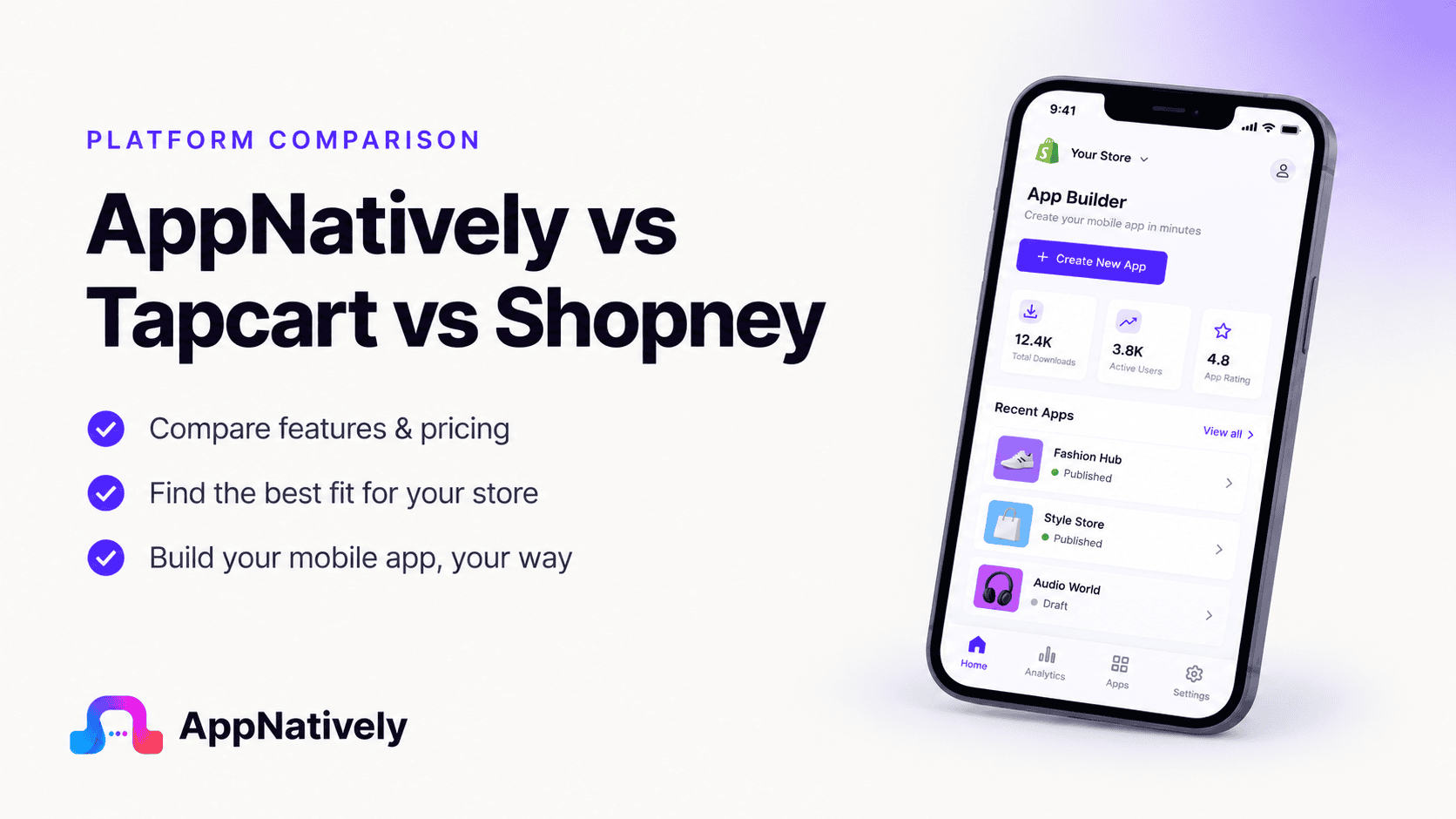
If you want to turn a website or ecommerce store into a native mobile app, AppNatively, Tapcart, MobiLoud, and Shopney are four platforms worth comparing.
All four can help businesses launch iOS and Android apps without building everything from scratch. However, they take very different approaches.
AppNatively focuses on flexible native app creation, visual customization, AI-assisted building, multiple website platforms, and developer-friendly integrations.
Tapcart is heavily focused on Shopify brands that want advanced mobile commerce, personalization, analytics, segmentation, and retention tools.
MobiLoud takes a managed-service approach, where its team builds, launches, and maintains the app around your existing website.
Shopney is a Shopify-focused no-code platform designed around ecommerce UX, merchandising, push notifications, and integrations.
So, which one is best?
For most businesses that want broad platform support, native apps, visual control, AI-assisted building, and a more flexible development approach, AppNatively is the strongest overall choice.
For Shopify brands focused heavily on advanced retention and marketing analytics, Tapcart can be a better fit. Shopney is particularly attractive for Shopify merchants who want an ecommerce-focused no-code experience. MobiLoud is better suited to businesses that want a managed service instead of building and maintaining the app themselves.
Quick Answer: AppNatively vs Tapcart vs MobiLoud vs Shopney
| Platform | Best for | Platform focus | Building approach | Native iOS & Android | Starting price* |
|---|---|---|---|---|---|
| AppNatively | Flexible native apps and website-to-app projects | WordPress, Shopify, custom APIs and more | Visual builder + AI | Yes | Check current offer |
| Tapcart | Shopify brands focused on retention and growth | Shopify | No-code visual builder + AI | Yes | $500/month |
| MobiLoud | Businesses wanting a managed app service | Websites, Shopify, WooCommerce and more | Done-for-you | Yes | $799/month |
| Shopney | Shopify ecommerce stores | Shopify | No-code visual builder | Yes | $149/month |
*Pricing and feature availability can change by plan. Tapcart currently lists Growth at $500/month, MobiLoud starts at $799/month, and Shopney starts at $149/month.
The short verdict
- Best overall flexibility: AppNatively
- Best for Shopify growth and retention: Tapcart
- Best managed service: MobiLoud
- Best Shopify-focused value: Shopney
- Best for businesses beyond Shopify: AppNatively or MobiLoud
- Best for advanced Shopify analytics and A/B testing: Tapcart
- Best for businesses that do not want to manage app development: MobiLoud
- Best for visual Shopify app building: Shopney or Tapcart
- Best for AI-assisted app development and MCP: AppNatively
AppNatively vs Tapcart vs MobiLoud vs Shopney at a Glance
The biggest difference between these platforms is not simply their feature lists. It is how they expect you to build and operate your mobile app.
| Feature | AppNatively | Tapcart | MobiLoud | Shopney |
|---|---|---|---|---|
| Native iOS app | Yes | Yes | Yes | Yes |
| Native Android app | Yes | Yes | Yes | Yes |
| Shopify | Yes | Yes | Yes | Yes |
| WordPress | Yes | No | Yes | No |
| WooCommerce | Yes | No | Yes | No |
| Custom REST API | Yes | Limited/Enterprise-focused | Yes | No |
| No-code workflow | Yes | Yes | Managed | Yes |
| Drag-and-drop builder | Yes | Yes | Not the primary approach | Yes |
| AI-assisted building | Yes | Yes | Not the primary approach | Yes |
| Custom app screens | Yes | Yes | Yes | Yes |
| Native UI components | Yes | Yes | Yes | Yes |
| OTA updates | Yes | Yes | Managed updates | Varies |
| Unlimited push notifications | Yes | Yes | Yes* | Yes |
| Deep linking | Yes | Yes | Yes | Yes |
| Custom APIs | Yes | Enterprise/developer options | Yes | Limited |
| MCP | Yes | Enterprise+ | No comparable MCP positioning | No |
| GitHub integration | Yes | Enterprise/developer tooling | Not a core workflow | No |
| Firebase | Yes | Available | Yes | Integrations available |
| App Store publishing | Yes | Yes | Yes | Yes |
| Google Play publishing | Yes | Yes | Yes | Yes |
| Shopify checkout | Yes | Yes | Yes | Yes |
| Product synchronization | Yes | Yes | Yes | Yes |
| Advanced A/B testing | Developing/plan dependent | Yes | Reporting/CRO focused | Limited |
| Customer segmentation | Yes | Advanced | Available through integrations | Yes |
| Fully managed service | No | No | Yes | Support/onboarding |
| Multiple website platforms | Yes | No, Shopify-focused | Yes | No, Shopify-focused |
| Best for agencies | Yes | Yes | Yes | Yes |
| Best for Shopify-only merchants | Yes | Yes | Yes | Yes |
*MobiLoud uses your own OneSignal account for push notifications on its standard plans.
Meet the Four Platforms
What is AppNatively?
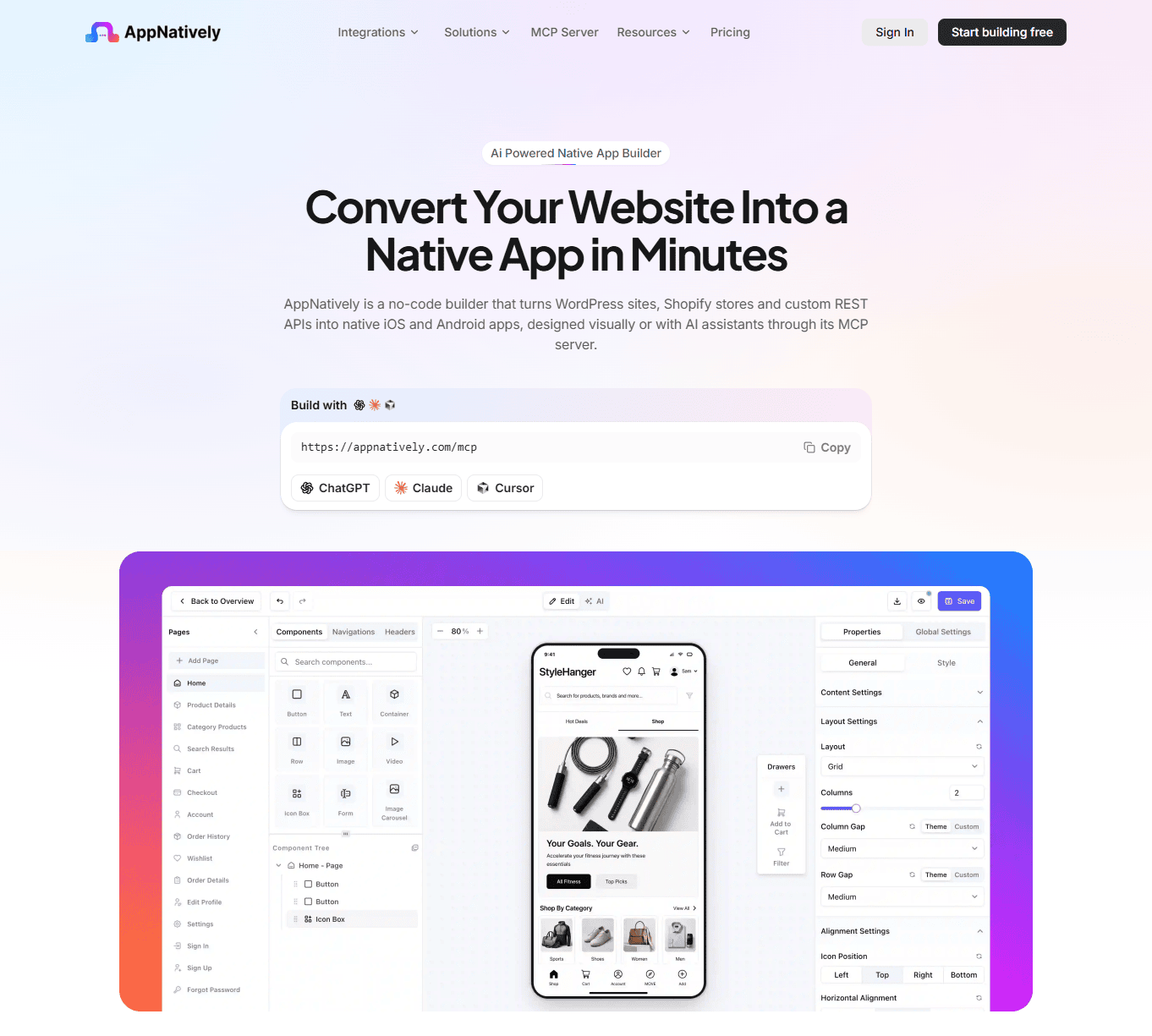
AppNatively is a modern native app builder that enables businesses to create iOS and Android apps without traditional mobile development. While it integrates deeply with Shopify, it also supports WordPress, WooCommerce, SureCart, FluentCart, custom APIs, directories, and other platforms, making it attractive for merchants and agencies managing multiple types of websites.
Its focus is on flexibility, AI-assisted workflows, native performance, and developer-friendly capabilities such as GitHub integration, custom APIs, and OTA updates.
Best suited for
- Shopify brands seeking long-term flexibility
- Growing ecommerce businesses
- Agencies building apps for clients
- Businesses wanting AI-assisted app creation
- Teams that expect custom integrations or future expansion beyond Shopify
What is Tapcart?
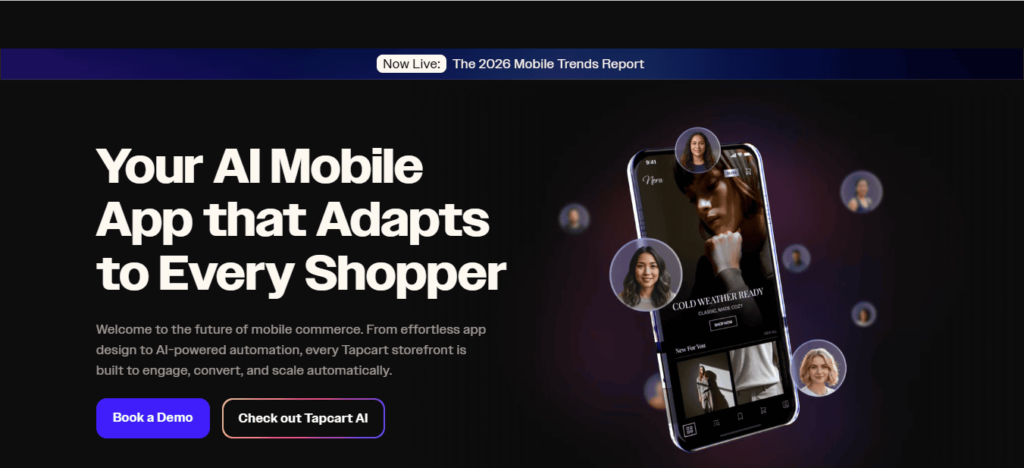
Tapcart is a Shopify-exclusive mobile app platform designed around customer retention and enterprise ecommerce. It provides native mobile apps, advanced analytics, personalization, A/B testing, segmentation, and AI-powered marketing tools. Its strengths are most evident for established Shopify brands with dedicated marketing teams and larger budgets.
Best suited for
- Shopify Plus merchants
- Enterprise ecommerce brands
- High-volume stores
- Marketing teams running sophisticated retention campaigns
What is Shopney?
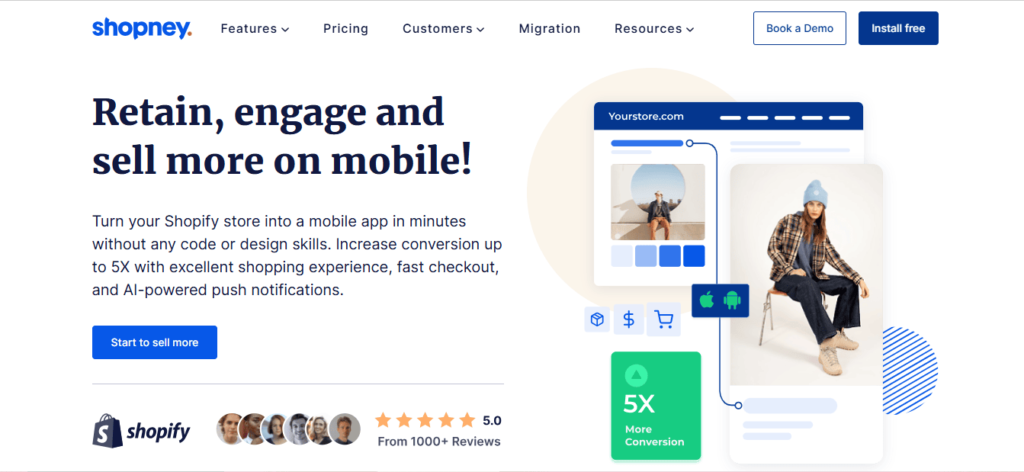
Shopney is a no-code Shopify mobile app builder that emphasizes ease of use, merchandising, and customer engagement. It offers drag-and-drop editing, real-time Shopify synchronization, push notifications, loyalty integrations, and ecommerce-focused templates. Its lower entry price makes it appealing to small and medium-sized Shopify merchants.
Best suited for
- Small and medium Shopify stores
- Merchants wanting quick deployment
- Businesses that prioritize ease of use over extensive customization
What is MobiLoud?
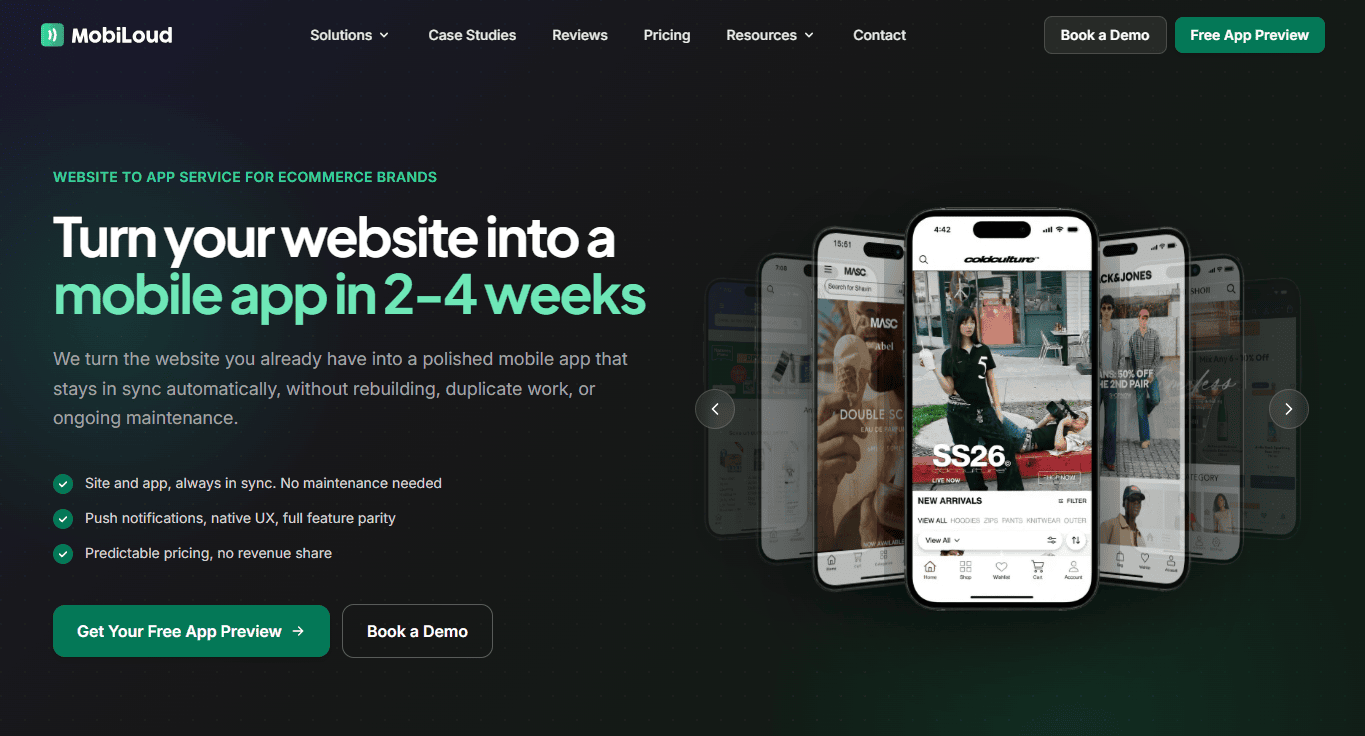
MobiLoud takes a different approach. Rather than asking merchants to recreate their store in a no-code builder, it converts an existing website into a native mobile app. Its team manages much of the build, launch, and maintenance process, making it attractive for businesses that prefer a hands-off experience.
It supports platforms beyond Shopify, including WooCommerce, Magento, BigCommerce, and custom websites.
Best suited for
- Businesses wanting a managed app service
- Brands with heavily customized websites
- Teams that don't want to maintain a separate app design
Our Evaluation Criteria
To provide a meaningful comparison, we'll evaluate each platform across the areas that matter most to ecommerce businesses:
- Native app performance
- Ease of setup
- Design flexibility
- Shopify integration
- AI capabilities
- Developer experience
- Push notifications
- Analytics and marketing
- Third-party integrations
- Pricing and total cost of ownership
- Scalability
- Customer support
- App publishing
- Long-term flexibility
- Return on investment
Rather than declaring a single winner for every category, we'll identify which platform performs best for different business needs, helping you make an informed decision based on your priorities.
Architecture, Performance & Flexibility Comparison
Most comparison articles stop at feature checklists.
Two platforms can offer the same feature, such as push notifications or product synchronization, yet deliver very different experiences because of their underlying architecture.
Understanding how each platform is built helps explain differences in app speed, customization, maintenance, and scalability over time.
1. Platform philosophy
Before comparing features, it helps to understand the core philosophy behind each platform.
| Platform | Primary Focus |
|---|---|
| AppNatively | Flexible native app builder for ecommerce and beyond |
| Tapcart | Enterprise Shopify growth platform |
| Shopney | Shopify-focused no-code app builder |
| MobiLoud | Managed website-to-app conversion service |
This difference shapes nearly every aspect of the product.
For example, if your business operates exclusively on Shopify and values built-in retention tools over deep customization, Tapcart may align well with your goals.
If you expect your mobile app to evolve with custom features, APIs, multiple CMS platforms, or unique customer experiences, a more flexible platform such as AppNatively offers greater room to grow.
2. Native app performance
One of the biggest questions merchants ask is:
Are all four platforms truly native?
Short answer: Yes, but they don't all take the same path to delivering native experiences.
Native apps generally provide:
- Faster loading
- Better animations
- Offline capabilities
- Push notifications
- Improved stability
- Better App Store rankings
- Higher customer satisfaction
However, native performance is influenced by more than the programming language. It also depends on how content is delivered, how updates are managed, and how efficiently the platform syncs with your ecommerce backend.
AppNatively
AppNatively builds native iOS and Android applications while allowing businesses to update many parts of the app without waiting for a complete App Store release. Its architecture is designed to support frequent content updates, custom integrations, and scalable workflows.
This approach is particularly useful for fast-moving ecommerce brands that regularly launch products, campaigns, or seasonal experiences.
Tapcart
Tapcart is optimized for Shopify stores and emphasizes reliability, speed, and retention-focused shopping experiences. Its mature infrastructure is one reason many enterprise Shopify brands choose the platform.
Shopney
Shopney delivers strong native performance with a straightforward architecture centered around Shopify. It prioritizes ease of implementation over extensive technical customization.
MobiLoud
MobiLoud generates native applications that closely mirror an existing website. Performance depends partly on how well the underlying website is optimized. Businesses with fast, responsive websites often see strong results, while slower websites may require optimization to achieve the best mobile experience.
Verdict
For businesses seeking maximum flexibility alongside native performance, AppNatively stands out because it combines native delivery with broader customization options.
For enterprise Shopify brands prioritizing stability and marketing workflows, Tapcart remains a strong contender.
3. Customization capabilities
This is where many merchants discover the biggest differences between platforms.
Not every business wants the same app.
Some only need product listings and checkout.
Others want:
- Custom loyalty systems
- Interactive onboarding
- Membership portals
- Marketplace functionality
- Booking systems
- AI-powered shopping assistants
- Custom dashboards
- API-driven experiences
The more unique your business becomes, the more important customization becomes.
AppNatively
AppNatively is designed with extensibility in mind.
Merchants can combine no-code tools with custom development when needed, making it suitable for businesses that expect their mobile app to evolve rather than remain a fixed template.
Potential customization areas include:
- Custom APIs
- Custom widgets
- Dynamic layouts
- Third-party integrations
- Developer workflows
- GitHub-based development
- AI-assisted content generation
- White-label capabilities
This flexibility makes AppNatively appealing not only to merchants but also to agencies and development teams building tailored solutions.
Tapcart
Tapcart offers extensive customization within its Shopify ecosystem, particularly around merchandising, promotions, and customer engagement.
However, merchants looking to build highly specialized workflows outside Shopify may find its customization options more structured.
Shopney
Shopney focuses on ease of use.
Customization is intentionally simplified so merchants can launch quickly without technical expertise.
For many businesses, this is an advantage.
For businesses with highly specialized requirements, it can become limiting as they grow.
MobiLoud
Customization largely follows the existing website.
If the website already contains custom functionality, those experiences can often carry over into the app.
However, businesses seeking app-specific experiences may need additional development.
Verdict
Best for flexibility: AppNatively
Best for rapid Shopify merchandising: Tapcart
Best for simplicity: Shopney
Best for existing custom websites: MobiLoud
4. Shopify integration
All four platforms integrate with Shopify.
The differences lie in the depth of integration and the surrounding ecosystem.
Important capabilities include:
- Product synchronization
- Inventory updates
- Customer accounts
- Collections
- Orders
- Discounts
- Checkout
- Search
- Reviews
- Loyalty
- Wishlist
- Subscription products
All four platforms cover the essentials, but AppNatively, Tapcart, and Shopney are designed specifically to leverage Shopify's ecosystem more deeply, while MobiLoud adapts to a wider variety of ecommerce platforms.
5. Beyond Shopify
This is an area many buyers overlook.
Businesses change.
Today's Shopify store could become tomorrow's:
- WooCommerce store
- Headless commerce setup
- Custom backend
- WordPress marketplace
- Multi-brand ecosystem
If your app platform only supports one commerce stack, migrating later may require rebuilding your mobile app.
Platform comparison
| Platform | Shopify | WooCommerce | WordPress | Custom API | Other CMS |
|---|---|---|---|---|---|
| AppNatively | ✅ | ✅ | ✅ | ✅ | ✅ |
| Tapcart | ✅ | ❌ | ❌ | Limited | ❌ |
| Shopney | ✅ | ❌ | ❌ | Limited | ❌ |
| MobiLoud | ✅ | ✅ | ✅ | ✅ | ✅ |
For agencies, software companies, franchises, marketplaces, publishers, or businesses with multiple digital properties, broader compatibility can significantly reduce future migration costs.
6. Developer experience
Many merchants start with a no-code platform but eventually need custom functionality.
Questions worth asking include:
- Can developers extend the app?
- Is version control supported?
- Can custom APIs be integrated?
- Is there support for CI/CD workflows?
- Can agencies collaborate efficiently?
- Are updates streamlined?
AppNatively places a stronger emphasis on developer flexibility, making it suitable for businesses that anticipate custom development over time.
Tapcart also offers advanced capabilities, particularly for enterprise customers.
Shopney focuses on keeping development requirements minimal.
MobiLoud handles much of the technical work through its managed-service model.
Section Summary
After evaluating architecture, flexibility, and platform design, several patterns emerge:
- AppNatively offers the broadest flexibility, making it a strong fit for businesses that expect to grow beyond standard templates or Shopify-only workflows.
- Tapcart excels as a mature platform for larger Shopify brands with dedicated marketing teams and enterprise requirements.
- Shopney prioritizes simplicity and speed, making it appealing for merchants who want to launch quickly with minimal technical effort.
- MobiLoud is well suited to businesses that want to transform an existing website into a native app without managing the technical build themselves.
Pricing, Total Cost of Ownership & ROI Comparison
Choosing a mobile app builder is not just about the monthly subscription.
A platform that appears cheaper upfront can become expensive if it requires:
- Developer involvement
- Additional tools
- Custom development
- Expensive upgrades
- Migration costs
- Limited scalability
The right question is not:
"Which platform has the lowest monthly price?"
The better question is:
"Which platform gives my business the highest return over the next 2 to 5 years?"
A mobile app is a long-term customer retention channel. The platform you choose affects your ability to increase repeat purchases, improve customer engagement, and create better mobile experiences.
Pricing overview: AppNatively vs Tapcart vs Shopney vs MobiLoud
Pricing changes frequently, and many platforms offer different tiers based on features, users, revenue, and support levels. Businesses should confirm current pricing directly before purchasing.
| Platform | Pricing Approach | Best Fit |
|---|---|---|
| AppNatively | Flexible plans designed for businesses, agencies, and developers | Startups, SMBs, agencies, growing brands |
| Tapcart | Premium SaaS pricing focused on Shopify merchants | Mid-market and enterprise Shopify brands |
| Shopney | Lower-cost Shopify app builder plans | Small and medium Shopify stores |
| MobiLoud | Managed service pricing | Companies wanting hands-off development |
AppNatively pricing strategy
AppNatively positions itself around accessibility and flexibility.
The biggest advantage of this model is that businesses can access advanced app-building capabilities without necessarily entering enterprise-level pricing.
For many brands, the challenge is not simply building an app. The challenge is having enough budget left for:
- Marketing
- Customer acquisition
- Product development
- Retention campaigns
- App store optimization
A platform that delivers native capabilities while preserving budget flexibility can create a better overall ROI.
Best value scenarios:
AppNatively is especially attractive for:
- New ecommerce brands
- Growing Shopify stores
- Agencies building multiple apps
- Businesses experimenting with mobile commerce
- Companies needing custom functionality later
Tapcart pricing strategy
Tapcart follows a premium positioning.
Its pricing reflects its focus on established Shopify brands that want sophisticated mobile commerce capabilities.
The platform is particularly valuable when a company already has:
- Significant mobile traffic
- Large customer databases
- Dedicated marketing teams
- Budget for retention campaigns
For these businesses, advanced segmentation, analytics, personalization, and lifecycle marketing can justify a higher investment.
However, smaller brands may find that the cost exceeds their immediate needs.
Best value scenarios:
Tapcart works best for:
- Shopify Plus merchants
- Large DTC brands
- Businesses with high customer lifetime value
- Companies running advanced retention strategies
Shopney pricing strategy
Shopney focuses on making mobile apps accessible to Shopify merchants.
Its pricing approach appeals to businesses that want:
- Fast launch
- Simple setup
- Essential mobile commerce features
- Lower entry barriers
This makes it attractive for smaller stores that need a mobile app without significant complexity.
The tradeoff is that businesses requiring deeper customization may eventually need more advanced capabilities.
Best value scenarios:
Shopney works well for:
- Small Shopify stores
- First-time app owners
- Merchants prioritizing simplicity
MobiLoud pricing strategy
MobiLoud takes a managed-service approach.
Instead of giving businesses only a builder, it provides more hands-on technical assistance.
This can reduce internal workload because the business does not need to manage every technical detail.
The tradeoff is that managed services generally come with higher costs because expertise and implementation are included.
Best value scenarios:
MobiLoud fits:
- Businesses without technical teams
- Companies with complex existing websites
- Organizations that prefer outsourcing app development
Total cost of ownership (TCO)
The subscription price is only one part of the investment.
A realistic mobile app budget includes:
1. Initial setup
Consider:
- Design
- Configuration
- Store submission
- Integrations
- Testing
Platforms with easier setup reduce launch costs.
2. Ongoing maintenance
Mobile apps require:
- OS updates
- Bug fixes
- Feature improvements
- Security updates
- Compatibility changes
A platform with efficient update workflows reduces maintenance overhead.
3. Custom development
This is where platforms can differ significantly.
A basic ecommerce app may require little customization.
A growing brand may eventually need:
- Custom checkout experiences
- Loyalty systems
- AI shopping assistants
- Membership areas
- Advanced search
- External integrations
The ability to extend the platform becomes increasingly important.
4. Marketing costs
A mobile app only creates value when customers use it.
Successful app strategies often include:
- Push notifications
- Personalized campaigns
- Exclusive offers
- Loyalty rewards
- Mobile-only promotions
A cheaper app that customers do not engage with produces less value than a premium app that increases retention.
ROI Comparison: Which Platform Creates the Most Business Value?
The answer depends on your growth stage.
Early-stage brands
Priority:
- Keep costs controlled
- Launch quickly
- Test mobile demand
Best fit:
AppNatively or Shopney
Why:
Both allow merchants to enter mobile commerce without enterprise-level investment.
Growing brands
Priority:
- Increase repeat purchases
- Add customization
- Build stronger customer relationships
Best fit:
AppNatively
Why:
Growing companies often need flexibility. They may start with standard ecommerce features but later require custom workflows, integrations, and more control.
Enterprise brands
Priority:
- Advanced analytics
- Customer segmentation
- Large-scale retention campaigns
Best fit:
Tapcart or AppNatively
Why:
Tapcart offers strong enterprise Shopify marketing capabilities, while AppNatively provides flexibility for businesses building more customized ecosystems.
Businesses without technical resources
Priority:
- Minimal internal workload
- Someone else manages implementation
Best fit:
MobiLoud
Why:
Its managed approach reduces the need for internal technical ownership.
Hidden Costs Buyers Should Consider
Many companies underestimate these factors:
Platform lock-in
Ask:
- Can I move my app later?
- Can I export my data?
- Can I customize beyond templates?
- Will I need to rebuild everything?
A flexible platform reduces future risk.
Feature limitations
A platform may appear affordable until you discover important features require:
- Higher tiers
- Custom quotes
- Developer work
Always compare the complete feature set, not the entry price.
Growth limitations
A platform that works for a $10,000/month store may not work for a $1M/month brand.
Choose based on where your company is going, not only where it is today.
Pricing verdict
There is no universal cheapest winner because each platform solves a different problem.
| Business Goal | Recommended Platform |
|---|---|
| Best balance of flexibility and value | AppNatively |
| Enterprise Shopify retention marketing | Tapcart |
| Affordable Shopify app launch | Shopney |
| Fully managed app development | MobiLoud |
For most businesses looking for a long-term mobile commerce foundation, AppNatively provides the strongest combination of capability, flexibility, and investment efficiency.
AI Capabilities, Automation & The Future of Mobile Commerce
Artificial intelligence is becoming one of the biggest differentiators between mobile app platforms.
However, there is an important distinction:
Some platforms use AI to help merchants market better.
Others use AI to help merchants build, customize, and operate the app itself.
These are two very different approaches.
The future of ecommerce apps will likely combine both:
- AI-assisted app creation
- AI-powered shopping experiences
- Automated customer engagement
- Intelligent personalization
- Faster iteration without developer dependency
This is where AppNatively has a strategic advantage because AI is positioned closer to the app creation workflow itself, not only the marketing layer.
What does "AI-Powered App Building" actually mean?
The phrase "AI-powered" has become common in software marketing.
But there are different levels of AI integration.
Level 1: AI content assistance
Examples:
- Writing push notifications
- Creating product descriptions
- Generating campaign ideas
- Suggesting marketing copy
Useful, but limited.
Level 2: AI design assistance
Examples:
- Creating app layouts
- Suggesting screens
- Generating themes
- Helping customize UI
This reduces design time.
Level 3: AI app development assistance
Examples:
- Creating app screens from prompts
- Modifying components
- Connecting workflows
- Building app experiences through AI commands
This changes how apps are created.
Instead of waiting for developers or designers, teams can describe what they want and iterate much faster.
This is the direction where AppNatively differentiates itself.
AppNatively AI capabilities
AppNatively approaches AI as part of the creation and management workflow.
Its MCP integration allows AI assistants such as ChatGPT, Claude, Cursor, and other MCP-compatible tools to interact with AppNatively workflows. Merchants can describe changes, create screens, and refine app experiences through AI-assisted commands while keeping control over publishing decisions.
Examples of AI-assisted workflows:
"Create a holiday shopping homepage"
An AI assistant can help generate:
- Hero banners
- Product sections
- Category layouts
- Promotional blocks
- Navigation changes
"Build a loyalty dashboard"
AI can assist with creating:
- Member sections
- Rewards screens
- Account experiences
- Custom app flows
"Create a marketplace experience"
AI-assisted workflows can accelerate:
- Seller pages
- Product discovery
- Category structures
- Custom screens
The strategic advantage is that AI becomes part of the building process, not just the marketing process.
Tapcart AI capabilities
Tapcart has invested heavily in AI features focused on ecommerce growth.
Its AI capabilities are designed around:
- Personalization
- Campaign creation
- Push notifications
- Content optimization
- Customer engagement
Examples include:
- AI-assisted editing
- AI push notifications
- AI personalization features
- AI-powered merchandising workflows
This makes Tapcart especially attractive for brands where the mobile app is primarily a retention and revenue channel.
Shopney AI capabilities
Shopney focuses its AI capabilities around helping merchants create and optimize ecommerce app experiences.
Its AI tools support areas such as:
- App design assistance
- Push notification creation
- Ecommerce engagement workflows
Shopney's approach is centered around helping Shopify merchants launch and operate shopping apps quickly without requiring technical knowledge.
MobiLoud AI capabilities
MobiLoud follows a different philosophy.
Its core value proposition is managed app development and website-to-app conversion rather than AI-driven app creation.
For businesses that want someone else to manage the technical process, this can be valuable.
However, businesses looking for AI-assisted self-service creation and rapid experimentation may prefer platforms where AI is directly integrated into the builder workflow.
AI comparison: AppNatively vs Tapcart vs Shopney vs MobiLoud
| Capability | AppNatively | Tapcart | Shopney | MobiLoud |
|---|---|---|---|---|
| AI app creation | ✅ Strong focus | Limited | Limited | Not core focus |
| AI design assistance | ✅ | ✅ | ✅ | Limited |
| AI marketing workflows | Growing | ✅ Strong | ✅ | Limited |
| AI assistant integrations | ✅ MCP | Enterprise-focused | Limited | No major focus |
| Prompt-based app changes | ✅ | Limited | Limited | No |
| Developer AI workflows | ✅ | Enterprise | No | No |
Why AI will change mobile commerce
Traditional app development follows this process:
- Idea
- Design request
- Designer creates mockups
- Developer builds features
- Testing
- Release
- Repeat
This process can take weeks or months.
AI-assisted app development changes the workflow:
- Describe the experience
- Generate a first version
- Adjust visually
- Publish improvements
- Iterate continuously
The businesses that can experiment faster will have a major advantage.
AI and competitive advantage
A mobile app is no longer just a digital storefront.
The next generation of apps will become:
- Personalized shopping assistants
- Loyalty platforms
- Community channels
- Subscription hubs
- Customer relationship engines
The platform you choose should support where mobile commerce is going, not only what it does today.
Which platform wins for AI?
Best AI app creation:
🏆 AppNatively
Best fit for businesses that want AI to accelerate the actual building and customization process.
Best AI ecommerce marketing:
🏆 Tapcart
Best fit for enterprise brands focused on personalization, campaigns, and retention.
Best AI-assisted Shopify simplicity:
🏆 Shopney
Best fit for merchants who want easier ecommerce app setup with AI assistance.
Best managed experience:
🏆 MobiLoud
Best fit for businesses that prefer a service provider handling implementation.
Strategic verdict
The biggest difference is not whether these platforms use AI.
Most modern platforms do.
The difference is where AI sits in the product strategy.
- Tapcart uses AI mainly to make enterprise ecommerce marketing smarter.
- Shopney uses AI mainly to simplify Shopify app creation and engagement.
- MobiLoud focuses on managed execution.
- AppNatively uses AI closer to the foundation of app creation, allowing businesses to build, customize, and evolve mobile experiences faster.
For companies that believe the future of software is moving toward AI-assisted creation, this distinction becomes increasingly important.
Push Notifications, Retention Marketing & Customer Engagement
A mobile app is only valuable if customers continue to use it.
This is why retention is often a better success metric than downloads.
Many brands celebrate reaching 10,000 app installs, only to discover that a large percentage of users stop opening the app within a few weeks.
The most successful mobile commerce strategies focus on keeping customers engaged through relevant, timely, and personalized experiences.
Push notifications are one of the most effective tools for doing that.
Why push notifications matter
Unlike email or social media, push notifications reach customers directly on their devices.
They can help merchants:
- Announce new product launches
- Recover abandoned carts
- Promote flash sales
- Notify customers about back-in-stock items
- Reward loyal shoppers
- Encourage repeat purchases
- Re-engage inactive users
Because users have already installed your app and opted in, push notifications often become one of the highest-performing owned marketing channels when used thoughtfully.
What makes a great retention platform?
Sending unlimited notifications is only the beginning.
Modern mobile commerce platforms are evaluated on capabilities such as:
- Audience segmentation
- Behavioral triggers
- Rich media support
- Deep linking
- Automated journeys
- Personalization
- Analytics
- Scheduling
- A/B testing
- Integration with marketing platforms
The richer the retention toolkit, the more opportunities merchants have to increase customer lifetime value.
AppNatively: Flexible engagement built around your business
AppNatively includes unlimited push notifications and supports Firebase-based delivery, allowing merchants to communicate directly with app users.
Its advantage is less about offering a long list of prebuilt marketing workflows and more about providing flexibility.
Because the platform is designed for customization, businesses can build engagement strategies around their own workflows rather than being limited to fixed campaign templates.
Examples include:
- Product launch campaigns
- Flash sale notifications
- Loyalty reminders
- Membership announcements
- Event promotions
- Custom API-triggered notifications
- Personalized customer experiences
For merchants using AI-assisted workflows, notifications can become part of broader automated customer journeys rather than isolated marketing campaigns.
Best suited for
- Brands wanting flexibility
- Agencies building custom experiences
- Businesses integrating multiple systems
- Merchants expecting their engagement strategy to evolve
Tapcart: Enterprise-grade retention marketing
Retention marketing is one of Tapcart's biggest strengths.
Its platform combines:
- Unlimited push notifications
- Automated campaigns
- Behavioral segmentation
- Personalized offers
- In-app messaging
- AI-generated push campaigns
- Customer journey analytics
- A/B testing
- Smart audience building
Recent updates have expanded Tapcart's AI capabilities with features such as AI Push Notifications, App Agent, personalized shopping feeds, and automated campaign recommendations.
This makes Tapcart particularly compelling for brands with dedicated lifecycle marketing teams.
If your organization already runs sophisticated email and SMS programs through platforms like Klaviyo or Attentive, Tapcart's marketing ecosystem can fit naturally into that strategy.
Best suited for
- Shopify Plus brands
- Enterprise ecommerce
- High-volume DTC businesses
- Dedicated retention marketing teams
Shopney: Ecommerce-focused customer engagement
Shopney emphasizes practical engagement tools for Shopify merchants.
Its push notification capabilities include:
- Unlimited notifications
- Scheduled campaigns
- Personalized messages
- Welcome notifications
- Abandoned cart reminders
- Rich media support
- AI-generated notification copy on eligible plans
- Back-in-stock alerts
- Promotional campaigns
For many small and medium-sized merchants, these built-in automations cover the majority of day-to-day engagement needs without requiring complex setup.
Best suited for
- Shopify merchants
- Smaller marketing teams
- Brands focused on ecommerce promotions
MobiLoud: Push Notifications through a managed approach
MobiLoud supports push notifications, typically through integrations such as OneSignal, with enterprise options supporting additional marketing platforms.
Its philosophy differs from the others.
Rather than providing an extensive no-code marketing suite inside the builder, MobiLoud focuses on ensuring the app works seamlessly with the website and existing marketing stack.
This can be attractive for companies that already have established customer engagement systems.
Feature Comparison
| Capability | AppNatively | Tapcart | Shopney | MobiLoud |
|---|---|---|---|---|
| Unlimited Push Notifications | ✅ | ✅ | ✅ | ✅ |
| Scheduled Campaigns | ✅ | ✅ | ✅ | Depends on integration |
| Rich Media Notifications | ✅ | ✅ | ✅ | Via provider |
| Deep Linking | ✅ | ✅ | ✅ | ✅ |
| Abandoned Cart Notifications | Configurable | ✅ | ✅ | Via integration |
| Welcome Campaigns | Configurable | ✅ | ✅ | Via integration |
| AI Push Copy | Growing | ✅ | ✅ | Limited |
| Behavioral Segmentation | Customizable | ✅ Advanced | Moderate | Depends on stack |
| In-App Messaging | Customizable | ✅ | Available | Limited |
| Marketing Automation | Flexible | Extensive | Good | Integration-driven |
Segmentation: The difference between broadcasting and personalization
Imagine sending the same promotion to every customer.
Now compare that with sending different offers to:
- First-time buyers
- VIP customers
- Dormant users
- Customers who abandoned their cart
- High-value purchasers
- Frequent app users
The second approach almost always delivers better engagement because the message matches customer intent.
Tapcart invests heavily in segmentation and personalization, giving enterprise merchants detailed targeting options.
Shopney offers personalization and automated campaigns suitable for most Shopify stores.
AppNatively takes a more flexible route, enabling businesses to build segmentation strategies around their own integrations and workflows instead of prescribing a single marketing model.
Beyond push notifications
Retention is about more than alerts.
Successful mobile apps create multiple reasons for customers to return.
These may include:
- Exclusive app-only discounts
- Loyalty rewards
- Personalized home screens
- Product recommendations
- Wishlists
- Saved shopping carts
- New arrival collections
- Community content
- Referral programs
- Membership benefits
The strongest retention strategies combine these experiences with thoughtful notification campaigns rather than relying on frequent promotional messages.
Which platform is best for customer retention?
The answer depends on how your business approaches customer engagement.
Choose AppNatively if:
- You want flexibility to create custom engagement experiences.
- Your retention strategy extends beyond standard ecommerce campaigns.
- You anticipate integrating AI, custom APIs, or proprietary workflows into your app.
Choose Tapcart if:
- Retention marketing is a core competitive advantage.
- You need advanced segmentation, AI-assisted campaigns, experimentation, and analytics.
- Your team actively manages lifecycle marketing across multiple channels.
Choose Shopney if:
- You want practical, ready-to-use engagement features without enterprise complexity.
- Your marketing team values simplicity and speed.
Choose MobiLoud if:
- Your existing marketing stack already handles engagement.
- You prefer your app to complement your website rather than introduce a separate marketing workflow.
Design, Customization & User Experience: AppNatively vs Tapcart vs MobiLoud vs Shopney
A mobile app is not just a smaller version of a website. The best ecommerce apps are designed around speed, simplicity, personalization, and repeat purchases.
The biggest difference between these platforms is how much control businesses have over the customer experience.
AppNatively: Best for flexibility and custom experiences
AppNatively is built for brands that want more than a standard ecommerce template.
It allows businesses to create branded mobile experiences with:
- Custom layouts
- AI-assisted design workflows
- Custom APIs
- Advanced integrations
- White-label apps
- Flexible app structures
This makes it a strong choice for brands that want their app to evolve as their business grows.
Best for: Growing brands, agencies, and businesses needing customization.
Tapcart: Best for premium Shopify experiences
Tapcart focuses heavily on Shopify ecommerce optimization.
Strengths include:
- Polished shopping experiences
- Product merchandising
- Conversion-focused layouts
- Strong marketing integrations
- Enterprise-level customization
Its main advantage is helping established Shopify brands create high-converting shopping apps quickly.
Best for: Shopify Plus and enterprise ecommerce brands.
Shopney: Best for simplicity
Shopney focuses on helping Shopify merchants launch quickly.
Strengths include:
- Easy setup
- Drag-and-drop customization
- Ecommerce templates
- Simple branding controls
It works well for businesses that want a mobile app without complex development needs.
Best for: Small and medium Shopify stores.
MobiLoud: Best for website-based apps
MobiLoud takes a different approach by converting existing websites into native apps.
Advantages:
- Managed implementation
- Existing website functionality carries over
- Less technical involvement required
Best for: Businesses that want a hands-off app development process.
Design & customization comparison
| Feature | AppNatively | Tapcart | Shopney | MobiLoud |
|---|---|---|---|---|
| Visual builder | ✅ | ✅ | ✅ | ❌ |
| Custom experiences | ✅ Strong | Good | Limited | Website-based |
| AI-assisted creation | ✅ | Limited | Limited | ❌ |
| Developer flexibility | ✅ | Enterprise | Limited | Moderate |
| White-label options | ✅ | Limited | Limited | Limited |
Design Verdict
- Best overall customization: AppNatively
- Best Shopify ecommerce design: Tapcart
- Best simplicity: Shopney
- Best managed website conversion: MobiLoud
For businesses that want an app that can grow beyond basic shopping features, AppNatively provides the most flexibility without forcing brands into a fixed template system.
Integrations, APIs & Ecommerce Ecosystem Comparison
A mobile app rarely works alone.
The strongest ecommerce apps connect with the tools businesses already use for:
- Customer data
- Marketing automation
- Payments
- Reviews
- Loyalty programs
- Analytics
- Inventory
- CRM systems
A platform's integration ecosystem determines how easily your app can become part of your overall business operations.
AppNatively: Best for Flexibility Beyond Shopify
AppNatively stands out because it is not limited to a single ecommerce ecosystem.
It supports:
- Shopify
- WooCommerce
- WordPress
- Custom APIs
- External data sources
This makes it useful for businesses that may have more complex technology stacks.
Key advantages:
- API flexibility
- Developer-friendly workflows
- Custom integrations
- Support for unique business models
Best for: Businesses, agencies, and brands that need more than a standard Shopify app.
Tapcart: Best Shopify ecosystem depth
Tapcart is deeply connected with Shopify.
It works well with many popular ecommerce tools, including:
- Shopify products and collections
- Customer accounts
- Reviews
- Loyalty platforms
- Email and SMS marketing tools
- Analytics solutions
Its ecosystem is strongest for brands already committed to Shopify as their core platform.
Best for: Shopify-focused brands that want a mature ecommerce stack.
Shopney: Best Shopify app for simplicity
Shopney focuses on essential Shopify integrations.
Common integrations include:
- Shopify products
- Customer accounts
- Reviews
- Loyalty tools
- Marketing apps
Its strength is simplicity. Merchants can launch quickly without managing complex technical connections.
Best for: Shopify merchants who need practical integrations without heavy customization.
MobiLoud: Best for existing technology stacks
MobiLoud works differently.
Because it converts websites into native apps, it can inherit functionality already built into the website.
This makes it useful for businesses with:
- Custom websites
- Existing ecommerce platforms
- Complex web functionality
Best for: Companies that already have a strong digital infrastructure.
Integration comparison
| Capability | AppNatively | Tapcart | Shopney | MobiLoud |
|---|---|---|---|---|
| Shopify | ✅ | ✅ | ✅ | ✅ |
| WooCommerce | ✅ | ❌ | ❌ | ✅ |
| WordPress | ✅ | ❌ | ❌ | ✅ |
| Custom APIs | ✅ | Limited | Limited | ✅ |
| Third-party integrations | Extensive | Extensive | Good | Website-dependent |
| Developer flexibility | High | Medium | Low | Medium |
Integration verdict
Different businesses need different levels of flexibility.
Choose AppNatively if:
- You need custom integrations
- You may expand beyond Shopify
- You want API control
- You need a future-proof app foundation
Choose Tapcart if:
- Shopify is your entire ecosystem
- You need enterprise ecommerce integrations
Choose Shopney if:
- You want simple Shopify connections
Choose MobiLoud if:
- Your existing website already contains important functionality
App Store Publishing, Updates & Maintenance Comparison
Launching a mobile app is only the beginning.
A successful app requires ongoing improvements:
- Bug fixes
- New features
- Design updates
- Operating system compatibility
- Performance improvements
- Security updates
The best platform is not only the one that helps you launch quickly, but the one that makes long-term management easier.
App Store publishing
All four platforms support publishing apps to:
- Apple App Store
- Google Play Store
However, the level of support varies.
AppNatively: Flexible publishing & faster iteration
AppNatively helps businesses create and publish native apps while giving them more control over future improvements.
Key advantages:
- Native iOS and Android apps
- Faster iteration through OTA updates
- Developer-friendly workflows
- Ability to introduce custom functionality over time
This is valuable for brands that want to continuously improve their app experience without rebuilding from scratch.
Best for: Businesses that want ownership and flexibility.
Tapcart: Streamlined Shopify app launch
Tapcart provides a mature publishing process designed around Shopify merchants.
Strengths:
- Reliable app deployment
- Shopify-focused workflows
- Enterprise support options
Its process works especially well for brands that want a polished ecommerce app without managing much technical complexity.
Best for: Shopify brands prioritizing speed and reliability.
Shopney: Simple launch process
Shopney focuses on making app creation accessible to merchants without technical backgrounds.
Advantages:
- Simple setup
- Guided publishing
- Easy management
This works well for smaller teams launching their first mobile app.
Best for: Merchants who want simplicity.
MobiLoud: Managed publishing
MobiLoud handles much of the technical publishing process as part of its managed service approach.
Advantages:
- Less technical workload
- Professional assistance
- Existing website functionality carried into the app
Best for: Businesses that prefer outsourcing technical operations.
OTA Updates & maintenance
One major difference between platforms is how quickly changes can reach users.
Traditional app updates require:
- Development
- Testing
- App Store review
- User update adoption
This can slow down improvements.
Modern platforms increasingly use OTA (over-the-air) updates where possible.
Maintenance comparison
| Feature | AppNatively | Tapcart | Shopney | MobiLoud |
|---|---|---|---|---|
| iOS app | ✅ | ✅ | ✅ | ✅ |
| Android app | ✅ | ✅ | ✅ | ✅ |
| App Store publishing support | ✅ | ✅ | ✅ | ✅ |
| OTA updates | ✅ | ✅ | Partial | Managed |
| Custom development support | ✅ | Enterprise | Limited | Available |
| Merchant control | High | Medium | Medium | Lower |
Ownership & long-term control
A key question businesses should ask:
"Am I building an app asset that I control, or am I renting a fixed experience?"
Important considerations:
- Can the app evolve with your business?
- Can developers add custom functionality?
- Can you introduce new business models?
- Can you avoid expensive rebuilds later?
Maintenance verdict
AppNatively
Best for businesses that want control, flexibility, and continuous improvement.
Tapcart
Best for established Shopify brands wanting a reliable enterprise solution.
Shopney
Best for merchants who value easy management.
MobiLoud
Best for companies that want a managed technical partner.
Support, Scalability & Best Platform by Business Type
The right mobile app platform depends heavily on your business stage, technical needs, and growth plans.
A small Shopify store and a global ecommerce brand have very different requirements.
AppNatively
Best for: Growing brands, agencies, and businesses needing flexibility.
Strengths:
- Scales beyond basic ecommerce
- Supports custom integrations
- Works for multiple business models
- Gives more control as requirements grow
Ideal for companies that want a mobile app platform they won't quickly outgrow.
Tapcart
Best for: Enterprise Shopify brands.
Strengths:
- Strong ecommerce marketing features
- Advanced retention tools
- Mature Shopify ecosystem
Ideal for brands with dedicated marketing teams and larger customer bases.
Shopney
Best for: Small and medium Shopify merchants.
Strengths:
- Easy setup
- Simple management
- Lower complexity
Ideal for businesses that want a straightforward shopping app.
MobiLoud
Best for: Businesses wanting a managed solution.
Strengths:
- Less technical involvement
- Works well with existing websites
- Professional implementation support
Ideal for companies that prefer outsourcing app development.
Quick Decision Guide
| If you are... | Best fit |
|---|---|
| A growing brand wanting flexibility | AppNatively |
| A Shopify Plus enterprise company | Tapcart |
| A small Shopify store | Shopney |
| A business wanting a managed app | MobiLoud |
| An agency building apps for clients | AppNatively |
Final Verdict
Choosing a mobile app builder depends on your business goals.
All four platforms can help businesses create native mobile experiences, but they are designed for different types of companies.
Choose AppNatively if you want:
- A flexible native app platform
- AI-assisted app creation
- Custom integrations and APIs
- More control over your customer experience
- A solution that can scale beyond basic ecommerce
- A platform suitable for both merchants and agencies
Best overall choice for businesses that want long-term flexibility.
Choose Tapcart if you want:
- Enterprise Shopify optimization
- Advanced retention marketing
- Strong ecommerce analytics
- A mature Shopify-focused ecosystem
Best choice for larger Shopify brands with dedicated marketing teams.
Choose Shopney if you want:
- A simple Shopify mobile app
- Fast setup
- Easy management
- Essential ecommerce features
Best choice for smaller Shopify merchants getting started with mobile apps.
Choose MobiLoud if you want:
- A managed app development experience
- Your existing website converted into an app
- Less technical involvement
Best choice for businesses that prefer outsourcing implementation.
Overall Comparison Winner by Category
| Category | Winner |
|---|---|
| Flexibility | 🏆 AppNatively |
| AI-assisted app creation | 🏆 AppNatively |
| Enterprise Shopify marketing | 🏆 Tapcart |
| Ease of Shopify setup | 🏆 Shopney |
| Managed implementation | 🏆 MobiLoud |
| Multi-platform support | 🏆 AppNatively |
| Custom development potential | 🏆 AppNatively |
| Simplicity | 🏆 Shopney |
The future of Ecommerce apps
The next generation of mobile commerce will not just be about converting websites into apps.
The winners will be platforms that help businesses create:
- Personalized shopping experiences
- AI-powered customer journeys
- Loyalty ecosystems
- Community-driven commerce
- Custom digital experiences
Businesses need platforms that can adapt as technology changes.
That is why flexibility, AI capabilities, integrations, and long-term ownership matter more than just launch speed.
Frequently asked questions
The best Shopify mobile app builder depends on your needs. AppNatively is a strong choice for businesses that want flexibility, customization, and AI-assisted app creation. Tapcart is better suited for enterprise Shopify brands focused on retention marketing, while Shopney is ideal for smaller Shopify stores.
AppNatively and Tapcart serve different audiences. Tapcart is strong for enterprise Shopify marketing and retention, while AppNatively provides more flexibility for businesses that want custom workflows, broader integrations, and AI-powered app creation.
Tapcart can be worth the investment for large Shopify brands that need advanced retention marketing, personalization, and analytics. Smaller businesses may find more value in flexible platforms with lower complexity.
Yes. Shopney is a good option for Shopify merchants who want an easy-to-use mobile app builder with ecommerce-focused features and quick setup.
MobiLoud is different from traditional app builders. It is better suited for businesses that want a managed service that converts an existing website into a native app.
Yes. AppNatively supports native iOS and Android app creation.
AppNatively and MobiLoud support custom API-based workflows. Tapcart and Shopney are more focused on Shopify-based integrations.
AppNatively is a strong option for agencies because it provides flexibility for creating customized apps across different client requirements.
Small businesses should consider AppNatively or Shopney depending on their needs. Shopney is ideal for simple Shopify apps, while AppNatively offers more room for future growth.
Tapcart is a strong choice for enterprise Shopify brands, especially those focused on lifecycle marketing and customer retention. AppNatively is also a strong option for enterprises needing more customization.
Related posts