
AppNatively vs MobiLoud vs AppMySite: Which Mobile App Builder Is Best in 2026?

Turning a website into a mobile app is easier than ever.
You no longer necessarily need to hire a dedicated iOS and Android development team, spend tens of thousands of dollars on custom development, or wait months before your app reaches the App Store and Google Play.
Platforms such as AppNatively, MobiLoud, and AppMySite have made website-to-app development considerably more accessible.
But they do not solve the problem in exactly the same way.
AppNatively focuses on building highly customizable native mobile experiences through a visual builder, AI-assisted workflows, API connectivity, and MCP-powered development.
MobiLoud takes a managed-service approach. Its team turns an existing website into iOS and Android apps while maintaining the website as the primary source of content and functionality.
AppMySite focuses on simplifying the website-to-app process through a self-service platform with strong WordPress, WooCommerce, Shopify, and ecommerce capabilities.
So which one should you choose?
The answer depends on what you actually need from your mobile app.
If you want to design the mobile experience yourself and have extensive control over native screens, components, APIs, AI workflows, and updates, AppNatively is particularly compelling.
If you operate a larger ecommerce business and want a team to build, launch, and maintain the app for you, MobiLoud's managed model can make more sense.
If you want a self-service way to turn a WordPress and WooCommerce website into an app, AppMySite is worth considering.
Let's break down the differences.
AppNatively vs MobiLoud vs AppMySite at a Glance
Before getting into the details, here's the short answer.
| Category | AppNatively | MobiLoud | AppMySite |
|---|---|---|---|
| Core approach | Visual native app builder | Managed app service | Self-service app builder |
| Native iOS & Android | Yes | Yes | Yes |
| No-code workflow | Yes | Mostly managed | Yes |
| Visual app builder | Yes | Limited compared with builder-first platforms | Yes |
| AI-assisted building | Yes | Not the primary focus | Yes |
| AI agent / MCP workflows | Yes | No comparable MCP-first workflow | Not its primary differentiator |
| Custom REST API | Yes | Supports custom/headless sites | Supports custom app workflows |
| WordPress | Yes | Yes | Yes |
| WooCommerce | Yes | Yes | Yes |
| Shopify | Yes | Yes | Yes |
| Directory apps | Strong fit | Possible | Possible |
| Custom mobile-first UI | Strong | Strong, managed | Strong |
| OTA updates | Yes | Website changes sync through its model | Supported update/sync workflows |
| Push notifications | Yes | Yes | Yes |
| Real-device preview | Yes | Preview/service-led workflow | Yes |
| App-store submission | Yes | Managed by MobiLoud | Supported |
| Managed service | No, primarily self-service | Yes | No, primarily self-service |
| Best for | Custom native experiences | Established brands wanting done-for-you service | Fast website/ecommerce conversion |
| Pricing model | Builder/platform plans | Premium monthly managed service | Subscription/self-service plans |
These comparisons are based on the platforms' currently published capabilities and positioning, not independent performance testing.
What Is the Difference Between AppNatively, MobiLoud, and AppMySite?
The easiest way to understand these three platforms is to look at what each one considers the source of the mobile app.
AppNatively: Build the mobile experience
AppNatively starts with your website, store, directory, or API, but gives you a visual environment for designing the actual mobile experience.
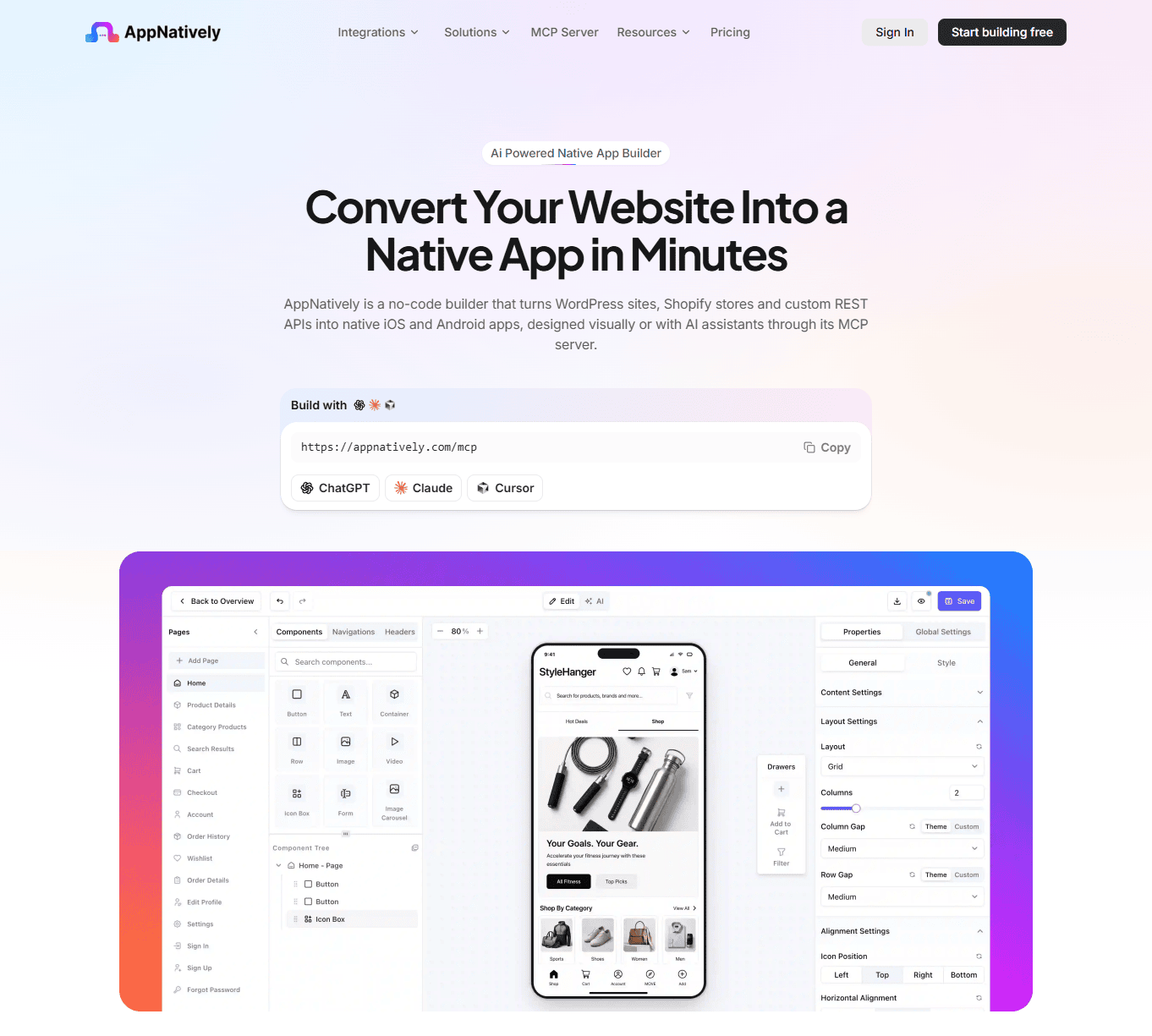
You connect your existing backend, create native screens, configure navigation, use native components, preview the app on a real device, and publish to the app stores.
It supports WordPress, WooCommerce, SureCart, FluentCart, directory platforms such as Directorist, GeoDirectory, and HivePress, Shopify, and custom REST APIs.
The basic workflow is:
Connect → Design → Preview → Build → Publish → Update
That distinction matters.
The goal isn't simply to put your website inside an app.
It is to create a mobile experience around the data and functionality you already have.
MobiLoud: Let a team build and manage the app
MobiLoud approaches the problem differently.
Instead of primarily giving you a visual builder and asking you to create the application yourself, MobiLoud combines its technology with a managed service.
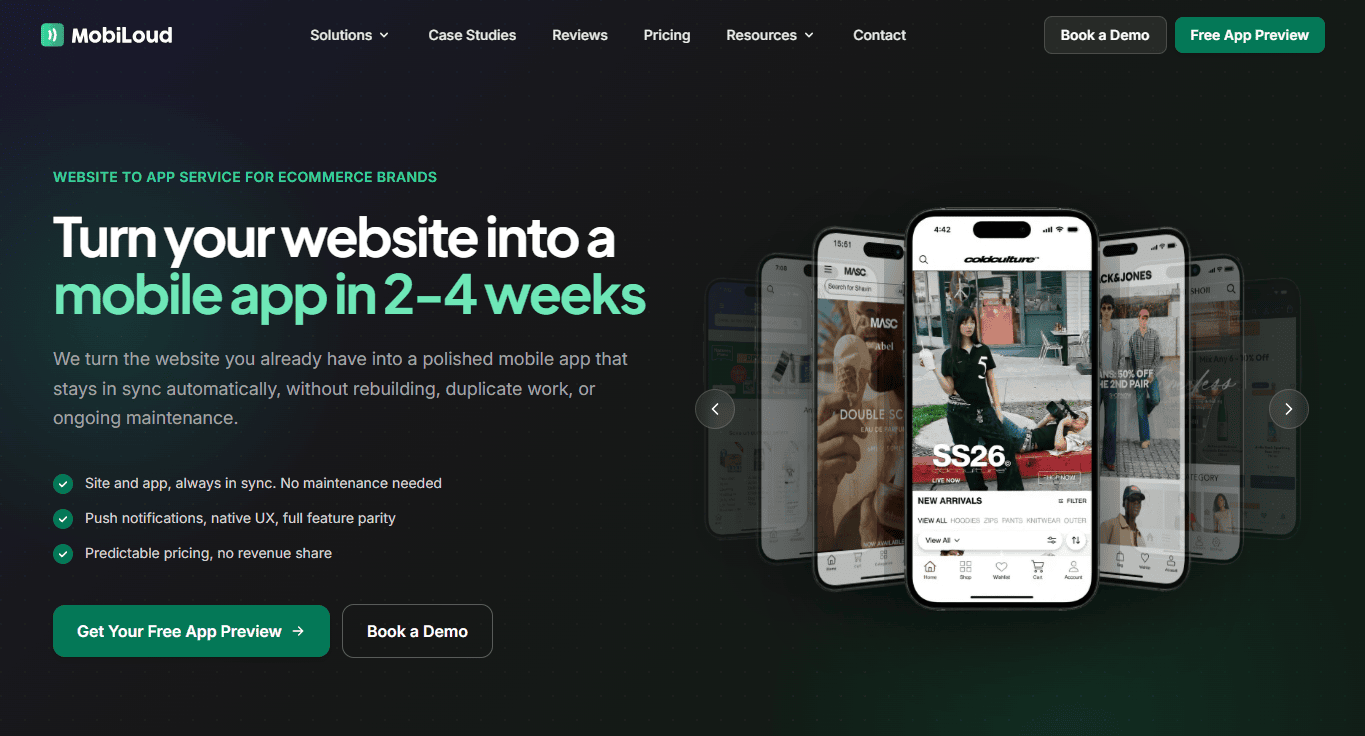
Its team configures, builds, tests, submits, and maintains the app.
MobiLoud says it has published more than 2,000 apps since 2013. Its current offering supports WordPress, WooCommerce, Shopify, BigCommerce, custom sites, and headless/API-driven websites.
This model is particularly attractive for companies that don't want to become app developers.
You maintain your website.
MobiLoud handles much of the mobile-app work.
AppMySite: Convert your existing stack into an app
AppMySite is positioned more like a self-service website-to-app platform.
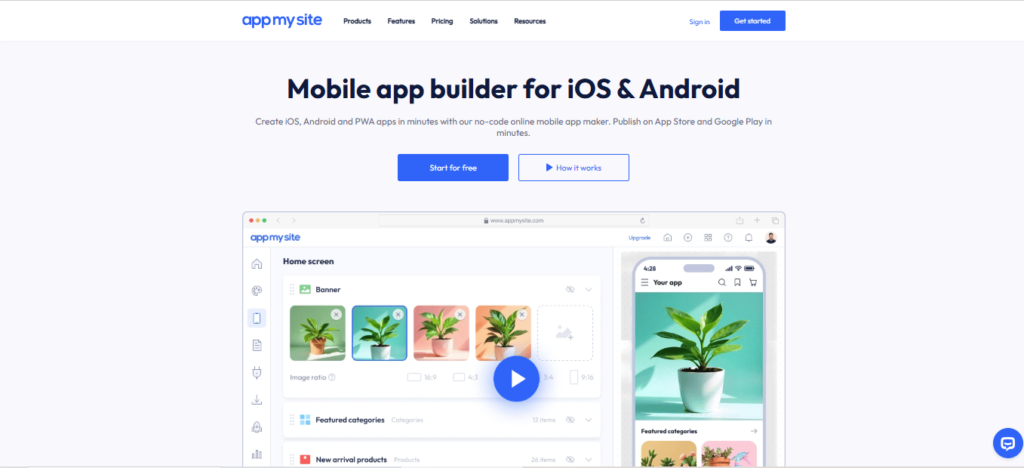
It supports WordPress, WooCommerce, Shopify, custom app projects, Android, iOS/iPadOS, and Progressive Web Apps.
Its platform also provides ecommerce features such as:
- Product synchronization
- Product variations
- Categories
- Search and filtering
- Wishlists
- Cart
- Coupons
- Checkout
- Payments
- Shipping
- Taxes
- Order tracking
For businesses that want a relatively straightforward route from an existing ecommerce website to a mobile app, this can be a strong proposition.
How Does AppNatively Compare With MobiLoud and AppMySite?
The biggest difference is control versus management.
AppNatively gives you a platform to build the mobile experience.
MobiLoud gives you a platform plus a team that handles much of the work.
AppMySite gives you a self-service environment optimized around website and ecommerce conversion.
That means the right choice depends heavily on your internal resources.
If you have someone who wants to actually design and manage the app, AppNatively or AppMySite may be more appropriate.
If you would rather hand the project to a specialized team, MobiLoud becomes more attractive.
1. AppNatively vs MobiLoud vs AppMySite: Native App Experience
Let's start with one of the most important questions:
Will the resulting app actually feel like a mobile application?
All three platforms are designed to produce iOS and Android applications, but their approaches are different.
AppNatively
AppNatively is built around native mobile screens and components.
Its platform includes components for things such as:
- Products
- Categories
- Search
- Cart
- Checkout
- User accounts
- Listings
- Maps
- Reviews
- Wishlist
- Posts
- Media
- Navigation
- Drawers
- Headers
The builder lets you create screens visually and configure mobile navigation around the experience you want.
This is especially useful when your app needs to do more than simply reproduce your website.
For example, a directory app could have:
Home → Search → Filters → Map → Listings → Listing Details → Contact
A WooCommerce app could have:
Home → Categories → Products → Product Details → Cart → Checkout → Orders
You can design those flows around mobile users.
Verdict
AppNatively has a strong advantage when mobile UX customization is the priority.
MobiLoud
MobiLoud's model is fundamentally different.
It uses the existing website as the foundation and adds native app functionality such as navigation, push notifications, app-store presence, deep linking, and other mobile features.
MobiLoud says its platform is built natively while allowing the existing web experience, functionality, integrations, and checkout to remain the foundation.
That gives MobiLoud an interesting advantage:
You don't necessarily need to rebuild your website's functionality for the app.
Your website remains the primary system.
Verdict
MobiLoud is particularly strong when preserving the existing website experience is more important than rebuilding the mobile experience from scratch.
AppMySite
AppMySite provides native Android and iOS/iPadOS app creation alongside its website, WordPress, WooCommerce, and Shopify integrations.
It also provides mobile-first navigation, app layouts, ecommerce components, search, filtering, checkout, and other app-focused functionality.
Verdict
AppMySite is a strong middle ground between straightforward website conversion and mobile app customization.
2. Visual Customization
Customization is one of the biggest differences between app platforms.
There is a major difference between:
"Turn my website into an app."
and:
"Give me control over how my mobile product works."
AppNatively
AppNatively is particularly focused on the second approach.
The App Editor allows you to build screens manually or use AI-assisted design and then refine the result yourself. It includes controls for pages, headers, bottom navigation, drawers, themes, and components.
This makes it possible to treat the app as a separate mobile experience while still using your existing backend.
That can be especially valuable for:
- SaaS products
- Ecommerce stores
- Directories
- Booking websites
- Restaurants
- LMS platforms
- Communities
- Content websites
- Custom API applications
MobiLoud
MobiLoud emphasizes custom branding and UI while keeping the existing website as the underlying source.
Its published feature set includes custom branding and UI, app-only content, custom navigation, and other ways to tailor the app experience.
The advantage is less about handing you a blank canvas and more about having a team configure the experience for you.
AppMySite
AppMySite provides extensive design and branding controls, along with mobile navigation, layouts, themes, ecommerce components, and app previews.
Its platform is designed to allow businesses to customize the appearance and structure of the app without traditional coding.
Customization winner
AppNatively has the strongest positioning if your priority is creating a highly customized mobile-first experience yourself.
MobiLoud is strong if you want customization but prefer a managed service.
AppMySite is strong for structured website and ecommerce apps.
3. AI App Building
AI has changed the app-builder market significantly.
But there is an important difference between:
AI that helps generate an app
and:
AI that can actually interact with your app-building environment.
AppNatively's AI and MCP Approach
AppNatively integrates AI into its development workflow through its MCP server.
Its platform allows compatible AI assistants to interact with AppNatively projects and help build, customize, and manage apps through conversational instructions.
That creates an interesting workflow.
Instead of manually navigating through multiple configuration screens, you can describe what you want.
For example:
Add a search bar to the header and place the wishlist icon beside the cart.
The idea is that AI can work with the actual app-building environment rather than simply generating generic advice.
This is one of AppNatively's more distinctive differentiators.
AppMySite's AI
AppMySite has also made AI a major part of its current platform.
Its AI builder allows users to create and refine apps using prompts, including content, visuals, branding, layouts, and structure.
That makes AppMySite a serious AI-assisted competitor.
MobiLoud and AI
MobiLoud's primary differentiation is not AI-powered self-service app building.
Its strength is the combination of technology and a managed team.
The company handles much of the build, QA, submission, maintenance, and ongoing support.
AI winner
For AI-assisted self-service building, AppNatively and AppMySite are the more relevant choices.
For AI-agent-style interaction with the app-building environment, AppNatively has a particularly differentiated proposition through MCP.
4. WordPress Support
WordPress is one of the biggest use cases for website-to-app platforms.
But "WordPress support" can mean very different things.
A basic WordPress blog is easy.
A WordPress site running WooCommerce, memberships, directories, LMS plugins, custom post types, custom APIs, and third-party integrations is much more complicated.
AppNatively
AppNatively supports WordPress and a growing range of WordPress-based business types.
It supports WooCommerce, SureCart, FluentCart, directory plugins including Directorist, GeoDirectory, and HivePress, as well as custom post types and custom REST APIs.
This makes it especially interesting for businesses that don't fit neatly into the standard "WordPress blog" category.
MobiLoud
WordPress is one of MobiLoud's core use cases.
Its approach is particularly attractive when you want your existing WordPress site to remain the primary system.
MobiLoud says WordPress plugins, themes, Gutenberg blocks, page builders, and other site functionality can continue to power the app through its platform.
This can be a major advantage for businesses with highly customized WordPress websites.
AppMySite
AppMySite has extensive WordPress integration.
It supports:
- Pages
- Posts
- Categories
- Tags
- Users
- Custom post types
- Custom taxonomies
- Menus
- Comments
- WooCommerce
- Product variations
- Inventory
- Orders
- Checkout
and other WordPress-related functionality.
WordPress verdict
There isn't one universal winner.
AppNatively: strongest when you want a customized mobile experience around your WordPress backend.
MobiLoud: strongest when preserving the existing WordPress site and functionality is the priority.
AppMySite: strongest for straightforward WordPress and WooCommerce conversion.
5. WooCommerce App Building
WooCommerce deserves its own section because it is one of the most important mobile app use cases.
A serious WooCommerce app needs more than product listings.
It may need:
- Product variations
- Search
- Filters
- Categories
- Wishlist
- Cart
- Coupons
- Checkout
- Payment gateways
- Shipping
- Taxes
- Customer accounts
- Order tracking
- Push notifications
- Deep links
All three platforms address major parts of this problem.
AppNatively for WooCommerce
AppNatively provides native ecommerce components for products, categories, cart, checkout, accounts, orders, wishlist, and other shopping workflows.
Its biggest advantage is the ability to design the experience rather than simply replicate the store.
This is useful when the business wants its app to become a dedicated customer channel.
MobiLoud for WooCommerce
MobiLoud is especially strong for established WooCommerce brands.
Its managed model means the MobiLoud team handles much of the app development, testing, launch, and maintenance.
Its WooCommerce offering is designed to retain existing site functionality and integrations while adding native app capabilities.
MobiLoud currently lists a Business plan at $1,499 per month, or $1,274 per month when billed annually, plus a one-time development and submission fee. The plan includes up to 10,000 monthly active users.
That makes its target market relatively clear.
It is designed for businesses where the mobile app is an important revenue channel and the company wants professional ongoing support.
AppMySite for WooCommerce
AppMySite has extensive WooCommerce functionality.
Its published features include:
- Product synchronization
- Simple products
- Variable products
- Virtual products
- External products
- Inventory
- Customer addresses
- Shipping
- Taxes
- Payment providers
- Cart
- Coupons
- Checkout
- Order tracking
- Ecommerce analytics
WooCommerce verdict
Small and mid-sized store wanting DIY: AppMySite
Established brand wanting a managed service: MobiLoud
Store wanting a highly customized native experience: AppNatively
6. Shopify App Building
Shopify is another important area where the platforms differ.
AppNatively
AppNatively supports Shopify through the Storefront API.
Its platform can work with products, collections, blog content, pages, customers, orders, and other Shopify-related functionality while allowing the app experience to be designed through native screens.
This makes it attractive for Shopify brands that want more control over the mobile product.
MobiLoud
MobiLoud supports Shopify as part of its broader website-to-app offering.
The important benefit is the managed model.
Rather than asking your marketing team to become mobile developers, MobiLoud handles the app side.
AppMySite
AppMySite also supports Shopify.
Its Shopify app functionality includes product discovery, cart, checkout, payments, shipping, taxes, order tracking, and other ecommerce workflows.
Shopify verdict
AppNatively: strong for customization
MobiLoud: strong for managed implementation
AppMySite: strong for self-service ecommerce conversion
7. Custom API and Headless Websites
This is where the comparison gets more interesting.
Not every business runs on WordPress or Shopify.
You may have:
- A custom SaaS backend
- A headless CMS
- A custom ecommerce platform
- A directory backend
- A booking system
- A proprietary API
- A React or Next.js frontend
- A custom REST API
AppNatively
AppNatively supports custom REST API connections.
That means the platform can connect the app to existing backend systems rather than forcing the business to migrate its data into a new database.
This is one of the reasons AppNatively can work beyond conventional website-to-app scenarios.
MobiLoud
MobiLoud also supports custom and headless websites.
Its documentation states that it can work with custom tech stacks and API-driven websites, including setups built with frameworks such as Next.js, React, and Vue.
Its advantage is that the implementation remains managed.
AppMySite
AppMySite also offers custom mobile app workflows, although its strongest positioning remains around websites, WordPress, WooCommerce, and Shopify.
Custom API winner
AppNatively is particularly attractive for teams that want API-driven flexibility while still controlling the mobile experience themselves.
MobiLoud is strong when the same requirement exists but the company wants a managed implementation.
8. Directory Website Apps
This is an area where a lot of generic app-builder comparisons miss an important distinction.
A directory isn't simply a website with pages.
A good directory app may need:
- Listings
- Categories
- Search
- Advanced filtering
- Maps
- Locations
- Reviews
- Favorites
- User profiles
- Listing submission
- Booking
- Contact actions
- Memberships
- Notifications
The mobile experience needs to be designed around discovery.
AppNatively
AppNatively is particularly interesting for directory businesses because its platform includes native components for listings, listing queries, locations, listing maps, reviews, listing details, and related functionality.
It also supports directory ecosystems such as Directorist, GeoDirectory, and HivePress.
That allows directory owners to create a dedicated mobile discovery experience.
For example:
Location → Category → Filters → Map → Listings → Listing Details → Contact/Booking
This is fundamentally different from simply opening a directory website inside an app.
Directory verdict
AppNatively is the strongest choice of these three for a directory-first mobile experience.
9. App Updates and OTA Updates
Launching an app is only the beginning.
The bigger question is:
How easy is it to update the app after launch?
Traditional native app development can make every change feel expensive.
You may need to:
- Modify the app.
- Create a new build.
- Submit it.
- Wait for review.
- Ask users to update.
That isn't ideal for every change.
AppNatively
AppNatively provides OTA updates for supported JavaScript, content, and UI changes.
The company says supported changes can reach installed apps without requiring a new App Store or Google Play review. Native capability changes, store metadata changes, and other platform-sensitive changes may still require a new store submission.
This is particularly useful for fast-moving products.
MobiLoud
MobiLoud's advantage is different.
Because the website remains the source of truth, website changes can flow through to the app without requiring the business to maintain two completely separate content systems.
MobiLoud describes this as managing a single codebase and keeping the website and app synchronized.
AppMySite
AppMySite provides automatic synchronization for supported WordPress and ecommerce content.
For example, its WordPress integration can sync pages, posts, categories, tags, users, custom post types, taxonomies, and other content.
Update winner
For rapid mobile UI iteration, AppNatively has a particularly strong proposition.
For keeping an existing website as the source of truth, MobiLoud has a major advantage.
For automated website and ecommerce content synchronization, AppMySite is strong.
10. Push Notifications
Push notifications are one of the main reasons businesses build apps in the first place.
An app puts your brand on the user's device.
That creates a direct communication channel that a website alone doesn't provide.
AppNatively
AppNatively provides unlimited push notifications through Firebase and supports campaigns with titles, messages, images, and deep links.
This can be particularly useful for:
- Ecommerce promotions
- New products
- Directory updates
- Booking reminders
- Restaurant offers
- Content notifications
- Order updates
MobiLoud
Push notifications are one of MobiLoud's major strengths.
Its platform supports push campaigns and integrations such as OneSignal and Klaviyo, including use cases such as abandoned carts, back-in-stock alerts, drops, and subscription-related notifications.
AppMySite
AppMySite also supports push notifications through Firebase and OneSignal.
Verdict
All three are strong.
The difference is more about the surrounding workflow than the existence of push notifications.
11. App Store and Google Play Publishing
Creating the app is only one part of the project.
You also need to publish it.
That means dealing with:
- Apple Developer accounts
- Google Play Console
- App icons
- Splash screens
- Screenshots
- App descriptions
- Privacy requirements
- Permissions
- App review
- Build certificates
- Store policies
AppNatively
AppNatively supports native Android and iOS builds and helps prepare apps for App Store and Google Play submission.
The actual developer accounts remain important because the app should generally be published under the business owner's own accounts.
MobiLoud
MobiLoud takes this a step further by handling the build, QA, and store submission as part of its managed service.
Its current pricing documentation states that the development and submission fee covers native iOS and Android engineering, QA, store assets, and submission through approval.
AppMySite
AppMySite provides native Android and iOS/iPadOS app generation and the files required for store submission.
Publishing winner
MobiLoud is the most hands-off.
AppNatively and AppMySite are better suited to businesses that want more direct control over the app-building and publishing workflow.
12. Real-Time App Preview
Seeing your app before publishing is critical.
Screenshots aren't enough.
You want to know:
- Does the navigation feel right?
- Is the listing layout usable?
- Is the checkout flow comfortable?
- Does the header look correct?
- Does the app work properly on a real phone?
AppNatively
AppNatively Go allows users to scan a QR code and see changes on their own physical phone in real time.
That is particularly useful when designing mobile interfaces.
Verdict
AppNatively has a particularly strong workflow for rapid real-device iteration.
13. Pricing: AppNatively vs MobiLoud vs AppMySite
Pricing is one area where you should avoid comparing the numbers without understanding the business model.
These platforms are selling different things.
MobiLoud
MobiLoud is clearly positioned at the premium end.
Its current Business plan is listed at:
$1,499/month
or:
$1,274/month when billed annually
There is also a one-time app development and submission fee. The Business plan includes up to 10,000 monthly active users.
That price makes sense within a managed-service model.
You are paying not only for software but also for development, QA, launch, maintenance, support, and ongoing expertise.
AppMySite
AppMySite follows a subscription-based self-service model, with separate product lines for website-to-app, Shopify, WordPress, WooCommerce, custom mobile apps, and agency use cases.
Its pricing is therefore much more accessible to smaller businesses than a premium managed service.
AppNatively
AppNatively is positioned as a no-code native app platform rather than a high-touch managed development agency.
The major value proposition is giving businesses access to:
- Native iOS and Android building
- Visual app design
- AI-assisted workflows
- MCP
- Custom APIs
- OTA updates
- Push notifications
- App-store deployment
- Real-device preview
- Ecommerce and directory components
The important distinction is therefore:
MobiLoud: pay more to have a team handle the app.
AppMySite: pay for a self-service platform optimized for website-to-app conversion.
AppNatively: pay for a flexible native app-building environment where you can actually design and manage the mobile product.
14. Ease of Use
Ease of use isn't simply about how many clicks it takes to create an app.
It's about how much work you have to do after those clicks.
AppNatively
AppNatively is designed for users who want to actively build and customize their app without coding.
You connect your backend, create screens, customize navigation, preview the app, build it, and publish it.
The visual approach is especially useful for people who want control without hiring developers.
MobiLoud
MobiLoud may actually be the easiest option for a business owner who doesn't want to build an app.
Why?
Because you don't have to do most of the work.
MobiLoud's team handles the technical side.
That makes it extremely attractive for established brands with the budget to outsource the project.
AppMySite
AppMySite is also designed for self-service users.
Its website emphasizes no-code app creation, AI-assisted building, previews, and integrations with existing technology stacks.
Ease-of-use winner
It depends on what "easy" means.
Easiest DIY: AppMySite / AppNatively
Easiest overall if you want someone else to do it: MobiLoud
15. Who Should Use AppNatively?
AppNatively is a particularly good fit if you want to create the mobile app as a product, not simply as another presentation layer for your website.
Choose AppNatively if you want:
- A native iOS and Android app
- Visual drag-and-drop building
- AI-assisted development
- MCP-powered AI workflows
- Custom REST API support
- WordPress support
- Shopify support
- WooCommerce support
- Directory support
- Custom mobile navigation
- Native components
- OTA updates
- Unlimited push notifications
- Real-device preview
- Frequent iteration
- More control over the mobile UX
It is especially compelling for:
Ecommerce + directories + booking + SaaS + content + custom API applications.
16. Who Should Use MobiLoud?
MobiLoud is a strong fit for companies that say:
"We don't want to build the app ourselves. We want an experienced team to handle it."
That includes:
- Established ecommerce brands
- Large WooCommerce stores
- Shopify businesses
- Enterprise WordPress websites
- Custom websites
- High-traffic businesses
- Companies with complex integrations
- Brands that want ongoing app management
Its managed-service model is the biggest differentiator.
MobiLoud says its team handles configuration, testing, store submission, OS updates, certificates, and ongoing support.
17. Who Should Use AppMySite?
AppMySite is a strong fit if your primary goal is:
"I already have a website or ecommerce store. I want to turn it into a mobile app without hiring developers."
It is particularly relevant for:
- WordPress websites
- WooCommerce stores
- Shopify stores
- Content websites
- Small and mid-sized businesses
- Agencies
- Ecommerce businesses
- Businesses looking for a self-service platform
Its large collection of WordPress and ecommerce features makes it especially useful for conventional website-to-app projects.
AppNatively vs MobiLoud vs AppMySite: Best by Use Case
| Use Case | Best Choice |
|---|---|
| Highly customized native app | AppNatively |
| AI-assisted app building | AppNatively / AppMySite |
| AI agent workflows | AppNatively |
| MCP-powered app development | AppNatively |
| Managed app development | MobiLoud |
| Enterprise ecommerce | MobiLoud |
| Complex WooCommerce store | MobiLoud / AppNatively |
| DIY WooCommerce app | AppMySite / AppNatively |
| WordPress website | AppMySite / AppNatively |
| Complex WordPress website | MobiLoud |
| Shopify store | AppNatively / AppMySite / MobiLoud |
| Custom REST API | AppNatively |
| Directory website | AppNatively |
| Booking website | AppNatively |
| Native mobile-first UX | AppNatively |
| Existing website preservation | MobiLoud |
| Minimal technical involvement | MobiLoud |
| Self-service app building | AppNatively / AppMySite |
| Rapid UI iteration | AppNatively |
| Push notifications | All three |
| App Store + Google Play | All three |
AppNatively vs MobiLoud vs AppMySite: Pros and Cons
AppNatively
Pros
- Native iOS and Android apps
- Visual app builder
- AI-assisted app building
- MCP integration
- AI-agent workflows
- Custom REST API support
- WordPress support
- WooCommerce support
- Shopify support
- Directory integrations
- Native UI components
- Custom navigation
- OTA updates
- Unlimited push notifications
- Real-device preview
- Unlimited build and deployment workflows
- Strong mobile-first customization
Cons
- More hands-on than a fully managed service
MobiLoud
Pros
- Fully managed service
- Native iOS and Android apps
- Strong WordPress and WooCommerce support
- Shopify support
- Custom and headless website support
- Existing website remains the source of truth
- Strong integration compatibility
- Push notifications
- Deep linking
- Analytics
- App Store submission
- Ongoing maintenance
- Professional customer success support
Cons
- Significantly more expensive than self-service platforms
- Less suitable for small businesses with limited app budgets
- Less appropriate if you want to personally build every screen and workflow
- Managed-service model means less hands-on control over the development process
AppMySite
Pros
- Self-service
- No-code workflow
- WordPress support
- WooCommerce support
- Shopify support
- Native iOS and Android apps
- AI-assisted building
- Product synchronization
- Ecommerce features
- Push notifications
- Search and filtering
- Cart and checkout
- Order tracking
- Agency and white-label options
- Broad website-to-app functionality
Cons
- Highly specialized mobile architectures may require working within the platform's supported approach
- Businesses looking for maximum API-driven flexibility may prefer a more developer-oriented architecture
- Less differentiated than AppNatively for AI-agent and MCP-driven development
- Less suitable than MobiLoud if you want a fully managed service
So, Is AppNatively Better Than MobiLoud?
Not for every business.
MobiLoud is a very different product.
If you run a major ecommerce business and don't want to deal with app development, MobiLoud's managed approach can be extremely valuable.
You pay more, but you get a team that handles much of the technical work.
However, if you want to build and control the mobile experience yourself, AppNatively is the more natural fit.
The difference can be summarized like this:
MobiLoud: "We'll build and manage your app."
AppNatively: "Here's the platform to build your native app."
That distinction is important.
Is AppNatively Better Than AppMySite?
Again, it depends.
AppMySite is an established option for businesses that want to convert WordPress, WooCommerce, Shopify, and other websites into mobile applications.
It has a broad feature set and strong ecommerce functionality.
AppNatively's biggest advantage is the level of emphasis it places on native mobile UX, visual flexibility, custom APIs, AI workflows, MCP, real-device development, and OTA iteration.
If your goal is:
"Get my website into an app."
AppMySite is worth considering.
If your goal is:
"Build a mobile product around my existing website or backend."
AppNatively becomes particularly compelling.
Which Is the Best Mobile App Builder in 2026?
There is no universal winner.
But there is a clear winner for different types of projects.
Choose AppNatively if you want:
A customizable native mobile product that you can build, design, modify, and evolve yourself.
Its combination of native UI, visual building, AI, MCP, API connectivity, OTA updates, directory support, ecommerce components, and real-device preview makes it particularly interesting for businesses that want more than a simple website conversion.
Choose MobiLoud if you want:
A premium, managed mobile app service.
It's particularly attractive for established brands that want their existing website and integrations preserved while a professional team handles the app build, launch, maintenance, and ongoing support.
Choose AppMySite if you want:
A straightforward self-service route from WordPress, WooCommerce, Shopify, or another website to a mobile app.
Its broad integrations and ecommerce functionality make it a practical option for businesses that want to get into mobile without managing a custom development project.
Final Verdict: AppNatively vs MobiLoud vs AppMySite
The real question isn't:
Which app builder is the best?
A better question is:
What do you want your mobile app strategy to look like?
If your priority is hands-off development, MobiLoud stands out.
If your priority is straightforward website and ecommerce conversion, AppMySite is a strong option.
If your priority is building a customized native mobile experience with modern AI-powered development workflows, AppNatively has the strongest overall proposition.
The three platforms represent three different approaches:
| Platform | Core Philosophy |
|---|---|
| AppNatively | Build the mobile experience |
| MobiLoud | Let experts build and manage the mobile experience |
| AppMySite | Convert your existing website or store into an app |
And that is ultimately what makes the comparison useful.
A mobile app should not exist simply because your competitors have one.
It should give customers a better way to interact with your business.
For some companies, that means preserving everything they already have.
For others, it means creating a completely new mobile-first experience.
And for businesses that want to build that experience themselves without starting from zero, AppNatively offers a particularly compelling middle ground between traditional custom development and basic website-to-app conversion.
Frequently asked questions
It depends on your priorities. AppNatively is better suited to businesses that want to build and customize their own native mobile experience. MobiLoud is better suited to companies that want a managed service where an experienced team handles the app development, launch, and maintenance.
AppNatively is particularly strong for custom native UX, custom API connections, AI-agent workflows, MCP, OTA updates, and mobile-first app design. AppMySite is particularly strong for straightforward WordPress, WooCommerce, Shopify, and ecommerce website-to-app projects.
MobiLoud is better described as a managed app platform and service rather than a traditional DIY no-code builder. Its team handles much of the app development, testing, submission, and maintenance.
For a DIY WooCommerce app, AppNatively and AppMySite are strong options. For a high-revenue WooCommerce business that wants a managed service, MobiLoud is particularly compelling.
All three support Shopify-related use cases. AppNatively is particularly interesting for businesses that prioritize customized native UX, AppMySite offers strong Shopify ecommerce functionality, and MobiLoud is attractive for businesses that want the project managed for them.
All three support WordPress. AppMySite is strong for straightforward WordPress conversion, MobiLoud is strong for complex existing WordPress sites where preserving functionality is critical, and AppNatively is strong when the business wants to build a customized native mobile experience around WordPress.
AppNatively is particularly well suited to directory applications because it supports directory-focused native components and integrations such as Directorist, GeoDirectory, and HivePress.
AppNatively and AppMySite both have significant AI capabilities. AppMySite focuses on AI-assisted app creation and refinement, while AppNatively combines AI-assisted development with MCP-based workflows that allow compatible AI assistants to interact with the app-building environment.
Yes. All three platforms support iOS and Android app publishing workflows. MobiLoud takes a more managed approach, while AppNatively and AppMySite provide tools and workflows for businesses that want more direct control.
No. AppNatively is designed as a no-code platform with visual components and guided workflows. Developers can benefit from its API and AI capabilities, but traditional programming knowledge isn't required for the core builder experience.
Yes. AppNatively supports custom REST API connections, allowing businesses to connect existing backend systems to native mobile screens.
Yes. AppNatively supports OTA updates for supported changes, meaning certain UI, JavaScript, and content updates can reach users without a new app-store submission. Native-level changes may still require a new store release.
Related posts
AppNatively vs Shopney vs Tapcart: Which Shopify App Builder Is Best in 2026?

AppNatively vs AppMySite vs AppPresser: Which One Delivers the Best Mobile App Experience?

WebView Apps in 2026: How They Work and When to Use Them




