
If you are looking for the best AppPresser alternatives in 2026, three platforms worth considering are AppNatively, Shoutem, and FluxBuilder.
AppPresser has built a strong position among WordPress users who want to turn a WordPress website into a mobile app. Its platform supports WordPress-powered apps, WooCommerce, memberships, BuddyPress, BuddyBoss, LearnDash, push notifications, offline content, analytics, and app store submission workflows.
However, not every website has the same mobile app requirements.
A WooCommerce store may need deep e-commerce functionality and real-time product synchronization. A directory website may need listings, maps, filters, custom APIs, and specialized integrations. An agency may need white-label capabilities, client management, and scalable app development workflows.
That is why businesses and developers are increasingly exploring AppPresser alternatives that provide different approaches to native mobile app development.
In this guide, we compare:
We will compare their features, integrations, customization options, e-commerce capabilities, publishing workflows, use cases, and overall suitability for different types of websites and businesses.
Quick Answer: What Are the Best AppPresser Alternatives in 2026?
If you want a quick answer:
- AppNatively is a strong AppPresser alternative for businesses that want an AI-powered native app builder with visual customization, WordPress, WooCommerce, SureCart, FluentCart, Shopify, BigCommerce (Coming Soon), Magento (Coming Soon), directory integrations, custom APIs, push notifications, OTA updates, and MCP support.
- Shoutem is a general-purpose no-code app builder for businesses, organizations, content platforms, communities, and agencies that need templates, integrations, push notifications, analytics, monetization, and publishing tools.
- FluxBuilder is particularly relevant to ecommerce businesses and agencies that need integrations with WooCommerce, Shopify, Magento, PrestaShop, OpenCart, BigCommerce, WordPress, and other platforms, along with extensive ecommerce and payment features.
The right alternative depends on what you are building.
For WordPress, WooCommerce, Shopify, directory websites, custom APIs, and highly customizable native apps, AppNatively deserves a closer look.
For general-purpose apps with a broad extension ecosystem, Shoutem is worth considering.
For ecommerce-focused projects with extensive commerce integrations, FluxBuilder is another option.
AppPresser Alternatives Comparison
| Feature | AppNatively | Shoutem | FluxBuilder |
|---|---|---|---|
| Android App | ✅ | ✅ | ✅ |
| iOS App | ✅ | ✅ | ✅ |
| Visual App Builder | ✅ | ✅ | ✅ |
| Drag-and-Drop Builder | ✅ | ✅ | ✅ |
| AI-Assisted Building | ✅ | ❌ | ✅ |
| WordPress | ✅ | ✅ | ✅ |
| WooCommerce | ✅ | ❌ | ✅ |
| Shopify | ✅ | ✅ | ✅ |
| Custom APIs | ✅ | ✅ | ✅ |
| Directory Support | ✅ | ❌ | ✅ |
| Push Notifications | ✅ | ✅ | ✅ |
| OTA Updates | ✅ | ✅ | ✅ |
| Firebase Push | ✅ | ❌ | ✅ |
| Custom Mobile Screens | ✅ | ✅ | ✅ |
| Live Preview | ✅ | ✅ | ✅ |
| App Store Publishing | ✅ | ✅ | ✅ |
| Google Play Publishing | ✅ | ✅ | ✅ |
| GitHub Workflow | ✅ | ❌ | ✅ |
| MCP Support | ✅ | ❌ | ❌ |
| White-Label Options | Upcoming | ✅ | ✅ |
| Ecommerce Features | ✅ | ✅ | ✅ |
| Agency Features | ✅ | ✅ | ✅ |
Info is subject to changes over time
1. AppNatively
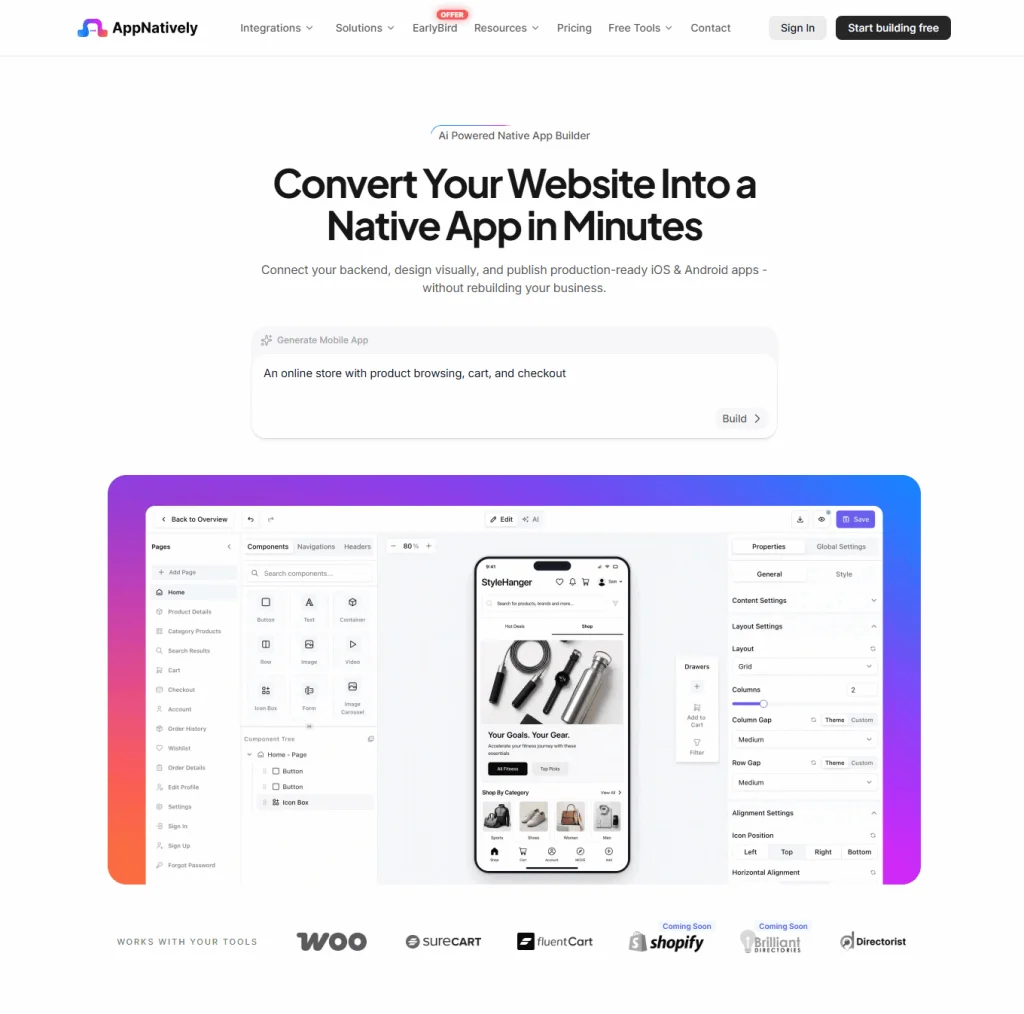
AppNatively is an AI-powered native app builder designed to turn websites, ecommerce stores, directories, booking platforms, and custom APIs into native iOS and Android applications.
Instead of rebuilding a business from scratch for mobile, you connect your existing backend, visually design the mobile experience, preview it, build the app, and publish it.
The platform is particularly relevant for WordPress and ecommerce users, but its focus extends beyond traditional website-to-app conversion.
Why Consider AppNatively as an AppPresser Alternative?
The biggest reason to consider AppNatively is flexibility.
AppPresser is heavily connected to the WordPress ecosystem. That can be an advantage when your entire business runs on WordPress, but businesses with multiple backend systems may want a platform designed around broader integrations.
AppNatively supports several website and backend types, including:
- WordPress
- WooCommerce
- SureCart
- FluentCart
- Shopify
- Directory platforms ( Directorist, GeoDirectory, HivePress, Brilliant Directories, Business Directory Plugin, aDirectory, and more)
- Booking websites
- Custom APIs
This gives businesses more options when building an app around an existing digital product.
Visual Native App Building
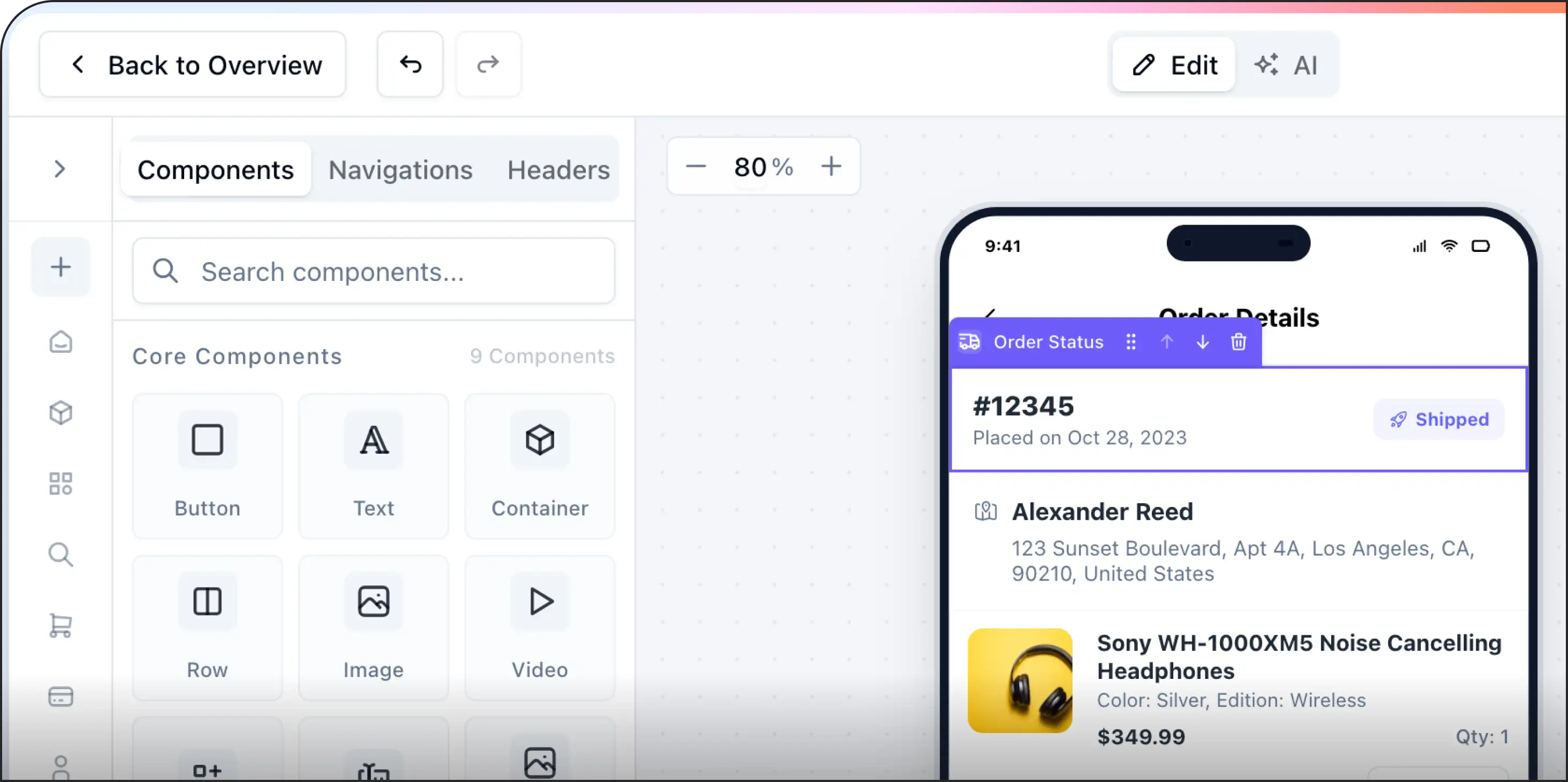
AppNatively provides a visual interface for creating mobile screens and customizing the app experience.
You can work with mobile components, layouts, navigation, visibility rules, and other elements without starting with a traditional mobile development project.
This makes it relevant for:
- Website owners
- SaaS founders
- WooCommerce store owners
- Directory businesses
- Agencies
- No-code builders
- Developers working with APIs
AppNatively and WordPress
WordPress remains one of the major use cases.
Instead of simply wrapping a website inside a mobile shell, AppNatively is designed around native mobile app experiences.
It can be used with WordPress-based businesses and connected with supported WordPress ecosystems.
For businesses already invested in WordPress, this can make the transition from website to mobile app more practical.
AppNatively for WooCommerce
WooCommerce stores often need more than basic content synchronization.
A useful ecommerce mobile app may need:
- Product browsing
- Categories
- Product search
- Filters
- Customer accounts
- Cart
- Checkout
- Orders
- Push notifications
- Promotions
- Mobile-specific screens
AppNatively is designed to support WooCommerce-based mobile experiences while allowing businesses to customize the app visually.
This makes it an AppPresser alternative worth evaluating if ecommerce is a major part of your business.
AppNatively for Directory Websites
This is another area where AppNatively can stand out.
Directory websites often require more complicated mobile experiences than a typical content website.
A directory app may need:
- Listings
- Listing details
- Categories
- Search
- Filters
- Maps
- User accounts
- Favorites
- Reviews
- Booking functionality
- Location-based experiences
- Custom APIs
AppNatively supports directory-focused integrations such as Directorist and GeoDirectory, along with other directory platforms.
That makes it particularly relevant to businesses building mobile apps for directory websites.
Push Notifications
Mobile apps create a direct communication channel with users.
AppNatively supports push notification campaigns, including Firebase-powered notifications.
Businesses can use notifications for:
- New products
- Special offers
- New listings
- Booking reminders
- Order updates
- Content updates
- User engagement campaigns
OTA Updates
Another important feature is OTA, or over-the-air, updates.
OTA updates allow supported app changes to be delivered without requiring users to download a new version through the app store for every change.
This can be useful when you frequently improve your app experience.
MCP Support
AppNatively also includes MCP support, which gives it a more modern AI-oriented development workflow.
For businesses experimenting with AI agents, automation, and connected development workflows, MCP can become an important part of how mobile applications are built and managed.
This is one area to consider if you are evaluating AppPresser alternatives based not only on today's requirements but also on emerging AI development workflows.
AppNatively for Agencies
Agencies often need to build mobile applications for multiple clients rather than one internal project.
A flexible visual builder can reduce the amount of repetitive mobile development work involved in client projects.
AppNatively can therefore be considered for agencies working with:
- WordPress clients
- WooCommerce stores
- Directory businesses
- Booking websites
- Ecommerce businesses
- Custom API projects
Who Should Consider AppNatively?
AppNatively is a strong fit if you need:
- Native iOS and Android apps
- WordPress support
- WooCommerce support
- FluentCart support
- SureCart support
- Shopify support
- Directory integrations
- Custom APIs
- Visual mobile customization
- Push notifications
- OTA updates
- AI-assisted workflows
- MCP support
- A no-code or low-code workflow
If your goal is to turn an existing website or backend into a customizable native app without rebuilding your entire business logic, AppNatively is one of the AppPresser alternatives worth evaluating first.
2. Shoutem
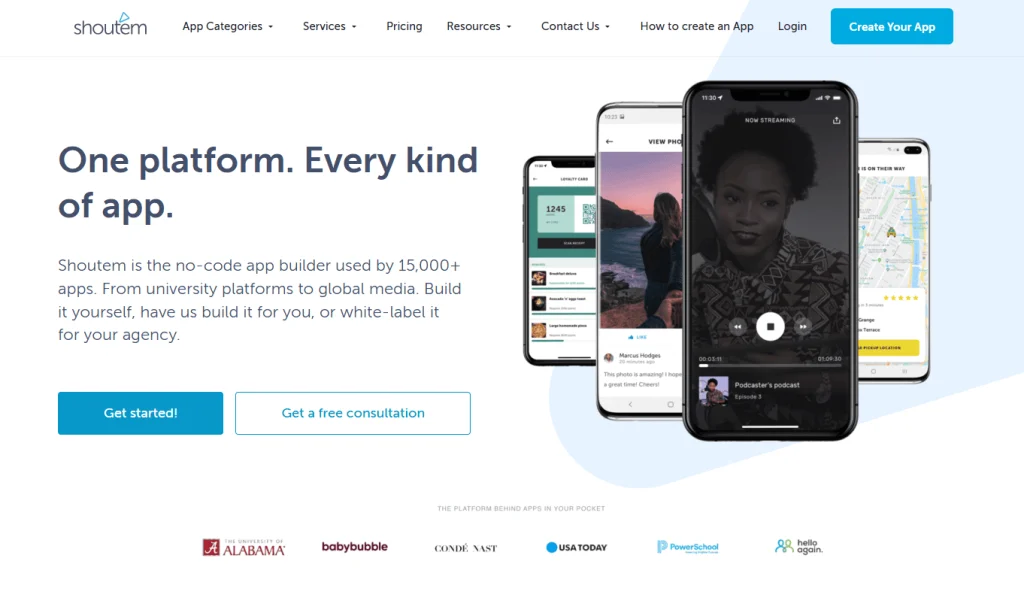
Shoutem is a general-purpose no-code mobile app builder designed for creating iOS and Android applications.
Unlike a platform focused primarily on WordPress, Shoutem approaches app development from a broader perspective.
Its platform includes a visual drag-and-drop builder, templates, app features, integrations, push notifications, analytics, user management, monetization tools, and publishing capabilities.
Why Consider Shoutem as an AppPresser Alternative?
Shoutem can make sense when your project is not exclusively tied to WordPress.
The platform supports a range of app types and provides pre-built functionality that can be assembled into a mobile application.
Its feature ecosystem includes options for:
- Content
- Events
- Social features
- User management
- Push notifications
- Analytics
- Monetization
- Ecommerce
- Loyalty programs
- Integrations
Drag-and-Drop App Builder
Shoutem uses a visual approach to mobile app development.
Users can select features and screens and organize them within the app navigation.
This can make the platform approachable for teams that do not want to manage a traditional mobile development stack.
Push Notifications
Push notifications are a major part of Shoutem's feature set.
Depending on the setup, businesses can use notifications to communicate with individual users, groups, or broader audiences.
Possible use cases include:
- Promotions
- Events
- New content
- Product updates
- User engagement
- Abandoned cart campaigns
Analytics
Shoutem also provides analytics capabilities that can help app owners understand how users interact with their applications.
For businesses focused on engagement, understanding what users do after installing an app can be just as important as building the app itself.
Monetization
Shoutem provides several monetization options.
These can include:
- Advertising
- In-app purchases
- Subscriptions
- Paid content
This can make the platform relevant for publishers, communities, content businesses, and other organizations that need monetization inside their apps.
Agency and White-Label Use
Shoutem also offers agency-oriented capabilities, including white-label options.
This can be useful for agencies that want to build applications for multiple customers under their own branding.
Who Should Consider Shoutem?
Shoutem may be worth considering if you need:
- A general-purpose app builder
- Visual app development
- iOS and Android apps
- Push notifications
- Analytics
- Monetization
- Social functionality
- Content management
- Agency or white-label workflows
If your primary requirement is a broad app-building platform rather than a WordPress-specific mobile solution, Shoutem provides a different approach to AppPresser.
3. FluxBuilder
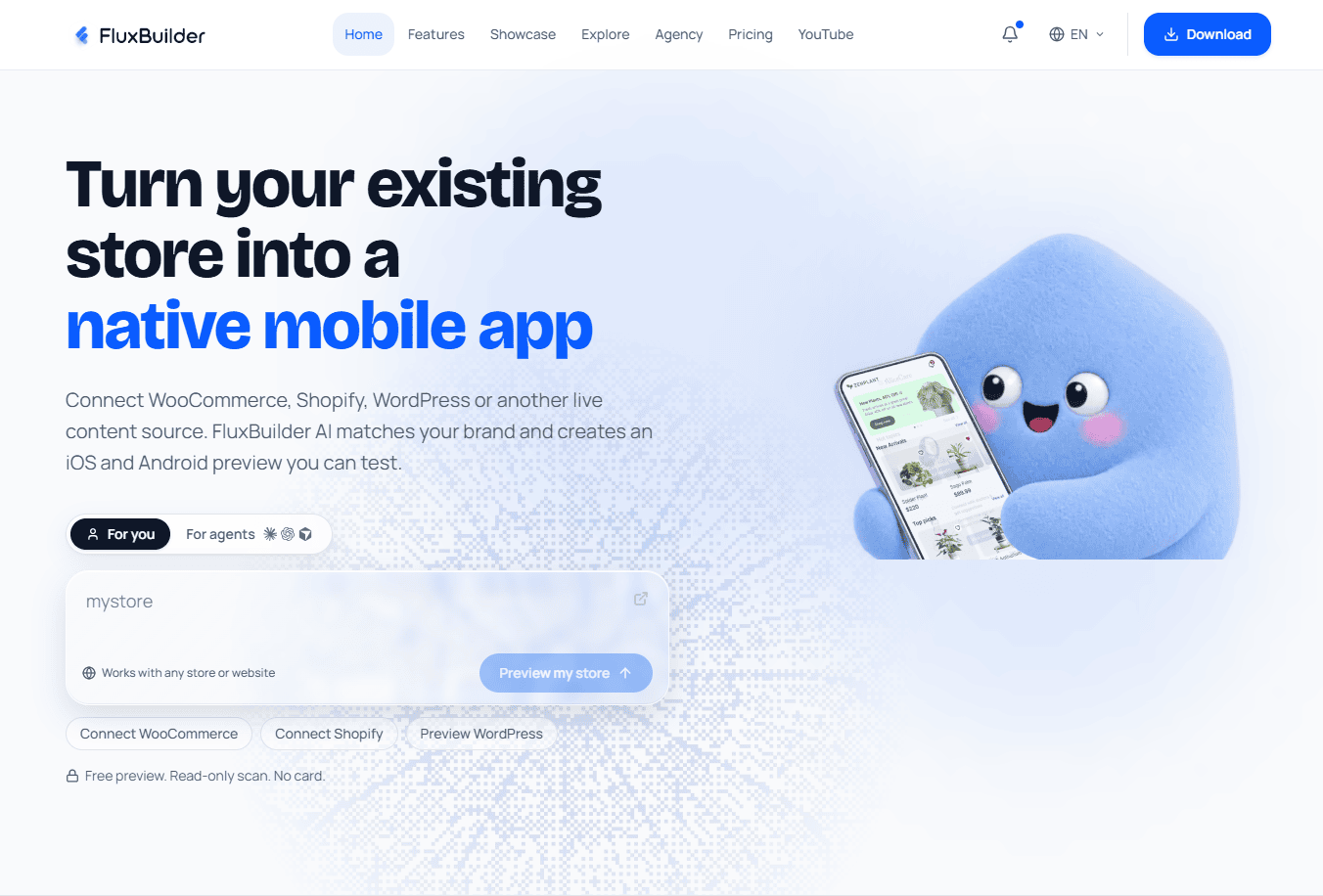
FluxBuilder is a mobile app builder with a particularly strong focus on ecommerce and integrations.
It supports platforms including WooCommerce, Shopify, Magento, PrestaShop, OpenCart, BigCommerce, and WordPress.
This makes FluxBuilder especially relevant to businesses that want to turn ecommerce stores into mobile applications.
Why Consider FluxBuilder as an AppPresser Alternative?
The key difference is its extensive ecommerce ecosystem.
For a store owner, creating a mobile app is not simply about displaying products.
The app may need to handle:
- Product catalogs
- Product variations
- Cart synchronization
- Checkout
- Payments
- Customer accounts
- Orders
- Shipping
- Coupons
- Reviews
- Wishlist
- Loyalty
- Subscriptions
- Multiple currencies
FluxBuilder provides a broad set of ecommerce-related capabilities.
WooCommerce
FluxBuilder supports WooCommerce and provides synchronization for products, inventory, orders, and customers.
It also supports ecommerce-specific functionality and integrations.
For WooCommerce businesses looking for an AppPresser alternative, this makes FluxBuilder worth considering.
Shopify
FluxBuilder also supports Shopify.
This is important for businesses operating outside WordPress and WooCommerce.
A business with Shopify as its primary ecommerce backend can use FluxBuilder to create a mobile application around its store.
Other Ecommerce Platforms
FluxBuilder supports several additional commerce platforms, including:
- Magento
- PrestaShop
- OpenCart
- BigCommerce
This broader ecommerce coverage can be useful for agencies working with clients across different platforms.
Ecommerce Features
FluxBuilder also provides features such as:
- Wishlist
- Product reviews
- Coupons
- Discounts
- Loyalty programs
- Subscriptions
- Shipping
- Order history
- Reordering
- Product variations
- Gift cards
- Multi-currency
- Barcode and QR scanning
For an ecommerce-heavy project, these capabilities can be important factors when choosing an AppPresser alternative.
Agency Features
FluxBuilder also includes agency-oriented functionality such as white-label capabilities, client management, templates, custom branding, custom domains, and Git repository integration.
This makes it relevant to agencies that want to provide mobile app development services to multiple ecommerce clients.
Who Should Consider FluxBuilder?
FluxBuilder may be a good option to evaluate if you need:
- WooCommerce mobile apps
- Shopify mobile apps
- Magento mobile apps
- BigCommerce mobile apps
- PrestaShop mobile apps
- OpenCart mobile apps
- Extensive payment integrations
- Ecommerce-specific features
- White-label agency capabilities
If ecommerce is the center of your project, FluxBuilder deserves consideration alongside AppNatively and other AppPresser alternatives.
AppNatively vs Shoutem vs FluxBuilder
The three platforms approach mobile app development differently.
AppNatively focuses on connecting websites and backends to customizable native mobile applications, with strong coverage across WordPress, ecommerce, directories, APIs, and MCP.
Shoutem takes a broader general-purpose no-code app builder approach with templates, extensions, content, social features, analytics, monetization, and push notifications.
FluxBuilder has a strong ecommerce orientation and supports a wide range of ecommerce platforms.
Which AppPresser Alternative Is Right for WordPress?
If your website is built with WordPress, all three platforms can be relevant, but their approaches are different.
AppPresser itself is deeply connected to WordPress.
AppNatively provides another route for WordPress users who want a more flexible native app builder with additional ecommerce, directory, API, AI, and automation capabilities.
Shoutem can be considered when the project requires a more general-purpose app platform.
FluxBuilder is especially interesting when the WordPress website is primarily an ecommerce business using WooCommerce.
Consider AppNatively if:
- You want WordPress plus broader integrations.
- You need custom mobile screens.
- You use WooCommerce, FluentCart, SureCart, or Shopify.
- You operate a directory website.
- You need custom APIs.
- You want OTA updates.
- You want AI-assisted app workflows.
- You are interested in MCP.
Consider Shoutem if:
- You want a general-purpose app builder.
- Your app relies heavily on content or community features.
- You need built-in monetization options.
- You want agency or white-label functionality.
Consider FluxBuilder if:
- Your WordPress site is an ecommerce business.
- You use WooCommerce.
- You need advanced ecommerce functionality.
- You work with multiple ecommerce platforms.
Which AppPresser Alternative Is Best for WooCommerce?
WooCommerce users have different priorities from content-focused WordPress users.
A serious WooCommerce mobile app may need product synchronization, customer accounts, cart and checkout functionality, order management, payment integrations, push notifications, and promotional features.
AppNatively is worth considering if you want WooCommerce combined with visual native app customization, push notifications, OTA updates, and a broader ecosystem of website and API integrations.
FluxBuilder is another strong option for ecommerce projects because of its extensive WooCommerce functionality and broader ecommerce platform and payment integrations.
Shoutem can be considered when ecommerce is part of a broader general-purpose app experience.
Which AppPresser Alternative Is Best for Directory Websites?
Directory websites have different requirements from ecommerce stores.
A directory app may need:
- Listing synchronization
- Listing categories
- Search
- Filters
- Maps
- User accounts
- Reviews
- Favorites
- Location-based discovery
- Booking
- Custom APIs
This is an area where AppNatively is particularly relevant.
Its directory-focused integrations make it possible to build mobile experiences around directory platforms rather than treating the website as a generic content source.
If you operate a directory powered by Directorist, GeoDirectory, HivePress, Brilliant Directories, or another supported platform, include AppNatively in your evaluation.
Which AppPresser Alternative Is Best for Agencies?
Agencies have different requirements.
Instead of building one app, an agency may need to build dozens of apps for different clients.
Important requirements can include:
- Multiple app projects
- Visual customization
- Client management
- White-label branding
- Custom domains
- Reusable workflows
- Multiple backend integrations
- Publishing support
- Developer access
- Custom code capabilities
Shoutem and FluxBuilder both offer agency-oriented capabilities, including white-label workflows.
AppNatively can also be relevant to agencies that primarily serve WordPress, WooCommerce, directory, booking, and API-based businesses.
The right choice depends heavily on the type of clients an agency serves.
Why Are People Looking for AppPresser Alternatives?
AppPresser remains useful for WordPress-focused app development, but businesses may start looking elsewhere for several reasons.
1. They Need More Than WordPress
Some businesses operate across WordPress, WooCommerce, Shopify, APIs, SaaS tools, and custom platforms.
A builder with broader integration options may be more appropriate.
2. They Want More Mobile Customization
A website-to-app solution should not necessarily mean simply placing a website inside an app.
Businesses may want custom mobile navigation, layouts, screens, components, and workflows.
3. They Need Ecommerce Flexibility
WooCommerce businesses may require advanced product, checkout, payment, order, and customer functionality.
4. They Need Directory Support
Directory websites have specialized requirements that generic website-to-app platforms may not cover deeply.
5. They Want Modern AI Workflows
AI-assisted app building is becoming increasingly relevant.
Businesses may want tools that can help with app creation, workflows, integrations, and automation.
6. They Need More Publishing and Update Flexibility
OTA updates, automated builds, previews, and streamlined publishing can reduce friction during ongoing app development.
What Should You Look for in an AppPresser Alternative?
Before switching platforms, do not compare app builders only by their screenshots or number of templates.
Look at the complete development workflow.
1. Backend Compatibility
First, confirm that the platform supports your actual backend.
For example:
- WordPress
- WooCommerce
- Shopify
- Directory plugins
- Booking platforms
- Custom APIs
2. Native App Support
Check whether the platform produces native mobile applications and how it handles web content and mobile functionality.
3. Customization
Look for:
- Custom navigation
- Custom screens
- Components
- Layout controls
- Visibility rules
- Branding
- Mobile-specific experiences
4. Push Notifications
Check whether push notifications are included and whether you can segment, schedule, or automate campaigns.
5. Updates
OTA updates can be useful for changes that do not require a new app-store release.
6. App Store Publishing
Check the process for:
- Apple App Store
- Google Play
- Certificates
- Builds
- Submission
- Updates
7. Integrations
Integrations often matter more than the number of templates.
If you use WooCommerce, a directory plugin, a booking platform, or a custom API, verify that integration before committing.
8. Agency Capabilities
If you build apps for clients, check:
- White-label support
- Client management
- Multiple projects
- Team access
- Custom branding
- Custom domains
- Reusable templates
9. Long-Term Cost
Do not compare only the initial subscription.
Consider:
- App builder fees
- App publishing costs
- Apple developer fees
- Google developer fees
- Add-ons
- Push notification limits
- Development costs
- Maintenance
- Third-party services
AppPresser Alternatives for Different Use Cases
| Use Case | Recommended Platform to Evaluate |
|---|---|
| WordPress website | AppNatively |
| WooCommerce store | AppNatively / FluxBuilder |
| Directory website | AppNatively |
| Custom API project | AppNatively |
| General-purpose app | Shoutem |
| Content/community app | Shoutem |
| Ecommerce-heavy app | FluxBuilder |
| Shopify store | AppNatively / FluxBuilder |
| Multi-platform ecommerce | FluxBuilder |
| Agency projects | Shoutem / FluxBuilder / AppNatively |
| AI-oriented app workflow | AppNatively |
This is not a universal ranking. Your backend, required integrations, app functionality, publishing workflow, and budget should determine which platform you evaluate.
Frequently Asked Questions (FAQs)
What is the best AppPresser alternative in 2026?
Three platforms worth evaluating are AppNatively, Shoutem, and FluxBuilder. AppNatively focuses on customizable native apps for websites, ecommerce, directories, and APIs. Shoutem is a general-purpose no-code app builder, while FluxBuilder has a strong ecommerce and multi-platform integration focus.
Is AppNatively an alternative to AppPresser?
Yes. AppNatively can be evaluated as an alternative to AppPresser for businesses that want to turn websites and backend systems into native iOS and Android apps with visual customization.
Is AppNatively better than AppPresser?
The answer depends on the project. AppPresser is strongly focused on WordPress, while AppNatively supports WordPress alongside ecommerce, directory, booking, and custom API use cases. Compare the integrations and features your specific app requires.
Can I turn a WordPress website into a native app without coding?
Yes. AppPresser, AppNatively, Shoutem, and FluxBuilder all provide visual or no-code-oriented approaches to mobile app development, although their supported integrations and workflows differ.
Can I turn WooCommerce into a mobile app?
Yes. Both AppNatively and FluxBuilder support WooCommerce-based mobile app development. AppPresser also supports WooCommerce through its WordPress-focused ecosystem.
What is the best AppPresser alternative for WooCommerce?
AppNatively and FluxBuilder are two platforms worth evaluating for WooCommerce. The better fit depends on whether your priority is broader app customization and integrations or a deep e-commerce-focused feature ecosystem.
What is the best AppPresser alternative for directory websites?
AppNatively is particularly relevant for directory websites because of its support for directory-focused integrations and mobile functionality.
Does AppNatively support push notifications?
Yes. AppNatively supports push notifications powered by Firebase, allowing businesses to communicate directly with app users.
Does AppNatively support OTA updates?
Yes. AppNatively supports OTA updates, allowing supported changes to be delivered without requiring a traditional app-store update for every change.
Does AppNatively support MCP?
Yes. MCP support is part of AppNatively's platform and can be relevant to teams exploring AI-assisted development and automation workflows.
Does Shoutem support iOS and Android?
Yes. Shoutem supports building and publishing applications for both iOS and Android.
Is Shoutem good for agencies?
Shoutem provides agency and white-label capabilities, making it relevant to agencies that build applications for multiple clients.
Is FluxBuilder good for ecommerce?
FluxBuilder is particularly focused on ecommerce use cases and supports multiple ecommerce platforms, payment systems, and commerce-specific features.
Can FluxBuilder build WooCommerce apps?
Yes. FluxBuilder provides WooCommerce integration with synchronization for products, inventory, orders, and customers.
Can FluxBuilder build Shopify apps?
Yes. FluxBuilder supports Shopify mobile app development and provides Shopify-specific ecommerce functionality.
Final Thoughts: Choosing an AppPresser Alternative
AppPresser remains an option for businesses that want to build mobile apps around WordPress. But the mobile app builder market has expanded, and businesses now have more options depending on their backend and product requirements.
AppNatively is worth evaluating if you want a flexible native app builder for WordPress, WooCommerce, directories, booking platforms, and custom APIs, along with visual customization, AI-oriented workflows, OTA updates, push notifications, and MCP.
Shoutem is a broader no-code app platform that can work well for content, community, social, monetization, and general-purpose mobile applications.
FluxBuilder is particularly relevant to ecommerce businesses and agencies that need broad integrations across WooCommerce, Shopify, Magento, BigCommerce, PrestaShop, OpenCart, and multiple payment platforms.
The most important question is not simply:
“Which AppPresser alternative is the best?”
Instead, ask:
“Which platform supports the backend, integrations, mobile experience, and growth model my business actually needs?”
For WordPress, WooCommerce, directory, booking, and custom API projects, AppNatively is a strong platform to put at the top of your evaluation list.