AppNatively vs Shopney vs Tapcart: Which Shopify App Builder Is Best in 2026?

If you run a Shopify store and want to launch a native mobile app, three platforms worth comparing are AppNatively, Shopney, and Tapcart.
All three can help Shopify merchants create iOS and Android shopping apps without traditional app development. But they are built around different priorities.
AppNatively focuses on native app creation, visual flexibility, AI-assisted development, developer-friendly tooling, OTA updates, and broader control. Shopney emphasizes polished ecommerce experiences, merchandising, integrations, and hands-on support. Tapcart focuses heavily on enterprise Shopify brands, retention, personalization, analytics, and marketing automation.
So, which one is best?
Quick answer
AppNatively is the strongest overall option for Shopify merchants who want a highly customizable native app without committing to an expensive enterprise platform.
Shopney is a strong choice for merchants who prioritize ecommerce-focused design, merchandising, push campaigns, and managed support.
Tapcart is best suited to larger Shopify brands that need advanced analytics, personalization, segmentation, testing, and enterprise marketing capabilities.
The right choice ultimately depends on your store size, budget, technical requirements, growth strategy, and how much control you want over your mobile app.
AppNatively vs Shopney vs Tapcart at a Glance
| Feature | AppNatively | Shopney | Tapcart |
|---|---|---|---|
| Native iOS App | Yes | Yes | Yes |
| Native Android App | Yes | Yes | Yes |
| Shopify Integration | Yes | Yes | Yes |
| No-Code Builder | Yes | Yes | Yes |
| Drag-and-Drop Builder | Yes | Yes | Yes |
| AI-Assisted App Building | Yes | Yes | Yes |
| Custom App Screens | Yes | Yes | Yes |
| Visual App Editor | Yes | Yes | Yes |
| OTA Updates | Yes | Varies by plan | Yes |
| Push Notifications | Unlimited | Unlimited | Unlimited |
| Deep Linking | Yes | Yes | Yes |
| Custom Components | Yes | Yes | Yes |
| MCP Integration | Yes | No | Enterprise+ |
| GitHub Integration | Yes | No | Enterprise |
| Firebase Integration | Yes | Integrations available | Yes |
| Custom API Support | Yes | Limited | Yes |
| Shopify Checkout | Yes | Yes | Yes |
| Shopify Customer Accounts | Yes | Yes | Yes |
| Product & Collection Sync | Yes | Yes | Yes |
| Multi-Currency | Shopify-dependent | Yes | Shopify-dependent |
| Multi-Language | Yes | Yes | Yes |
| App Analytics | Yes | Yes | Advanced |
| A/B Testing | Coming/varies | Limited | Yes |
| Customer Segmentation | Yes | Yes | Advanced |
| AI Push Notifications | Yes | Yes | Yes |
| App Store Publishing | Yes | Yes | Yes |
| Google Play Publishing | Yes | Yes | Yes |
| Best For | Flexibility, AI & control | Ecommerce UX & engagement | Enterprise growth & retention |
| Starting Price | Check current offer | From $149/month | From $500/month |
Feature availability can vary by plan and platform updates, so merchants should verify their required features before purchasing. AppNatively's current Shopify integration connects through Shopify's Storefront API and supports live products, collections, checkout, customer accounts, orders, blogs, pages, and metaobjects.
What Is AppNatively?
AppNatively is an AI-powered native app builder that converts websites and ecommerce platforms into native iOS and Android applications.
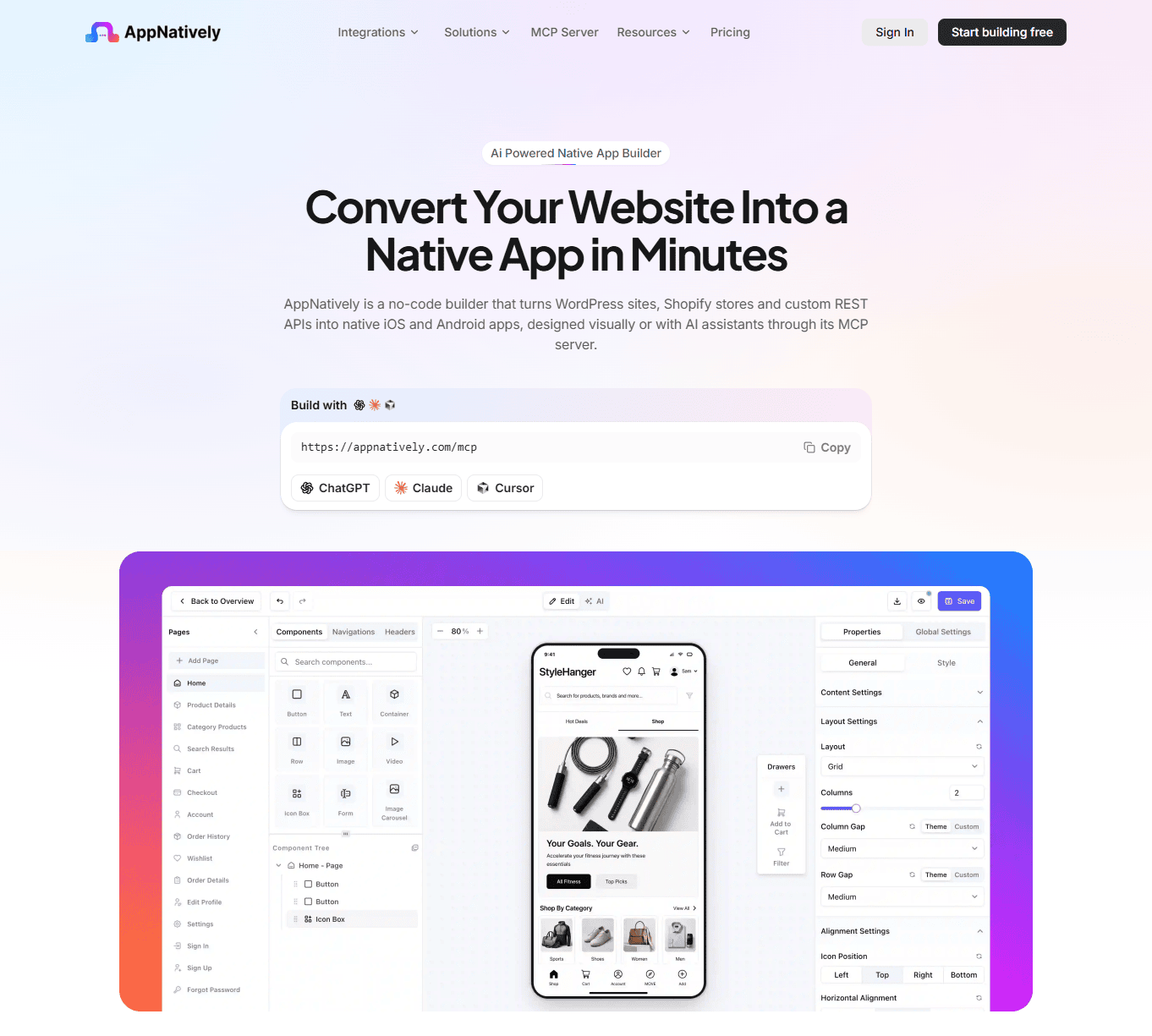
For Shopify merchants, AppNatively connects directly to Shopify through the Storefront API. It can display live products, collections, customer accounts, orders, blogs, pages, and other supported content without requiring merchants to rebuild their Shopify store from scratch.
The platform combines a visual drag-and-drop builder with AI-assisted app development and MCP connectivity.
That makes AppNatively different from a simple website-to-app wrapper.
The goal is to give Shopify merchants more control over how their mobile experience looks and behaves while keeping Shopify as the underlying commerce system.
Key AppNatively features
- Native iOS and Android apps
- Shopify Storefront API integration
- Drag-and-drop visual builder
- AI-powered app building
- MCP Server integration
- 120+ components
- Custom app screens
- Live preview
- OTA updates
- Unlimited push notifications
- Deep linking
- Custom app icons
- Splash screens
- GitHub integration
- Firebase integration
- Custom API support
- App Store and Google Play publishing
- Shopify customer accounts
- Shopify checkout
- Live product and inventory data
AppNatively also supports websites beyond Shopify, including WordPress, WooCommerce, SureCart, FluentCart, directory platforms, and custom REST APIs.
That broader platform approach can matter for agencies or businesses operating multiple types of websites.
What Is Shopney?
Shopney is a Shopify-focused mobile app builder designed around ecommerce businesses that want to launch branded iOS and Android applications without traditional development.
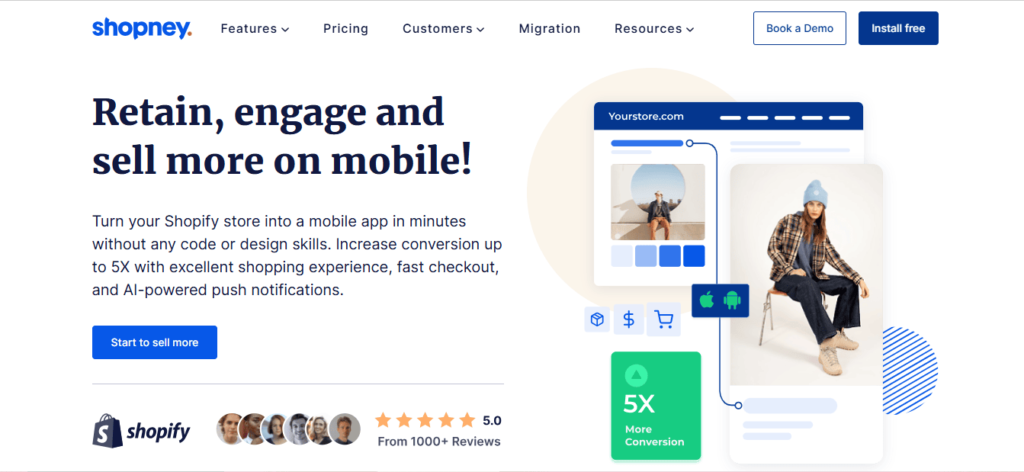
Its focus is heavily centered on the shopping experience.
Shopney provides a drag-and-drop editor, real-time Shopify synchronization, push notifications, app-exclusive promotions, localization, product discovery, and ecommerce-focused integrations.
Shopney is particularly interesting for merchants who want a guided ecommerce app-building experience rather than a highly developer-oriented workflow.
Key Shopney features
- Native iOS and Android applications
- Drag-and-drop design editor
- Shopify synchronization
- Unlimited push notifications
- In-app chat
- In-app campaigns
- Product search and filtering
- Multi-language support
- Multi-currency support
- Abandoned cart notifications
- Back-in-stock notifications
- Product recommendations
- Loyalty integrations
- Subscription integrations
- Klaviyo integration
- Rebuy integration
- Nosto integration
- Multiple app themes
- App-exclusive discounts
- Live selling
- Barcode scanning
- Augmented reality on higher plans
Shopney's current pricing starts at $149/month, with higher plans at $299, $599, and $1,299/month. It also advertises a 30-day free trial and no sales commissions.
What Is Tapcart?
Tapcart is a Shopify-focused mobile app platform aimed primarily at brands that want to use their mobile app as a serious retention and growth channel.
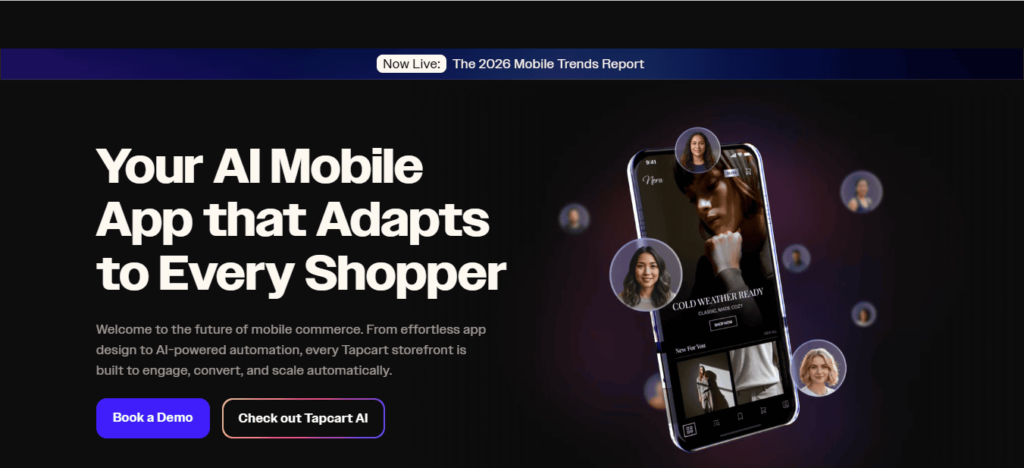
Its current platform emphasizes AI, personalized customer journeys, push notifications, analytics, segmentation, A/B testing, integrations, and enterprise infrastructure.
Tapcart is not simply trying to help a merchant "make an app."
It is positioning the mobile app as another major growth and retention channel.
Key Tapcart features
- Native iOS and Android apps
- Drag-and-drop App Studio
- Unlimited blocks
- Unlimited integrations
- Unlimited push notifications
- Custom app screens
- AI-assisted editing
- Advanced analytics
- A/B testing
- User segmentation
- Conditional content
- Shopify metafields
- Scheduled publishing
- Heatmaps and scrollmaps
- AI push notifications
- AI Autopilot
- AI Scenes
- Developer tools
- MCP capabilities on Enterprise+
- Tapcart CLI on Enterprise+
- Dedicated infrastructure on Enterprise+
Tapcart currently lists $500/month for Growth, $1,250/month for Scale, and $2,850/month for Enterprise+, with lower effective annual pricing displayed on its pricing page.
AppNatively vs Shopney vs Tapcart: Pricing
Pricing is one of the biggest differences between these three platforms.
Current published pricing
| Platform | Entry pricing | Higher tiers |
|---|---|---|
| AppNatively | Varies by current offer | Check current plan |
| Shopney | $149/month | Up to $1,299/month |
| Tapcart | $500/month | Up to $2,850/month |
Shopney currently lists Silver at $149/month, Gold at $299/month, Platinum at $599/month, and Enterprise from $1,299/month.
Tapcart lists Growth at $500/month, Scale at $1,250/month, and Enterprise+ starting at $2,850/month.
This makes the pricing difference particularly important for startups and small-to-medium Shopify stores.
If your store does not need enterprise analytics, advanced segmentation, dedicated infrastructure, or a large marketing team, paying hundreds or thousands of dollars every month may not make sense.
That is where AppNatively's value proposition becomes particularly interesting.
AppNatively vs Shopney: Which Is Better?
AppNatively and Shopney are both strong choices, but they take different approaches.
Choose AppNatively if you want:
- More visual freedom
- Native app customization
- AI-assisted development
- MCP connectivity
- OTA updates
- Developer-friendly workflows
- GitHub integration
- Custom API support
- A broader website-to-app platform
- Greater control over the mobile experience
Choose Shopney if you want:
- A Shopify-first experience
- Ecommerce-focused templates and layouts
- Strong merchandising features
- Advanced push notification workflows
- In-app campaigns
- Shopify-focused integrations
- Hands-on onboarding and support
Shopney is particularly strong when the main objective is to create a polished shopping app and then use ecommerce marketing tools to increase engagement and repeat purchases. Its published feature set includes segmentation, AI push notifications, abandoned-cart notifications, loyalty integrations, and marketing integrations depending on the plan.
AppNatively takes a broader approach.
Instead of treating the mobile app primarily as a Shopify marketing channel, it gives merchants a visual environment for creating the actual native application.
AppNatively vs Tapcart: Which Is Better?
This comparison is even more interesting because both platforms emphasize modern native apps, AI, customization, and growth.
Tapcart has a major advantage for larger Shopify brands that need mature enterprise marketing functionality.
Its Scale and Enterprise+ plans include features such as advanced analytics, A/B testing, segmentation, heatmaps, scheduled publishing, developer tooling, and enterprise infrastructure.
But those capabilities come with significantly higher subscription costs.
Choose Tapcart if you:
- Run a large Shopify brand
- Have an established mobile marketing team
- Need advanced segmentation
- Want A/B testing
- Need sophisticated analytics
- Rely heavily on retention marketing
- Use a large enterprise technology stack
- Have the budget for enterprise software
Choose AppNatively if you:
- Want a modern native Shopify app
- Want more control over app design
- Want AI-assisted app development
- Want OTA updates
- Want MCP integration
- Want GitHub integration
- Want custom API capabilities
- Want to avoid being locked into an enterprise-heavy workflow
- Want a broader website-to-app platform
AppNatively's Shopify comparison currently highlights native iOS and Android apps, drag-and-drop building, AI capabilities, OTA updates, MCP, GitHub integration, push notifications, and deep linking.
AppNatively vs Shopney vs Tapcart for Native App Experience
All three platforms produce native iOS and Android applications.
That is important because Shopify merchants should not automatically assume that every "mobile app builder" delivers the same mobile experience.
A native application can provide:
- Native navigation
- Mobile-specific interfaces
- Push notifications
- App Store presence
- Home-screen access
- Deep links
- Mobile-specific customer journeys
- Faster access to repeat shopping experiences
AppNatively explicitly positions its Shopify integration around native iOS and Android apps rather than simply displaying the Shopify website inside an app.
Shopney and Tapcart also position their products as native iOS and Android Shopify applications.
So the bigger question is not simply:
"Which one is native?"
All three are.
The better question is:
"Which platform gives me the right level of control, commerce functionality, marketing capabilities, and cost for my business?"
AppNatively vs Shopney vs Tapcart for Customization
Customization is where the platforms begin to separate.
AppNatively
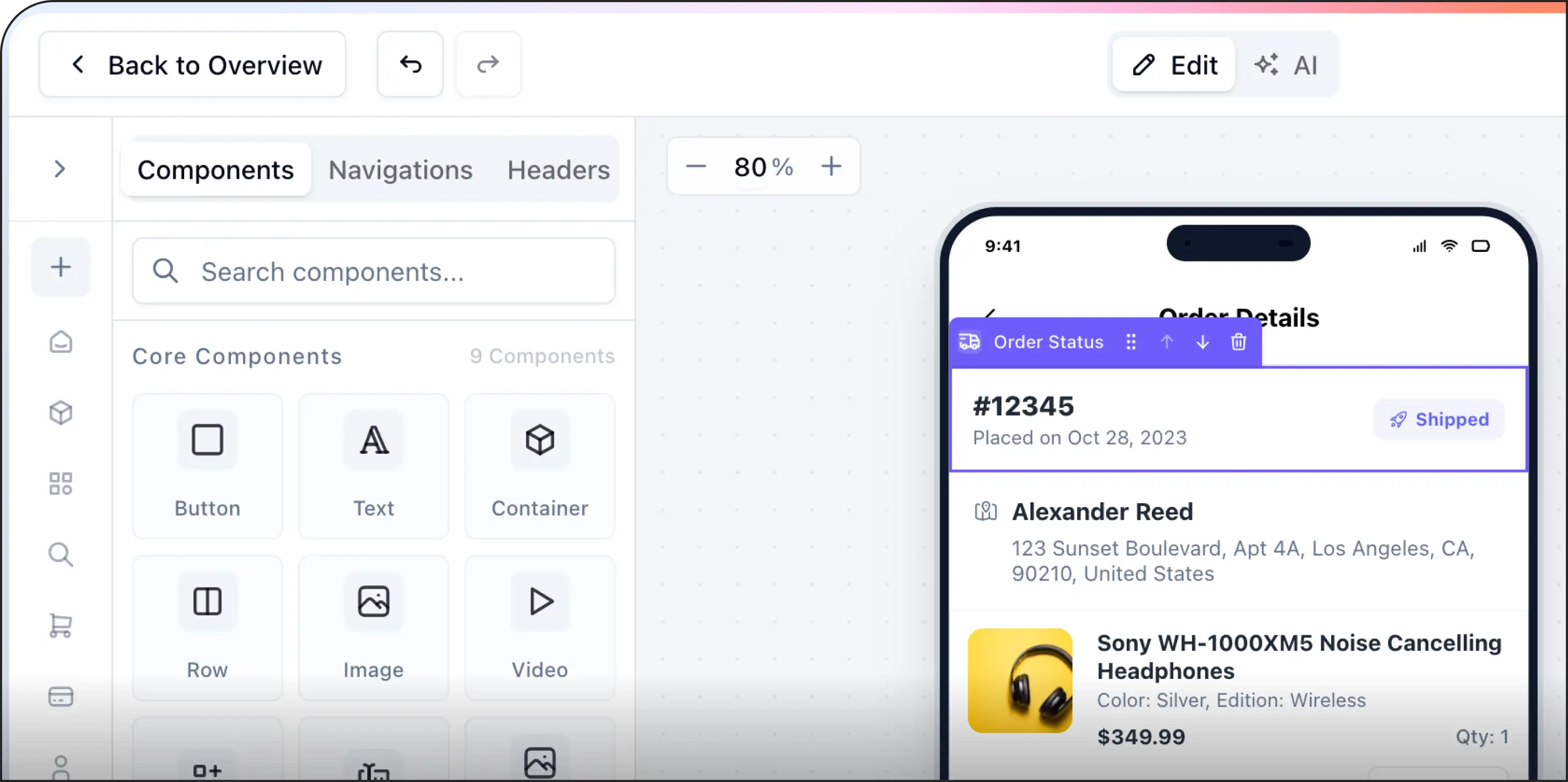
AppNatively emphasizes visual customization, custom components, native screens, real-time previews, AI-assisted development, and developer tooling.
It also supports MCP, allowing supported workflows to connect the app-building process with AI assistants.
Shopney
Shopney provides a strong visual editor with themes, design elements, customizable buttons and colors, navigation, product pages, collections, and ecommerce-specific layouts.
Tapcart
Tapcart offers App Studio with blocks, custom screens, AI editing, dynamic layouts, product page customization, conditional content, and advanced publishing workflows.
The verdict
Best for broad customization and control: AppNatively
Best for ecommerce-oriented visual design: Shopney
Best for enterprise marketing-driven customization: Tapcart
AppNatively vs Shopney vs Tapcart for AI
AI is becoming an important part of modern app builders.
But "AI-powered" can mean very different things.
AppNatively
AppNatively uses AI as part of the app-building workflow and supports MCP, allowing AI assistants to interact with supported app-building capabilities.
This makes AI more than just a marketing feature. It can become part of how merchants build and manage their apps.
Shopney
Shopney's higher-tier capabilities include AI-driven and segmented push notifications, with a strong focus on ecommerce engagement and merchandising.
Tapcart
Tapcart has a particularly strong AI focus around ecommerce growth.
Its current platform includes AI editing, AI Push Notifications, AI Autopilot, AI Scenes, and AI capabilities designed around personalization and campaign creation.
The verdict
If you want AI as part of the app-building and developer workflow, AppNatively has a compelling advantage.
If you want AI primarily for ecommerce personalization and marketing automation, Tapcart is particularly strong.
AppNatively vs Shopney vs Tapcart for Push Notifications
Push notifications are one of the biggest reasons Shopify merchants launch mobile apps.
They let brands communicate directly with customers without relying entirely on email, paid ads, or social media algorithms.
All three platforms support push notifications.
AppNatively
AppNatively provides unlimited push notifications through its platform, powered by Firebase.
Shopney
Shopney offers unlimited push notifications, plus automated, personalized, scheduled, promotional, rich-media, back-in-stock, and abandoned-cart notifications, depending on the plan.
Tapcart
Tapcart offers unlimited push notifications and goes further with AI-powered push campaigns and personalization capabilities.
The verdict
Best for straightforward native push campaigns: AppNatively
Best for ecommerce-focused push automation: Shopney
Best for AI-driven retention campaigns: Tapcart
AppNatively vs Shopney vs Tapcart for Shopify Integration
All three platforms are designed to work with Shopify.
But the technical approach and surrounding ecosystem differ.
AppNatively connects Shopify through the Storefront API. Products, variants, images, collections, availability, customer accounts, and orders can be surfaced in the native app while checkout remains connected to the merchant's Shopify store.
Shopney is deeply focused on Shopify and provides real-time store synchronization, checkout, customer accounts, orders, products, collections, and ecommerce features.
Tapcart also provides real-time Shopify synchronization and supports Shopify-specific functionality such as metafields and Shopify Multipass on higher plans.
The verdict
All three are strong Shopify choices.
The difference is what comes around the Shopify integration.
AppNatively: Shopify + native customization + AI + developer tooling
Shopney: Shopify + ecommerce UX + merchandising + engagement
Tapcart: Shopify + enterprise marketing + analytics + personalization
AppNatively vs Shopney vs Tapcart for Small Businesses
For a small Shopify business, monthly software costs matter.
A platform that costs $500, $1,250, or $2,850 per month can become a major operating expense before you even consider the Apple Developer and Google Play developer accounts required for publishing.
Tapcart's current pricing starts at $500/month, while Shopney starts at $149/month.
For a smaller merchant, the most important question is therefore not:
"Which platform has the most features?"
It is:
"Which features will actually generate enough value to justify the subscription?"
For many smaller Shopify stores, AppNatively can be the more attractive direction because it emphasizes native app functionality and customization without making enterprise-scale marketing infrastructure the center of the product.
AppNatively vs Shopney vs Tapcart for Enterprise Brands
The answer changes for enterprise merchants.
If your organization has:
- Dedicated growth teams
- Mobile marketing managers
- CRM specialists
- Large customer databases
- Advanced analytics requirements
- A/B testing requirements
- Complex segmentation
- Multiple stakeholders
- Enterprise infrastructure requirements
Tapcart becomes particularly compelling.
Its Scale and Enterprise+ plans include advanced analytics, A/B testing, segmentation, heatmaps, developer tooling, dedicated support, data streaming, regional apps, and enterprise infrastructure.
Shopney also offers enterprise capabilities, including multi-store support, professional design support, dedicated success management, and advanced integrations.
AppNatively can be more attractive when enterprise teams prioritize control over the actual app-building experience and want AI, MCP, APIs, GitHub, OTA updates, and custom development workflows.
Which Is the Best Shopify Mobile App Builder in 2026?
There is no universal winner.
But the answer becomes much clearer when you match the platform to the business.
| If your priority is... | Best choice |
|---|---|
| Overall flexibility | AppNatively |
| AI-assisted app building | AppNatively |
| MCP-powered workflows | AppNatively |
| OTA updates | AppNatively |
| Developer-friendly workflows | AppNatively |
| Ecommerce design and merchandising | Shopney |
| Ecommerce push automation | Shopney |
| Hands-on ecommerce support | Shopney |
| Enterprise analytics | Tapcart |
| A/B testing | Tapcart |
| Advanced segmentation | Tapcart |
| AI-powered retention marketing | Tapcart |
| Enterprise infrastructure | Tapcart |
| Shopify-only ecosystem | Shopney / Tapcart |
| Broader website-to-app capabilities | AppNatively |
AppNatively vs Shopney vs Tapcart: Final Verdict
The three platforms solve similar problems, but they are optimized for different types of Shopify merchants.
Choose AppNatively
Choose AppNatively if you want to build a genuinely native Shopify app while retaining significant control over the design, app structure, development workflow, and future updates.
It is particularly compelling for merchants who want:
- Native iOS and Android
- Visual app building
- AI-assisted development
- MCP
- OTA updates
- Unlimited push notifications
- Custom screens
- GitHub integration
- Custom API support
- Shopify integration
- More control without immediately moving into an enterprise pricing model
AppNatively also gives businesses an important advantage if they eventually want to build apps beyond Shopify because the platform supports WordPress, ecommerce platforms, directories, and custom APIs.
Choose Shopney
Choose Shopney if your priority is a polished Shopify shopping experience combined with strong ecommerce merchandising, push notifications, loyalty capabilities, integrations, and hands-on support.
Its $149/month entry plan makes it considerably more accessible than Tapcart for many growing brands, while its higher plans provide more advanced ecommerce functionality.
Choose Tapcart
Choose Tapcart if your Shopify store is already operating at a level where mobile retention, personalization, analytics, testing, segmentation, and enterprise infrastructure justify a significantly larger software investment.
Its current platform is particularly well suited to sophisticated DTC and enterprise Shopify brands.
So, Is AppNatively Better Than Shopney and Tapcart?
For every Shopify store? No.
For merchants looking for a flexible, native, AI-powered app builder with strong customization and modern development tooling? It can be.
Shopney is a strong ecommerce-focused platform.
Tapcart is a powerful enterprise mobile commerce platform.
AppNatively takes a different position: give merchants the tools to build and control a native mobile experience without forcing every business into an enterprise-level workflow.
That distinction matters.
If your goal is simply to launch a Shopify app, all three deserve consideration.
If your goal is to build a mobile product that you can customize, evolve, connect to AI, update quickly, and control as your business grows, AppNatively deserves a very close look.
Frequently asked questions
AppNatively can be a better fit for merchants who prioritize native customization, AI-assisted app development, MCP, OTA updates, custom APIs, and developer-friendly workflows. Shopney can be a better fit for merchants focused on ecommerce merchandising, push campaigns, integrations, and managed support.
It depends on the business. Tapcart is particularly strong for enterprise Shopify brands that need advanced analytics, segmentation, A/B testing, personalization, and enterprise infrastructure. AppNatively is compelling for merchants that want native app flexibility, AI-assisted building, MCP, OTA updates, and greater control without necessarily adopting an enterprise-focused platform.
Shopney can be a better option for merchants that want strong ecommerce functionality at a lower starting price. Tapcart is more compelling for larger brands that need advanced analytics, testing, segmentation, personalization, and enterprise infrastructure. Shopney currently starts at $149/month, while Tapcart's published Growth plan is $500/month.
Yes. All three platforms are designed to create native iOS and Android applications for Shopify merchants.
Yes. AppNatively, Shopney, and Tapcart all provide visual no-code or low-code workflows designed to reduce the need for traditional mobile development.
Yes. AppNatively connects Shopify through the Storefront API and supports live products, collections, checkout, customer accounts, orders, blogs, pages, and supported metaobjects.
Yes. Shopney supports unlimited push notifications and offers advanced notification capabilities such as abandoned cart, back-in-stock, scheduled, personalized, promotional, and segmented notifications depending on the plan.
Yes. Tapcart currently offers AI editing and AI-powered capabilities including AI Push Notifications, AI Autopilot, AI Scenes, and other AI-driven ecommerce functionality.
Yes. AppNatively supports OTA updates, allowing supported changes to reach existing app users without requiring a new App Store or Google Play review for every update.
Pricing changes frequently, so merchants should check the current plans before purchasing. As of October 2026, Shopney publicly lists plans starting at $149/month, while Tapcart lists Growth at $500/month. AppNatively's current offer should be checked directly before making a purchasing decision.
Choose AppNatively if flexibility, native customization, AI, MCP, OTA updates, and control are your priorities.
Choose Shopney if ecommerce UX, merchandising, push campaigns, and support are your priorities.
Choose Tapcart if enterprise analytics, personalization, segmentation, testing, and retention marketing are your priorities.
Related posts