
If you are looking for the best AppMySite alternatives in 2026, three platforms worth comparing are AppNatively, AppPresser, and Shoutem.
AppMySite remains a popular option for turning WordPress, WooCommerce, Shopify, and other websites into mobile apps without traditional development. Its current platform supports native Android and iOS apps, WordPress, WooCommerce, Shopify, push notifications, ecommerce features, analytics, and app publishing.
However, the best app builder depends on what you are actually trying to build.
A WooCommerce store may need deep ecommerce functionality. A WordPress membership or LearnDash website may need WordPress-specific integrations. A directory platform may need listing synchronization, maps, filters, user accounts, and custom APIs. An agency may need greater control over multiple apps and branding.
In this blog post, we’ll compare 3 AppMySite alternatives for 2026 and beyond:
- AppNatively
- AppPresser
- Shoutem
Quick Answer: What Are the Best AppMySite Alternatives in 2026?
For businesses evaluating AppMySite alternatives in 2026:
- AppNatively is a strong choice for businesses that want an AI-powered native app builder with visual customization, WordPress, WooCommerce, SureCart, FluentCart, directory integrations, custom APIs, OTA updates, MCP server, and push notifications.
- AppPresser is particularly relevant for WordPress users who need specialized integrations with platforms such as WooCommerce, BuddyPress, BuddyBoss, and LearnDash.
- Shoutem is a general-purpose no-code native app builder with templates, extensions, content management, push notifications, analytics, monetization, and publishing tools.
The right choice depends on your website, integrations, app requirements, and preferred development workflow.
AppMySite Alternatives Compared
| Feature | AppNatively | AppPresser | Shoutem | AppMySite |
|---|---|---|---|---|
| Android App | ✅ | ✅ | ✅ | ✅ |
| iOS App | ✅ | ✅ | ✅ | ✅ |
| Visual Drag-and-Drop Builder | ✅ | ✅ | ✅ | ✅ |
| AI-Assisted App Building | ✅ | ❌ | ❌ | ✅ |
| WordPress | ✅ | ✅ | ✅ | ✅ |
| WooCommerce | ✅ | ✅ | ✅ | ✅ |
| SureCart | ✅ | ❌ | ❌ | ❌ |
| FluentCart | ✅ | ❌ | ❌ | ❌ |
| Shopify | ✅ | ❌ | ✅ | ✅ |
| Custom APIs | ✅ | ❌ | ✅ | ✅ |
| Directory Integrations | ✅ | ❌ | ❌ | ❌ |
| Directorist | ✅ | ❌ | ❌ | ❌ |
| GeoDirectory | ✅ | ❌ | ❌ | ❌ |
| HivePress | ✅ | ❌ | ❌ | ❌ |
| Custom Mobile Screens | ✅ | ✅ | ✅ | ✅ |
| Push Notifications | ✅ | ✅ | ✅ | ✅ |
| OTA Updates | ✅ | ✅ | ✅ | ✅ |
| Firebase Push | ✅ | ✅ | ✅ | ✅ |
| GitHub Actions | ✅ | ❌ | ❌ | ❌ |
| MCP Support | ✅ | ❌ | ❌ | ❌ |
| Google Play Publishing | ✅ | ✅ | ✅ | ✅ |
| App Store Publishing | ✅ | ✅ | ✅ | ✅ |
AppMySite currently offers native Android and iOS app creation, WordPress and WooCommerce integrations, Shopify support, push notifications, ecommerce functionality, analytics, and multiple publishing options.
The alternatives become particularly interesting when you need a more specialized workflow.
1. AppNatively
Best for: WordPress, WooCommerce, SureCart, FluentCart, directory, booking, ecommerce, and custom API businesses looking for an AI-powered native app builder.
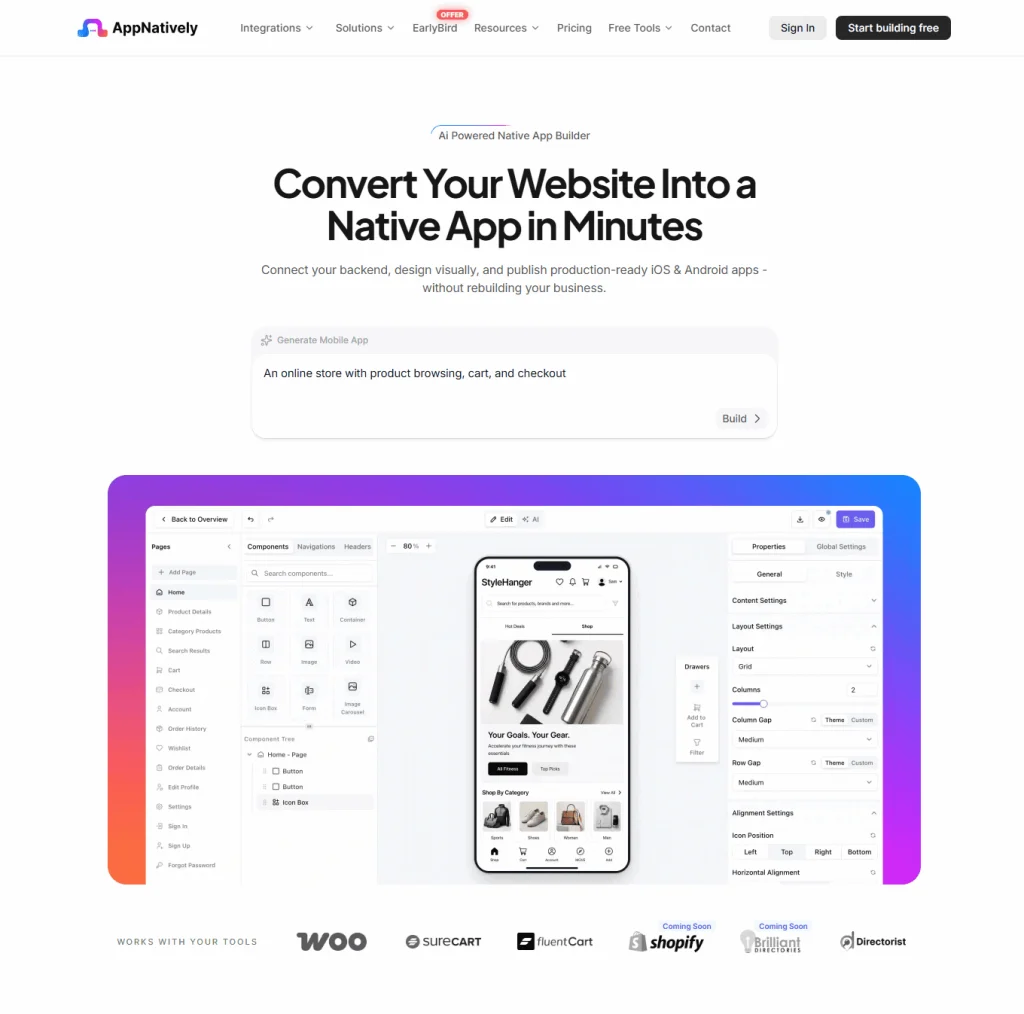
AppNatively is an AI-powered native app builder designed to turn existing websites and backends into production-ready iOS and Android applications without rebuilding the entire business from scratch.
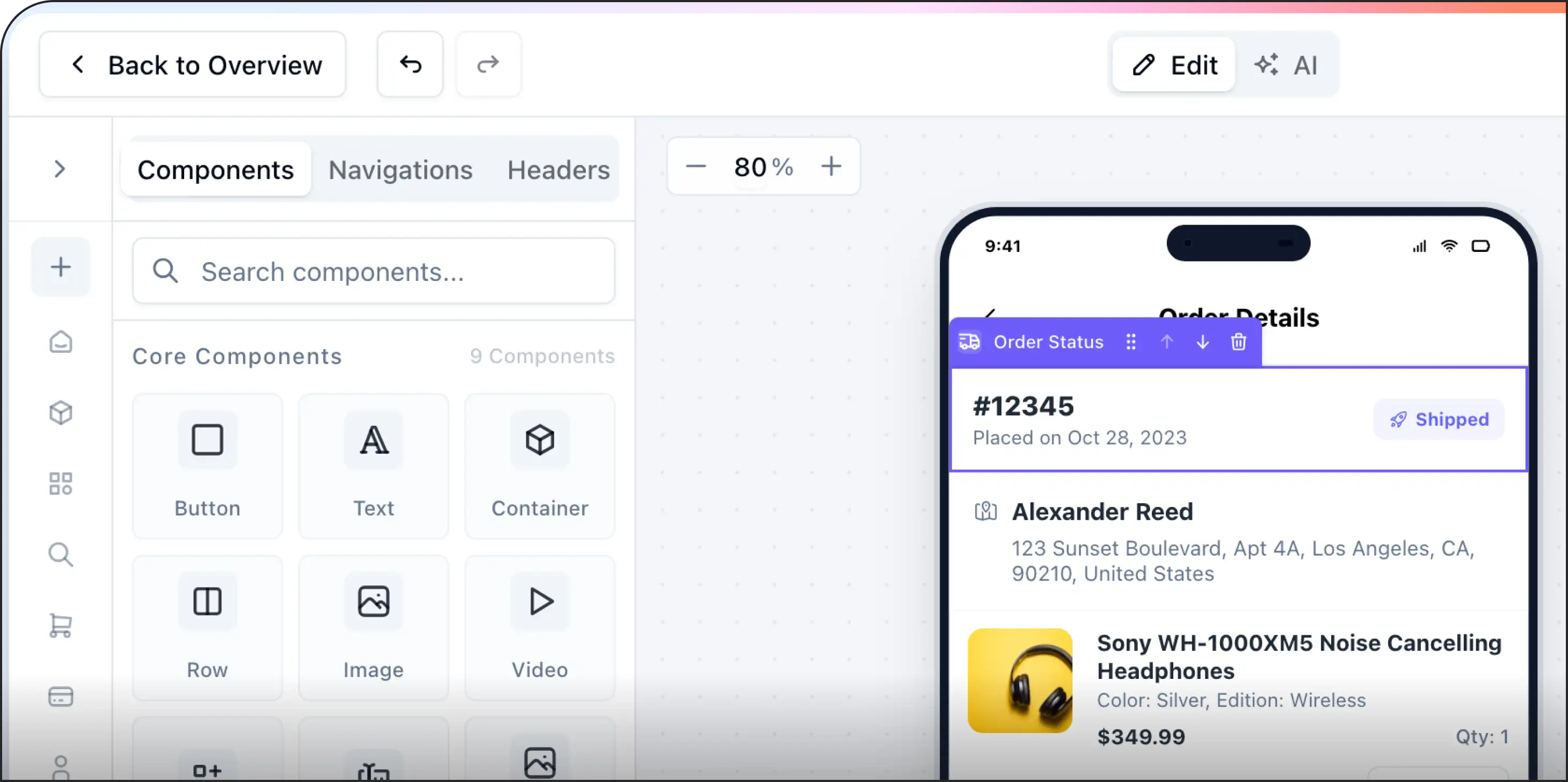
The platform uses a visual workflow where you connect your website or backend, design the mobile experience, preview it, and prepare the app for publishing.
AppNatively currently supports integrations and workflows for ecommerce, directories, forms, custom APIs, and other website-based businesses. Its website lists integrations including WooCommerce, SureCart, FluentCart, Directorist, HivePress,GeoDirectory, Business Directory, aDirectory, WPForms, Fluent Forms, Contact Form 7, Formidable Forms, and others.
Why Consider AppNatively as an AppMySite Alternative?
The biggest difference is the product philosophy.
Instead of treating the mobile app as simply another presentation layer for a website, AppNatively focuses on creating a native mobile experience connected to your existing business infrastructure.
You can connect your website or custom backend, visually build native screens, and publish Android and iOS applications from the same workflow.
AI-Powered App Building
AppNatively combines visual app building with AI-assisted workflows.
This matters because modern app development is moving beyond basic drag-and-drop templates.
AI can help with app structure, screens, workflows, and development tasks while the visual builder gives users control over the final product.
The objective is to reduce the gap between traditional development and no-code app building.
Native App Experience
AppNatively is designed around native Android and iOS apps rather than simply placing a website inside a mobile wrapper.
The platform supports native screens and components while allowing businesses to continue using their existing website, ecommerce system, directory platform, or custom backend.
This is especially useful for businesses that already have substantial infrastructure on the web and do not want to rebuild their backend just to launch a mobile app.
WordPress and WooCommerce
For WordPress businesses, AppNatively can connect the mobile experience to existing WordPress functionality.
WooCommerce businesses can use their existing store infrastructure while extending the customer experience into a native mobile application.
This makes AppNatively relevant to:
- WooCommerce stores
- Membership websites
- Directory websites
- Booking websites
- Service businesses
- Content websites
- Marketplace-style websites
- Custom WordPress applications
Directory App Integrations
Directory websites are one area where AppNatively has a particularly broad integration focus.
Its current integrations include directory platforms such as Directorist, GeoDirectory, HivePress, Business Directory and aDirectory. GeoDirectory support includes listing synchronization, maps, pins, clustering, search, filtering, categories, cities, custom fields, and reviews.
That means a directory owner can maintain the website as the primary data source while creating a dedicated mobile experience for users.
For example, a local business directory can turn:
Listings → Native listing screens
Categories → Native categories
Locations → Native maps
Reviews → Mobile review experience
Search → Native search
Filters → Mobile filtering
This can be particularly useful for directory owners whose websites already contain thousands of listings.
Custom API Support
AppNatively also supports custom APIs and existing backend systems.
Its current documentation states that users can connect existing website data, custom APIs, and backend services while maintaining native mobile screens and workflows.
This makes the platform relevant beyond WordPress.
For example, a company with a custom SaaS backend can potentially use its existing APIs as the data layer while building the mobile interface through AppNatively.
OTA Updates
One of AppNatively’s notable features is OTA, or over-the-air, updates.
The platform states that certain changes can be published to users’ existing apps without requiring a new app store review or forcing users to download a new version.
This can simplify ongoing app maintenance.
Instead of treating every visual or supported app-level change as a completely new store release, developers can use OTA updates where supported.
Unlimited Push Notifications
AppNatively provides push notification functionality powered by Firebase.
Its current product pages describe unlimited push notifications with campaigns that can include messages, images, and deep links.
This is useful for:
- New product announcements
- New directory listings
- Booking reminders
- Promotional campaigns
- Abandoned-cart campaigns
- Content notifications
- User re-engagement
- Important service updates
AppNatively Go
Another useful feature is AppNatively Go, which provides real-time previewing on a physical device through a QR-code workflow.
Instead of waiting for a complete production build every time you change a screen, you can preview changes on a device while designing.
GitHub Integration
For developers and technical teams, AppNatively also provides GitHub integration.
The integration supports GitHub Actions builds and can generate APK, AAB, and iOS builds through repository workflows.
This creates a bridge between visual no-code development and more traditional developer workflows.
MCP and AI Workflows
AppNatively is also building around the emerging Model Context Protocol ecosystem.
MCP can make it possible for AI systems and tools to interact with application development workflows in a more structured way.
For businesses building AI-assisted workflows, this direction can be particularly relevant as app development becomes increasingly connected to AI agents and automation.
Who Should Choose AppNatively?
AppNatively is worth considering if you:
- Run a WooCommerce store
- Have a Shopify store
- Own a WordPress website
- Run a directory website
- Use Directorist, GeoDirectory, HivePress or other supported directory systems
- Run a booking platform
- Use SureCart or FluentCart
- Need custom API connectivity
- Want native Android and iOS apps
- Need OTA updates
- Want built-in push notification capabilities
- Want visual app customization
- Want AI-assisted app development
- Need a workflow that can also accommodate developers
AppNatively vs AppMySite
The two platforms overlap significantly in their website-to-app use cases, but their positioning differs.
AppMySite provides a mature website-to-app platform with WordPress, WooCommerce, Shopify, native app creation, ecommerce features, push notifications, analytics, and app publishing.
AppNatively places more emphasis on native visual app creation, AI-assisted workflows, custom APIs, directory integrations, OTA updates, and a broader component-based approach to building the mobile experience.
For businesses with highly structured WordPress directories, custom backends, or a need for more control over the mobile experience, these differences can be important.
2. AppPresser
Best for: WordPress websites that need specialized mobile app functionality and deep connections with the WordPress ecosystem.
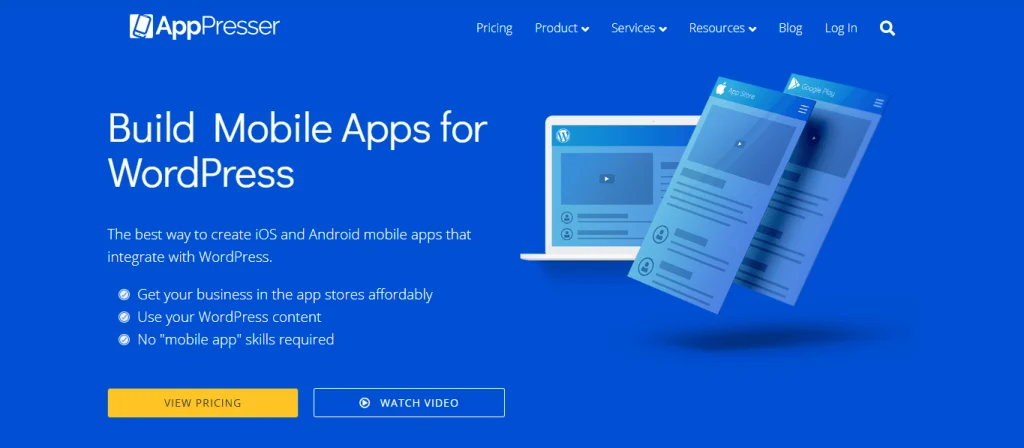
AppPresser is one of the established options for turning WordPress websites into mobile applications.
Its approach is particularly focused on WordPress.
According to its WordPress.org listing, AppPresser helps website builders create iOS and Android apps from WordPress sites and provides access to device capabilities such as the camera and contacts. The WordPress plugin itself acts as the connection layer between WordPress and the AppPresser app builder.
WordPress-Centered Architecture
AppPresser is not simply a generic website-to-app tool.
It is designed around WordPress, which makes it particularly relevant for businesses that have built their products around the WordPress ecosystem.
Its feature set supports several WordPress-driven app categories, including:
- WooCommerce
- Membership websites
- BuddyPress
- BuddyBoss
- LearnDash
- Podcasts
- Nonprofit websites
- Events
- Schools
- Organizations
- WordPress-based businesses
AppPresser’s official feature page specifically highlights these types of applications.
Visual App Customization
AppPresser provides a visual app customization workflow.
Users can select pages, customize the app interface, preview the app, test on devices, and prepare the application for app store submission.
For WordPress users already comfortable with the WordPress Customizer, this approach can feel familiar.
WooCommerce Apps
WooCommerce is one of AppPresser’s supported use cases.
This makes it an option for WordPress store owners who want to extend an existing WooCommerce site into a mobile application rather than build an ecommerce app completely independently.
LearnDash and Community Apps
One of AppPresser’s notable areas is its WordPress ecosystem support.
If your website depends heavily on LearnDash, BuddyPress, or BuddyBoss, the platform may deserve consideration because those systems can be central to the app experience.
This is different from choosing a generic app builder and then attempting to reproduce every WordPress-specific workflow manually.
AppPresser Extensions
AppPresser uses a WordPress-oriented extension approach.
The platform can connect different WordPress capabilities to the app experience, which makes it suitable for websites that rely on multiple WordPress plugins.
Who Should Choose AppPresser?
AppPresser may make sense if:
- Your business is heavily dependent on WordPress
- You use LearnDash
- You use BuddyPress or BuddyBoss
- You operate a WooCommerce store
- You want a WordPress-focused app builder
- Your mobile app needs WordPress-specific functionality
- You prefer a WordPress-oriented development workflow
AppPresser vs AppMySite
The distinction is mainly about ecosystem focus.
AppMySite is a broader website-to-app platform supporting WordPress, WooCommerce, Shopify, custom websites, and multiple mobile app capabilities.
AppPresser is much more centered around WordPress and its plugin ecosystem.
That makes the choice less about which platform has more features and more about which ecosystem matches your website.
3. Shoutem
Best for: Businesses, organizations, creators, and agencies that want a general-purpose no-code native app builder with templates, extensions, content tools, and monetization features.
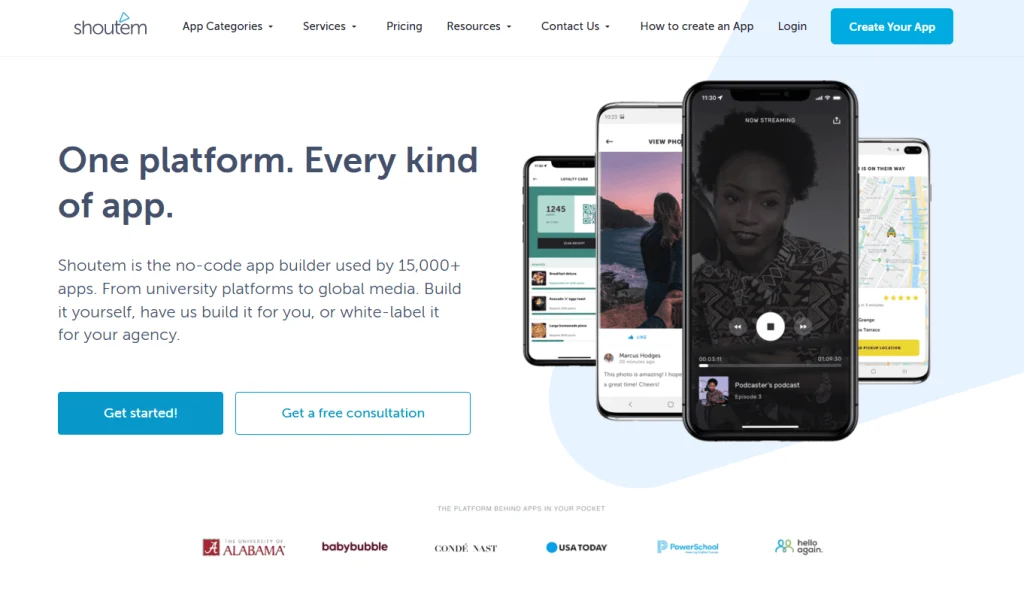
Shoutem is a general-purpose no-code app development platform that allows users to build mobile applications without traditional programming.
The platform supports native iOS and Android app development and provides templates, a visual builder, extensions, content management, push notifications, analytics, user management, monetization, and publishing tools.
Native App Builder
Shoutem’s developer documentation states that its platform is designed for building, publishing, and managing native iOS and Android apps and is built on React Native.
This makes it relevant for businesses looking for something beyond a simple website wrapper.
Drag-and-Drop Builder
Shoutem uses a visual drag-and-drop workflow.
Users can start with templates, select features, customize layouts, modify navigation, add content, and preview their application without writing traditional application code.
Templates and Extensions
One of Shoutem’s central concepts is its extension ecosystem.
The platform provides reusable functionality such as:
- Navigation
- Places
- Push notifications
- Analytics
- Advertising
- Social features
- Content
- Events
- User management
Its developer documentation describes apps as collections of reusable extensions that can be customized or extended.
Push Notifications
Shoutem supports push notifications as part of its app feature set.
Businesses can use notifications to communicate updates, announcements, promotions, and other information to app users.
Monetization
Shoutem also includes several monetization features.
Its current product information highlights advertising, in-app purchases, subscriptions, and other monetization mechanisms.
This can be useful for publishers, communities, media companies, and businesses that want their app to generate revenue beyond direct ecommerce transactions.
Offline Functionality
Shoutem also highlights offline functionality, including offline navigation maps for certain use cases.
For applications where users need access to certain content without a continuous internet connection, this can be useful.
Pricing
Shoutem’s current builder pricing lists an Android plan at $59 per month when billed monthly, a Standard plan at $99 per month, and a Professional plan at $179 per month. Quarterly billing is listed at lower monthly-equivalent rates. The plans include different levels of publishing, storage, extensions, analytics, notifications, and advanced functionality.
Pricing can change, so check the current pricing page before purchasing.
Who Should Choose Shoutem?
Shoutem can be a good fit for businesses that:
- Want a general-purpose app builder
- Need iOS and Android apps
- Want templates to accelerate development
- Need push notifications
- Want app monetization features
- Need social or community functionality
- Want content publishing capabilities
- Prefer a visual no-code builder
- Need extension-based functionality
Shoutem vs AppMySite
AppMySite is heavily focused on converting existing websites, WordPress sites, WooCommerce stores, Shopify stores, and other web properties into mobile apps.
Shoutem takes a more general app-builder approach.
That distinction matters.
If your starting point is an existing WooCommerce or WordPress website, a website-focused platform may fit your workflow differently from a general-purpose app builder.
If your starting point is a new content, community, media, or organization app, Shoutem’s templates and extension ecosystem may be more relevant.
Why Are People Looking for AppMySite Alternatives?
There is no single reason to switch from AppMySite.
Different businesses reach this point for different reasons.
1. They want more native customization
Some businesses want more control over the mobile experience than a standardized website-to-app workflow provides.
They may want custom screens, custom navigation, unique listing experiences, custom API connections, or more control over app logic.
This is where platforms such as AppNatively become relevant.
2. They need specialized WordPress integrations
A WordPress website may use a combination of plugins for:
- Ecommerce
- Memberships
- Courses
- Directories
- Bookings
- Forms
- Communities
- User profiles
The more specialized the website becomes, the more important integration support becomes.
AppPresser is particularly focused on this WordPress ecosystem.
3. They want a general-purpose app builder
Not every app starts with a website.
Some companies are creating:
- Communities
- Media apps
- Event apps
- Educational apps
- Content apps
- Membership apps
- Social applications
For these use cases, a general-purpose platform such as Shoutem can be relevant.
4. They need different pricing models
AppMySite currently offers different pricing depending on the product and platform. For example, its WordPress pricing page lists a free Android option, a $69/month Starter plan, a $129/month Pro plan, and a $249/month Premium plan for the displayed monthly pricing.
Its other products have different pricing structures.
That means businesses comparing alternatives should calculate the total cost based on:
- Number of apps
- Android vs iOS
- App publishing
- Advanced features
- Push notifications
- Analytics
- Branding
- Updates
- Agency requirements
The cheapest monthly price is not necessarily the same thing as the lowest total cost.
What Should You Look for in an AppMySite Alternative?
Before switching platforms, evaluate these areas.
Native vs WebView
First, understand what technology the platform uses.
A WebView-based application primarily displays web content inside a mobile application container.
A native or native-focused architecture can provide more control over mobile navigation, components, device capabilities, and application behavior.
However, “native” alone does not guarantee that a platform is the right choice. Integration depth and the quality of the actual mobile implementation matter too.
Website synchronization
If you already have a website, determine whether the app can synchronize:
- Products
- Listings
- Users
- Orders
- Categories
- Reviews
- Content
- Inventory
- Taxonomies
- Customer data
This is particularly important for ecommerce and directory websites.
Custom API support
If your business uses a custom backend, look for API connectivity.
A platform that supports custom APIs can be more flexible than one limited to a fixed collection of integrations.
Push notifications
Push notifications can turn an app into an active communication channel.
Check whether the platform supports:
- Segmentation
- Deep links
- Images
- Scheduled campaigns
- Automation
- Analytics
- Unlimited notifications
OTA Updates
Ask what changes can be deployed through OTA updates and which changes require a new store submission.
This distinction can significantly affect long-term maintenance.
App Store publishing
Check whether you can publish directly to:
- Google Play
- Apple App Store
Also check whether you own the developer accounts and signing credentials.
App ownership and portability
Before committing to a platform, understand:
- Who owns the source/build
- Whether you can export your app
- Whether you can use your own developer accounts
- Whether you can change platforms later
- What happens if you cancel your subscription
These questions become more important as your app grows.
AppMySite Alternative for WooCommerce
If your main requirement is a WooCommerce mobile app, compare the platforms specifically around ecommerce.
AppMySite currently provides WooCommerce product synchronization, variable products, categories, tags, reviews, wishlists, cart, coupons, native checkout, inventory, shipping, tax options, payment providers, and order tracking.
AppNatively also targets WooCommerce and other ecommerce systems while providing a more general native app-building workflow and support for custom APIs.
AppPresser is relevant when WooCommerce is part of a broader WordPress ecosystem.
Shoutem is more general-purpose and should be evaluated based on the exact ecommerce integration required.
Key question: Do you only need to turn your WooCommerce store into an app, or do you want to build a more customized mobile product around your store?
That distinction can change which platform fits your project.
AppMySite Alternative for WordPress
For WordPress websites, all four platforms can be relevant, but their approaches differ.
AppNatively: Native app builder with WordPress, WooCommerce, directory, form, and API integrations.
AppPresser: WordPress-focused platform with support for WooCommerce, BuddyPress, BuddyBoss, LearnDash, and other WordPress use cases.
Shoutem: General-purpose app builder with WordPress and other integrations.
The best choice depends heavily on your WordPress plugin stack.
AppMySite Alternative for Directory Websites
Directory websites have requirements that ordinary content websites do not.
A directory app may need:
- Listing synchronization
- Categories
- Locations
- Maps
- Search
- Filters
- User accounts
- Reviews
- Favorites
- Listing submissions
- Custom fields
- Booking
- Messaging
- Push notifications
This is where AppNatively’s directory integrations become particularly relevant.
For example, its GeoDirectory integration currently supports synchronized points of interest, categories and reviews, along with native maps, search and filtering.
AppNatively also lists integrations for Directorist, HivePress, Business Directory, aDirectory and other directory systems.
If your website is already a sophisticated directory, integration depth should be one of the first things you test before switching app builders.
AppMySite Alternative for Agencies
Agencies have a different set of requirements.
Instead of creating one application, an agency may need to create and manage apps for multiple clients.
Important considerations include:
- White labeling
- Multiple apps
- Client management
- Custom branding
- Developer access
- Build automation
- Publishing workflows
- API support
- Reusable components
AppMySite currently offers an agency app builder product designed around creating apps for clients under an agency’s own branding and domain.
AppNatively’s visual builder, custom API support and GitHub Actions workflow can also be relevant for agencies that want to combine no-code development with developer workflows.
Which AppMySite Alternative Should You Consider?
Rather than choosing purely from a feature checklist, start with your project.
Choose AppNatively if you want:
- AI-powered native app building
- Visual app customization
- WordPress, WooCommerce, SureCart, and FluentCart integration
- Directory integrations
- Custom API support
- OTA updates
- Push notifications
- Native Android and iOS apps
- A bridge between no-code and developer workflows
- GitHub Actions integration
Consider AppPresser if you want:
- A WordPress-focused app platform
- WooCommerce support
- LearnDash integration
- BuddyPress or BuddyBoss functionality
- WordPress-specific workflows
- A familiar WordPress-oriented approach
Consider Shoutem if you want:
- A general-purpose no-code app builder
- Templates
- Extension-based functionality
- Social and community features
- Push notifications
- Analytics
- Monetization features
- Content and event functionality
Frequently Asked Questions About AppMySite Alternatives
What is the best AppMySite alternative in 2026?
AppNatively, AppPresser, and Shoutem are three alternatives worth evaluating in 2026.
AppNatively focuses on AI-powered native app creation, WordPress, ecommerce, directory integrations, custom APIs, OTA updates, and push notifications.
AppPresser focuses heavily on WordPress-based applications.
Shoutem is a broader no-code native app platform with templates, extensions, content tools, monetization, and community features.
The right choice depends on your website and app requirements.
Is AppNatively an alternative to AppMySite?
Yes. AppNatively is designed to turn websites, ecommerce platforms, directories, booking systems, and custom APIs into native mobile applications.
Its current platform supports visual native app building, Android and iOS publishing, OTA updates, push notifications, custom APIs, and multiple WordPress ecosystem integrations.
Is AppPresser better than AppMySite for WordPress?
The two platforms have different areas of focus.
AppPresser is specifically designed around WordPress and supports WordPress-oriented applications including WooCommerce, BuddyPress, BuddyBoss and LearnDash.
AppMySite has a broader website-to-app offering that includes WordPress, WooCommerce, Shopify and other platforms.
Your existing WordPress plugin stack should be a major factor in the decision.
Is Shoutem a native app builder?
Yes. Shoutem describes its platform as a native app builder and states that its platform is built on React Native. It supports native iOS and Android applications.
Can I turn WooCommerce into a mobile app without coding?
Yes. AppMySite, AppNatively, and AppPresser all provide workflows for creating mobile apps connected to WooCommerce.
AppMySite currently documents WooCommerce features including products, variations, cart, coupons, checkout, inventory, shipping, payments and order tracking.
Can I turn a WordPress directory into a mobile app?
Yes, depending on the directory platform and integration.
AppNatively supports several directory ecosystems and currently documents GeoDirectory functionality including listing synchronization, native maps, search and filtering.
For other directory plugins, check the current integration documentation before starting the migration.
Does AppNatively support custom APIs?
Yes. AppNatively states that users can connect custom APIs and existing backend services to power native mobile screens and workflows.
Does AppNatively support OTA updates?
Yes. AppNatively currently provides OTA updates that allow supported changes to be delivered to existing app installations without a new app store review.
Does Shoutem support push notifications?
Yes. Push notifications are among Shoutem’s supported app features. Its platform also includes analytics, user management and other engagement functionality depending on the plan.
How much does AppMySite cost?
AppMySite pricing varies by product, platform and billing model.
Its current WordPress pricing page lists Free, Starter, Pro and Premium plans, with the displayed monthly pricing ranging from $0 to $249 per month. Its other products, such as Shopify and web-to-app, have separate pricing structures.
Because pricing changes, check the relevant AppMySite pricing page for your platform before purchasing.
What is the best AppMySite alternative for a directory website?
For a directory website, compare the platforms based on the directory plugin you already use.
AppNatively is particularly relevant if you use directory systems such as Directorist, GeoDirectory, HivePress, Business Directory, or aDirectory because it has dedicated integrations for these ecosystems.
What is the best AppMySite alternative for WooCommerce?
The answer depends on how much customization you need.
AppMySite has extensive WooCommerce-specific functionality. AppNatively provides WooCommerce integration while also emphasizing native customization, custom APIs, OTA updates and a wider set of website integrations.
AppPresser is another option when WooCommerce is part of a larger WordPress ecosystem.
What should I consider before switching from AppMySite?
Before switching, check:
- Your current integrations
- Product or listing synchronization
- User authentication
- Checkout and payments
- Push notifications
- App publishing
- OTA update capabilities
- Custom API support
- App ownership
- Pricing at your expected scale
Also build and test a real version of your app before migrating your production users.
Final Thoughts
AppMySite is still a substantial player in the website-to-app market, with support for WordPress, WooCommerce, Shopify, native Android and iOS apps, ecommerce functionality, push notifications, analytics and app publishing.
But the market has expanded, and businesses now have more specialized options.
AppNatively focuses on an AI-powered native app workflow with visual customization, custom APIs, WordPress and ecommerce integrations, directory support, OTA updates, push notifications, and developer-oriented workflows such as GitHub Actions.
AppPresser remains particularly relevant to WordPress users whose applications depend heavily on the WordPress ecosystem, including WooCommerce, LearnDash, BuddyPress and BuddyBoss.
Shoutem takes a broader no-code approach, combining native app development with templates, extensions, content management, push notifications, analytics and monetization features.
The most important question is therefore not simply “What is the best AppMySite alternative?”
It is:
“Which app builder fits the architecture, integrations and long-term requirements of my business?”
For a WordPress directory, WooCommerce store, booking platform, or custom website, start by mapping your existing backend, plugins, APIs and business workflows. Then compare how each platform handles those exact requirements.
That approach gives you a much clearer picture than comparing feature counts alone.