

What If Your Shopify Store Could Become a Native App Without Rebuilding It?

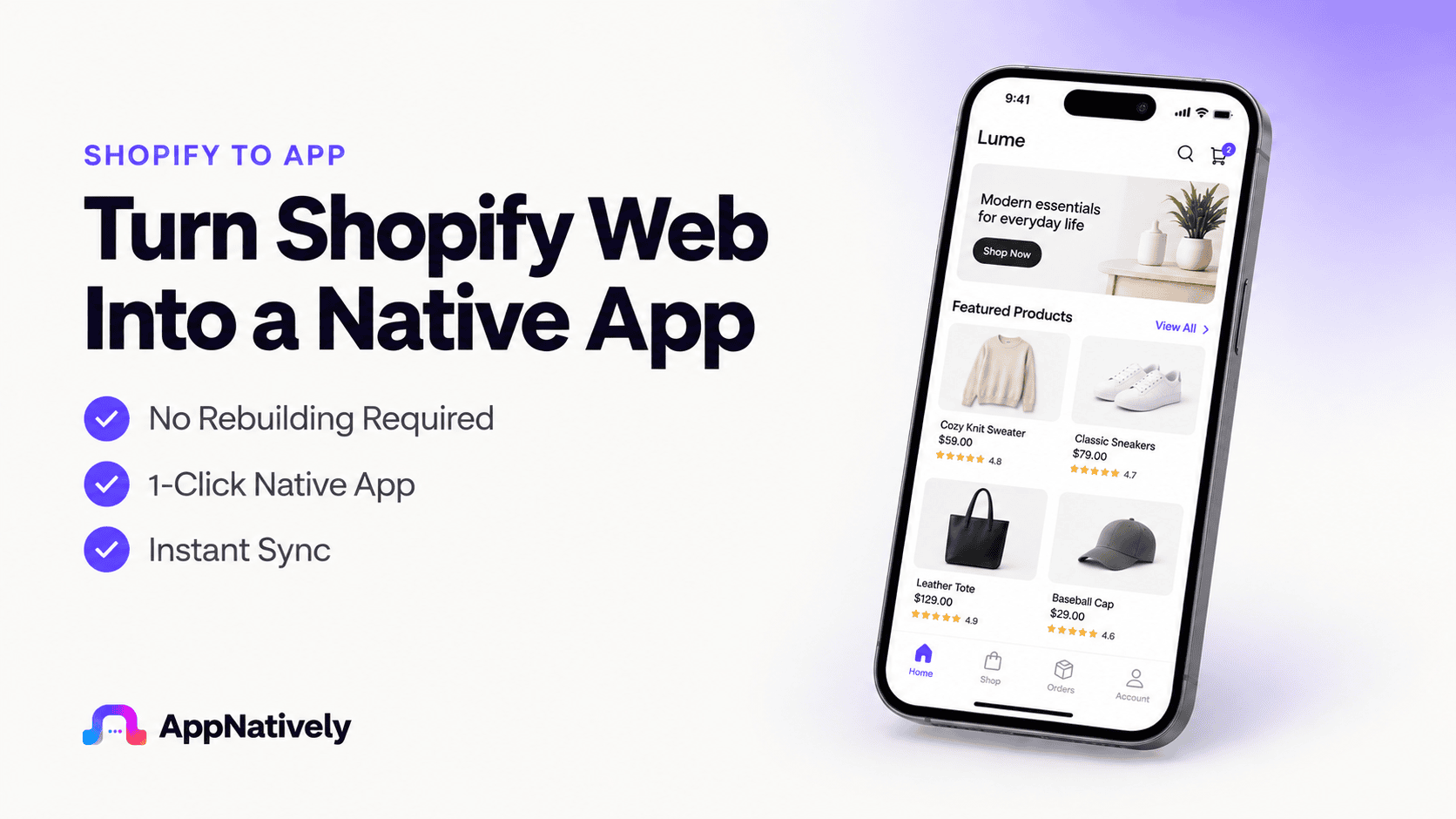
Mobile commerce is no longer the future. It’s the present.
Millions of shoppers now browse, compare products, and complete purchases directly from their smartphones. In fact, for many ecommerce businesses, mobile traffic already exceeds desktop traffic.
Yet thousands of Shopify store owners still rely solely on their websites to serve mobile customers.
The problem isn’t that their stores aren’t mobile-friendly. Most Shopify themes already are.
The real problem is that mobile-friendly websites simply can’t match the experience, engagement, and retention capabilities of a native mobile app.
That’s where many store owners face a difficult question:
Do we need to rebuild our entire Shopify store as a mobile app?
For years, the answer was often yes.
Today, that answer is changing.
What if your Shopify store could become a native mobile app without rebuilding everything from scratch?
Let’s explore what’s possible.
Why More Shopify Stores Are Launching Mobile Apps
Customer expectations have changed dramatically.
Modern shoppers expect:
- Faster browsing experiences
- One-tap access to products
- Personalized experiences
- Instant notifications
- Simplified checkout
- Mobile-first interactions
Native mobile apps deliver these experiences far better than traditional websites.
That’s why many of the world’s largest ecommerce brands invest heavily in mobile applications.
The challenge is that traditional app development can be expensive, slow, and difficult to maintain.
The Traditional Way of Turning Shopify Into an App
Historically, converting a Shopify store into a mobile app required a complete rebuild.
Businesses would typically need to:
- Hire developers
- Design separate Android interfaces
- Design separate iOS interfaces
- Rebuild product catalogs
- Connect Shopify APIs
- Create custom checkout systems
- Test across devices
- Publish to app stores
This process often involves:
- Significant development costs
- Months of work
- Ongoing maintenance
- Additional technical complexity
For many small and medium-sized businesses, this approach simply isn’t practical.
The Hidden Cost of Rebuilding Your Shopify Store
Many store owners underestimate what rebuilding actually means.
It’s not just creating screens that look like the website.
A complete rebuild often requires managing:
Product synchronization
Every product update must stay synchronized between Shopify and the mobile app.
Without proper integration, inconsistencies quickly appear.
Inventory updates
Stock levels must remain accurate across all sales channels.
Inventory mismatches can lead to customer frustration and lost sales.
Order management
Orders generated from the app need to flow seamlessly into Shopify workflows.
Customer accounts
Login systems, customer profiles, and purchase histories must remain connected.
Ongoing maintenance
Every Shopify change may require corresponding app updates.
Over time, maintenance costs can become substantial.
Why Mobile Apps Convert Better Than Mobile Websites
If mobile websites already work, why invest in an app?
The answer lies in user behavior.
Apps create a fundamentally different experience.
i. Faster loading speeds
Native apps load significantly faster than websites because much of the interface is stored directly on the device.
Users experience:
- Faster navigation
- Smoother browsing
- Better responsiveness
- Reduced frustration
ii. Better customer retention
Website visitors often disappear after a single session.
App users are far more likely to return repeatedly.
Having your brand on a customer’s home screen creates ongoing visibility.
iii. Push notifications
Perhaps the biggest advantage of native apps is push notifications.
Unlike email marketing, notifications can instantly reach customers with:
- Flash sales
- New arrivals
- Cart reminders
- Limited-time offers
- Order updates
This creates powerful opportunities to increase engagement and revenue.
iv. Simplified purchasing
Apps reduce friction throughout the buying process.
Features such as saved preferences, streamlined navigation, and persistent login sessions make purchasing easier.
What If You Didn’t Need to Rebuild Anything?
Imagine keeping your existing Shopify store exactly as it is.
- No rebuilding.
- No duplicate product management.
- No separate inventory system.
- No expensive development project.
Instead, your existing Shopify store becomes the foundation for a native mobile app.
This approach allows businesses to:
- Keep their current Shopify setup
- Maintain existing workflows
- Preserve product catalogs
- Continue using familiar tools
- Launch mobile apps significantly faster
For many ecommerce brands, this is a far more practical path.
The Rise of Website-to-App Solutions
Over the last few years, website-to-app platforms have become increasingly popular.
Instead of rebuilding an entire ecommerce platform, these solutions turn existing websites into mobile apps.
Benefits often include:
- Faster deployment
- Lower costs
- Easier maintenance
- Reduced technical complexity
- Faster time to market
For Shopify merchants, this can dramatically accelerate app launches.
Common Concerns Shopify Store Owners Have
Before launching an app, many merchants have similar questions.
1. Will I need to manage products twice?
Ideally, no.
A properly integrated solution should continue using your existing Shopify catalog.
2. Will checkout still work?
The best solutions maintain Shopify’s checkout and ecommerce infrastructure.
This ensures a consistent purchasing experience.
3. Will updates require rebuilding the app?
Not necessarily.
Modern approaches allow much of the content to remain connected to the existing Shopify store.
4. Is it expensive?
Traditional custom app development can be costly.
Alternative approaches often reduce both upfront investment and ongoing maintenance costs.
Signs Your Shopify Store Is Ready for a Mobile App
Not every store needs an app immediately.
However, several indicators suggest it’s time to consider one.
i. Growing mobile traffic
If most visitors come from smartphones, an app may significantly improve customer experience.
ii. High repeat purchase rates
Businesses with returning customers often benefit most from mobile apps.
iii. Strong customer loyalty
Apps work particularly well when customers actively engage with a brand.
iv. Increasing marketing costs
Push notifications can help reduce dependence on paid advertising channels.
v. Cart abandonment challenges
Apps often create smoother purchasing experiences that can improve conversions.
How AppNatively Helps Shopify Stores Become Native Apps
This is where AppNatively comes in.
AppNatively enables businesses to transform their existing websites into native mobile apps without the complexity of traditional development.
Instead of rebuilding everything from scratch, merchants can leverage their existing website infrastructure while gaining the benefits of native mobile experiences.
Benefits include:
- Native Android app generation
- Native iOS app generation
- Faster launch timelines
- No-code app creation
- Push notification support
- Improved customer engagement
- Simplified maintenance
- Better mobile shopping experiences
For Shopify store owners, this means spending less time rebuilding and more time growing their business.
The Business Impact of Launching a Mobile App
A mobile app isn’t simply another sales channel.
It’s a customer retention tool.
It’s a marketing asset.
It’s a branding opportunity.
And it’s often one of the most direct ways to increase customer lifetime value.
Businesses that successfully adopt mobile apps frequently experience improvements in:
- Customer retention
- Repeat purchases
- Engagement rates
- Brand visibility
- Conversion rates
- Customer loyalty
While results vary by industry and audience, the long-term advantages can be substantial.
Frequently Asked Questions
Can a Shopify store become a mobile app?
Yes. Modern solutions allow Shopify stores to be converted into native mobile applications without rebuilding the entire platform.
Do I need developers to create a Shopify app?
Not necessarily. No-code and low-code platforms have made app creation significantly more accessible.
Will my Shopify products sync with the app?
Most modern solutions are designed to keep products synchronized with the existing Shopify store.
Is a mobile app better than a mobile website?
Both serve important roles. However, mobile apps often provide stronger engagement, retention, and customer communication capabilities.
How long does it take to launch a Shopify mobile app?
Traditional development may take months. Alternative approaches can significantly reduce launch timelines.
Final Thoughts: What If Your Shopify Store Could Become a Native App
For years, launching a mobile app meant rebuilding your ecommerce business from the ground up.
That reality prevented countless Shopify merchants from entering the mobile app space.
Today, things are different.
If your customers increasingly shop on mobile devices, a native app can help improve engagement, retention, and overall shopping experiences.
The exciting part is that you may not need to rebuild your store at all.
With solutions like AppNatively, Shopify merchants can transform existing stores into native mobile apps faster and more efficiently than traditional development approaches.
Related posts
Can You Turn a Website Into a Mobile App? Here’s How It Works

AppNatively vs MobiLoud vs AppMySite: Which Mobile App Builder Is Best in 2026?

AppNatively vs Shopney vs Tapcart: Which Shopify App Builder Is Best in 2026?